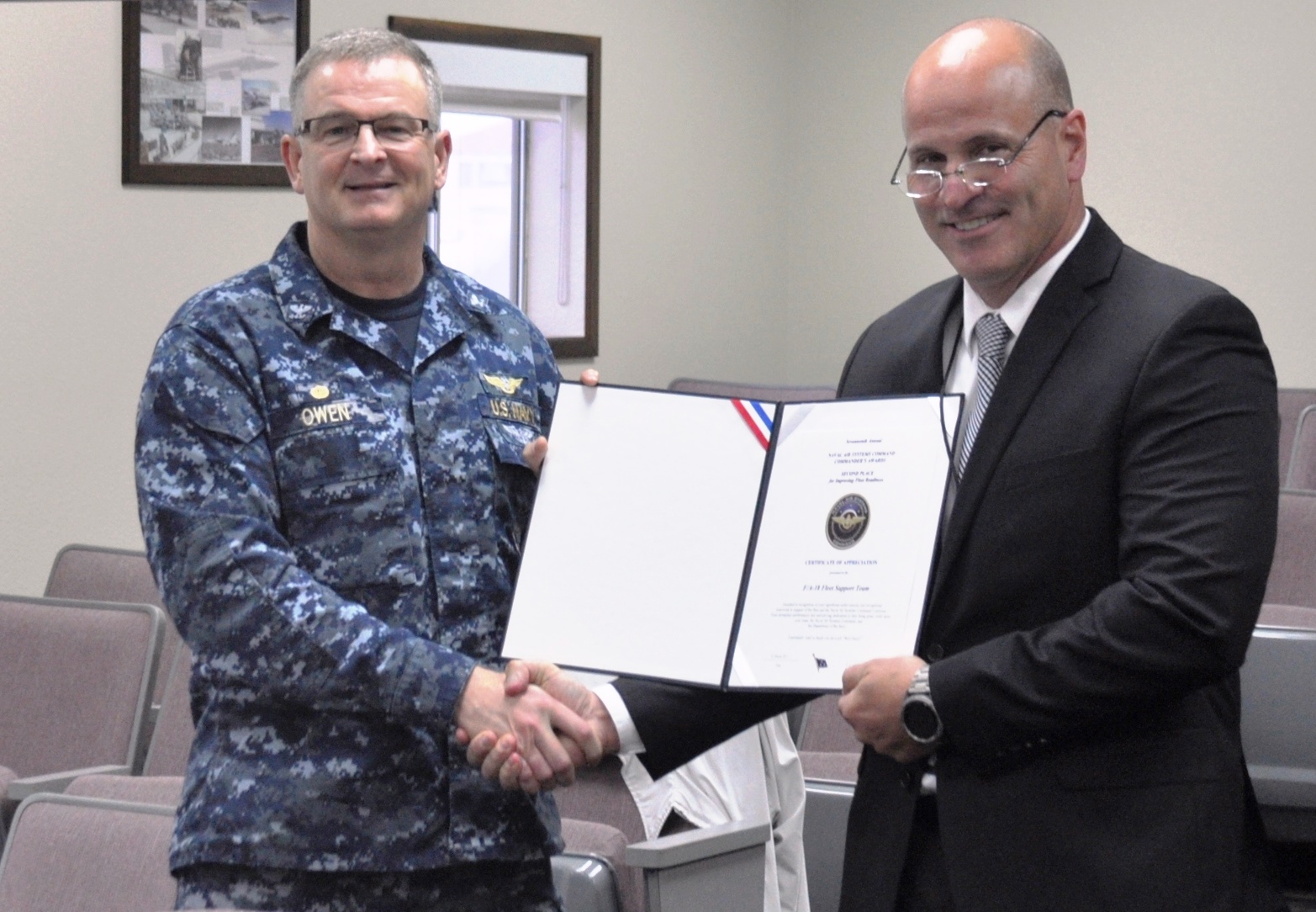
FRCSW Commanding Officer Capt. Craig Owen and F/A-18 & EA-18G Fleet Support Team Leader Thomas Jarvis hold the 2017 NAVAIR Commander’s Award for Improving Fleet Readiness (second place) certificate March 22 in the Building 94 conference room. (U.S. Navy photo)
F/A-18 Fleet Support Team Ensures Hornet Readiness
NAVAL AIR STATION NORTH ISLAND - A group of about 500 engineers, logisticians, chemists and scientists make up the organization that serves as the catalyst behind the Navy’s efforts to maintain the readiness of its F/A-18 Hornet fighter force.
From organizational to depot-level repairs and maintenance, the Fleet Support Team (FST) is the in-service support provider of engineering and logistics solutions to all F/A-18 activities.
“About 90 percent of the aircraft in terms of its systems, structure and components is all handled out of this activity,” said F/A-18 & EA-18G FST Leader Thomas Jarvis who is assigned to Fleet Readiness Center Southwest (FRCSW).
Though the main body of the FST operates from FRCSW, other components of the airframe, like the engines and electro-optical infrared components are assigned to FRC Southeast. Naval Sea Systems Command in Crane, Ind., handles some of the aircrafts airborne electronic attack components.
“Our job is to address any issues or problems that come up, to plan and develop modifications to the airplane and to assist the depot corporation in developing repairs to be implemented as either a scheduled depot maintenance event, modification or as part of an in-service repair (ISR),” Jarvis said.
FST personnel respond to a variety of requests ranging from damage engineering dispositions to technical publication deficiency reports. Requests for engineering information total about 100 a week, Jarvis noted.
Because its work is worldwide and cannot always be completed onsite, FST personnel often travel to overseas sites or to the fleet.
“Every week we have multiple people heading off in different directions, heading for ships or going to field sites to help out with issues like burn damage or major corrosion that we have to look at to figure out a repair,” Jarvis said.
In the event of an aircraft mishap, the FST typically provides its expertise to the Navy Safety Center, the investigating authority.
“We mainly help on the technical side,” Jarvis said. “If it’s a crash, for example, and if it’s mechanical related, then we’ll dissect the crash damage and figure out to the best of our ability what was the cause of the accident. Or we’ll look at causal factors and go through the data that’s recorded as part of the aircraft’s normal system and look for anything unusual in terms of caution codes, maintenance or unusual movements of flight control surfaces.”
Growth of the FST program accelerated during the past 25 years from when it was called the “Cognizant Field Activity Engineering Authority” (CFA) in the 1990s with a staff of less than 100, to its current activity level operating within an $80 million annual budget.
Unlike their future counterparts, CFA staff not only worked on F/A-18s, but F-4 Phantoms, F-14 Tomcats and E-2/C-2 airframes, as well. Eventually, a separate E-2/C-2 FST would form, while the F-4 and F-14 programs would end.
As the F/A-18 E and F Super Hornet and G Growler variances began entering service in the late 1990s, the number of fleet aircraft nearly doubled. Since, the Navy’s use of legacy Hornets has diminished to five squadrons; whereas the rest of the aircraft are assigned to the Marine Corps.
Consequently, the FST found itself challenged by the Marine Corps to develop a plan to improve the readiness of the 34-year-old legacy Hornets, while simultaneously handling the requirements of the newer airframes.
“We looked at the A-D Hornet requirements and what the program of record was for the need for those airplanes,” Jarvis said.
“With the help of Commander, Naval Air Forces (CNAF), COMFRC and the F/A-18 and EA-8G Program Office (PMA 265), we evaluated our current depot requirements for the aircraft and made a determination as to whether it was appropriate or not: We were either trying to fix too many airplanes, or the way we were trying to fix them was more than what we needed to get an airplane through its last 10 years of life,” he said.
The team identified each aircraft by its Bureau Number (BUNO) and noted its flight hours and assigned squadron. Afterward, they assessed the aircraft’s need and life-extension requirements including depot-level modifications, repairs, and inspections.
“When we looked at those BUNOs we made great discoveries for opportunities for combining events and pushing events off that we thought were necessary,” Jarvis said. “For example, based on the usage of a particular BUNO, if it would never reach its next pipeline on inspection, we would just not plan that event.”
Aircraft that were no longer required were stricken and used for spare parts.
Jarvis said that the goal was to not only increase Marine Corps and fleet readiness, but to clear the depots of legacy Hornets.
“By making strike decisions, combining or eliminating currently planned events, we reduced that budget for depots events $300 million and $400 million over the next five years,” Jarvis said. “And the savings will continue to accrue until the end of the program. As the fleet gets smaller, those savings will get smaller, but there are hundreds of millions of dollars that were planned to be spent that will not be spent now.”
“To accomplish this we had a lot of data to look at including airworthiness issues, and our configuration management data. And we had to be inventive as to how we were going to change our specifications so that we could do more combinations and still fly safe. It took us over a year to develop this and it’s the most proud I’ve been about a project since I’ve been on this team for the past 27 years,” Jarvis said.
On March 22, the F/A-18 FST was recognized during the 17th annual NAVAIR Commander’s Awards with a second place finish in the Improving Fleet Readiness category.