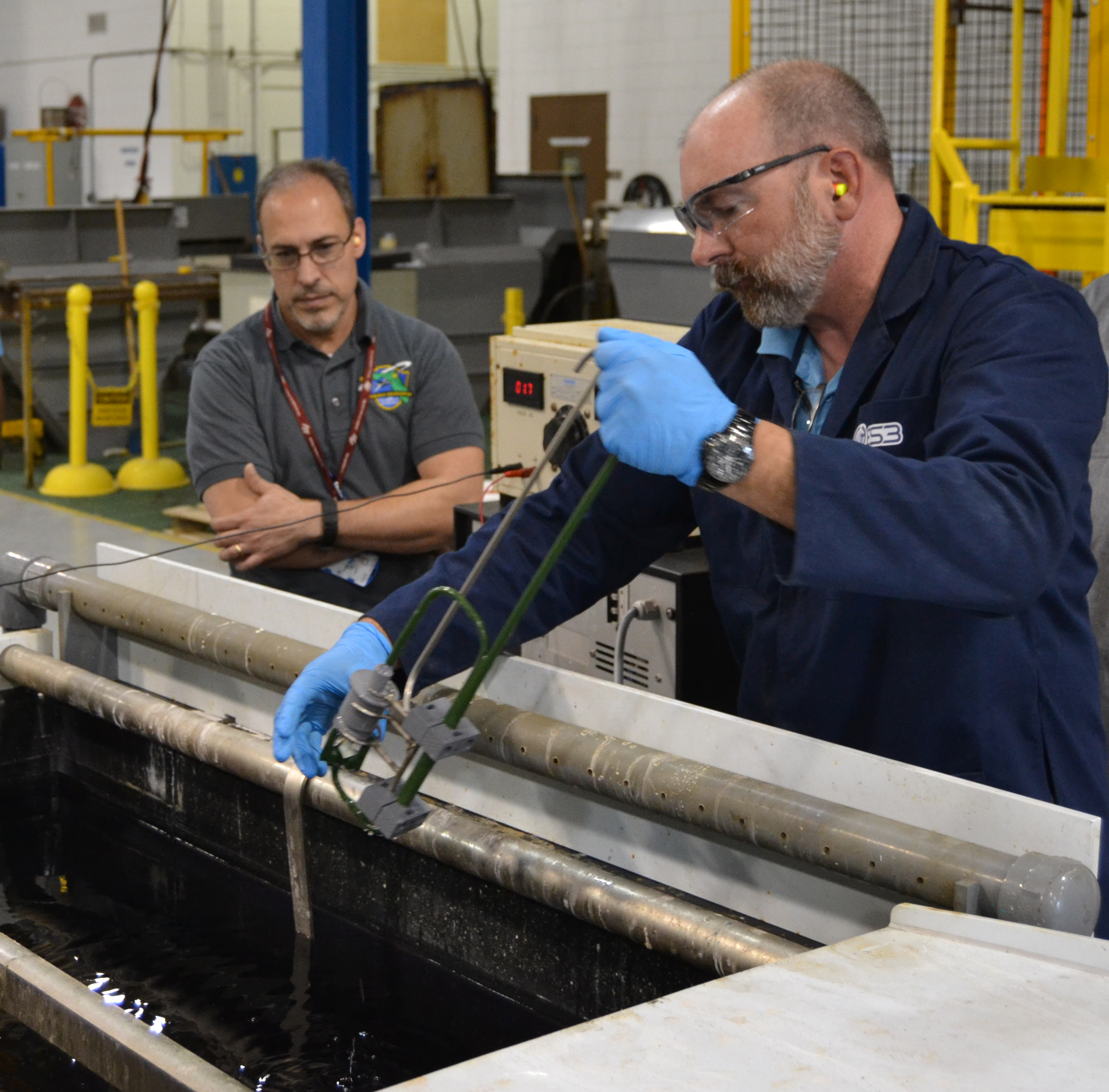
Fleet Readiness Center Southeast chemist Ruben Prado, left, looks on as materials engineer Tod Hickman removes a lifting pin from the zinc-nickel coating bath Feb. 15 in the facility’s plating shop. The pin will be the first production piece from the new process to deploy. (U.S. Navy photo/Released)
New Plating Process at FRCSE Selfless in Protecting Components
JACKSONVILLE, Fla. – An aircraft lifting pin will be the first piece of equipment deployed by the Navy with a new zinc-nickel plating process designed by chemists and engineers at Fleet Readiness Center Southeast.
The coating will act as a living barrier between aircraft components and the harsh marine environment in which they deploy.
“This coating is designed to sacrifice itself,” said FRCSE Lead Materials Engineer Jack Benfer. “In doing so, it protects what its coating.”
Navy aircraft operate where salt meets metal, and the lifting pin for aircraft dollies was chosen specifically because of the beating it takes on a daily basis aboard a carrier. The results of the first 12-month deployment should confirm the FRCSE team’s research.
“Each of six spotting dollies will have a zinc-nickel plated pin, a cadmium plated pin and an unprotected stainless steel pin,” FRCSE chemist Ruben Prado said. “We think that, not only will it be safer than cadmium plating but, it will also be more durable.”
The team will get plenty of data from the deployment. Every 90 days aboard the carrier, the ship’s maintenance crews pull the lifting pins, perform a non-destructive inspection and a visual inspection, Benfer said.
“It’s a great opportunity for us to get field data and detailed photos, while not interfering with the Sailors’ duties,” he said.
The secret to the coating lies in a chemical reaction between the coating, the material it protects and the surrounding environment.
“In corrosion, you have a metal that reacts to the environment and electrochemically oxidizes,” Benfer said. “It liberates an electron, and the atom then goes to its ionic state and begins corroding.”
The zinc-nickel plating prevents the corrosion process by giving up its own electrons to the steel, preventing it from oxidizing.
“If a part gets nicked or scratched, the zinc-nickel will react by producing electrons,” he said. “The electrons are then attracted to the surface of the steel that’s been exposed.
“Now the steel that’s trying to become an ion can’t because the plating keeps pushing electrons to it.”
Benfer and Prado are leading the $4 million project at FRCSE’s plating shop for the U.S. Navy Air Systems Command.
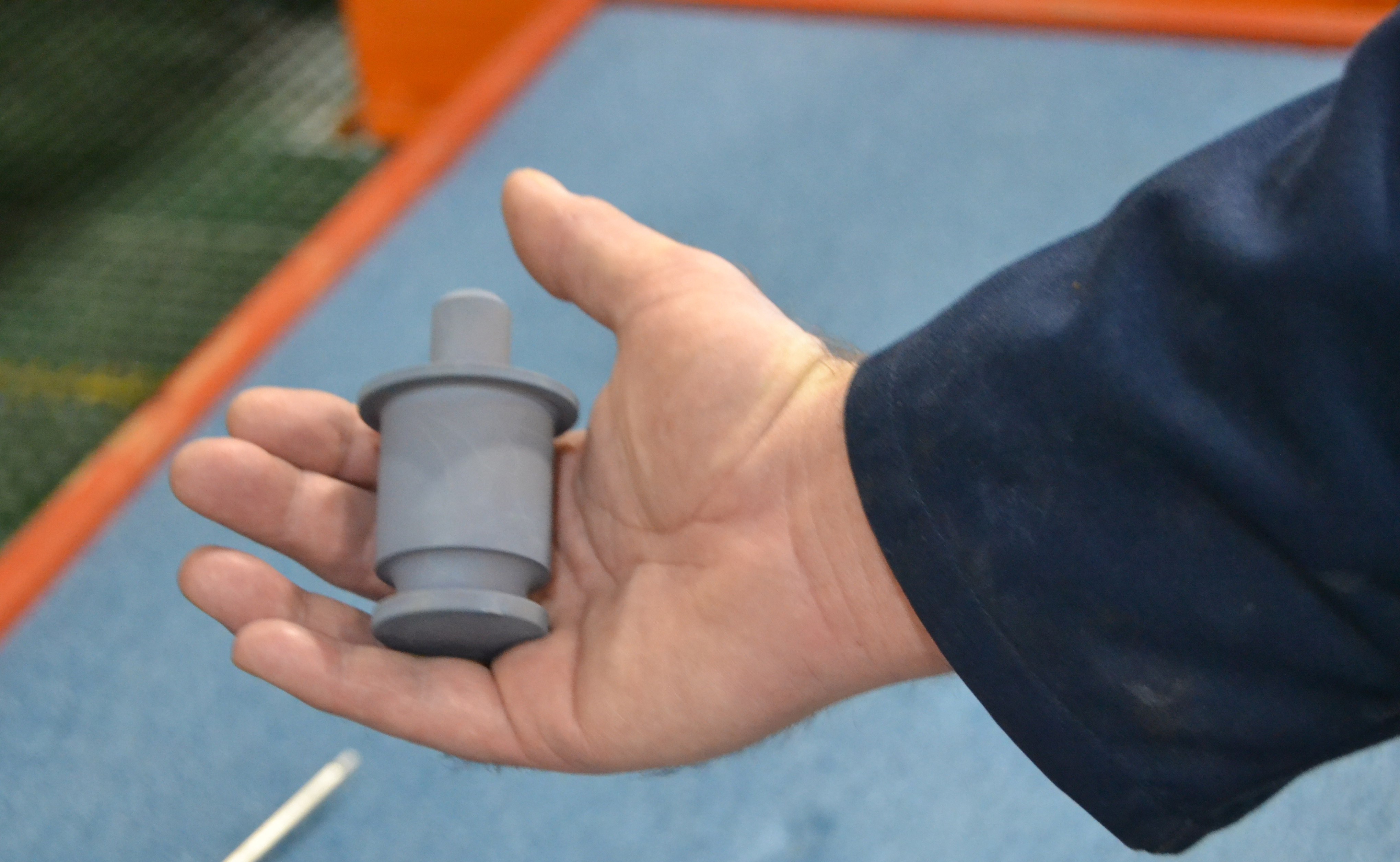
Materials engineer Tod Hickman holds the first production piece – a lifting pin for an aircraft spotting dolly – to undergo the new zinc-nickel plating process at Fleet Readiness Center Southeast on Feb. 15. The part will be the first that has undergone the new process to deploy aboard a Navy vessel. (U.S. Navy photo/Released)