
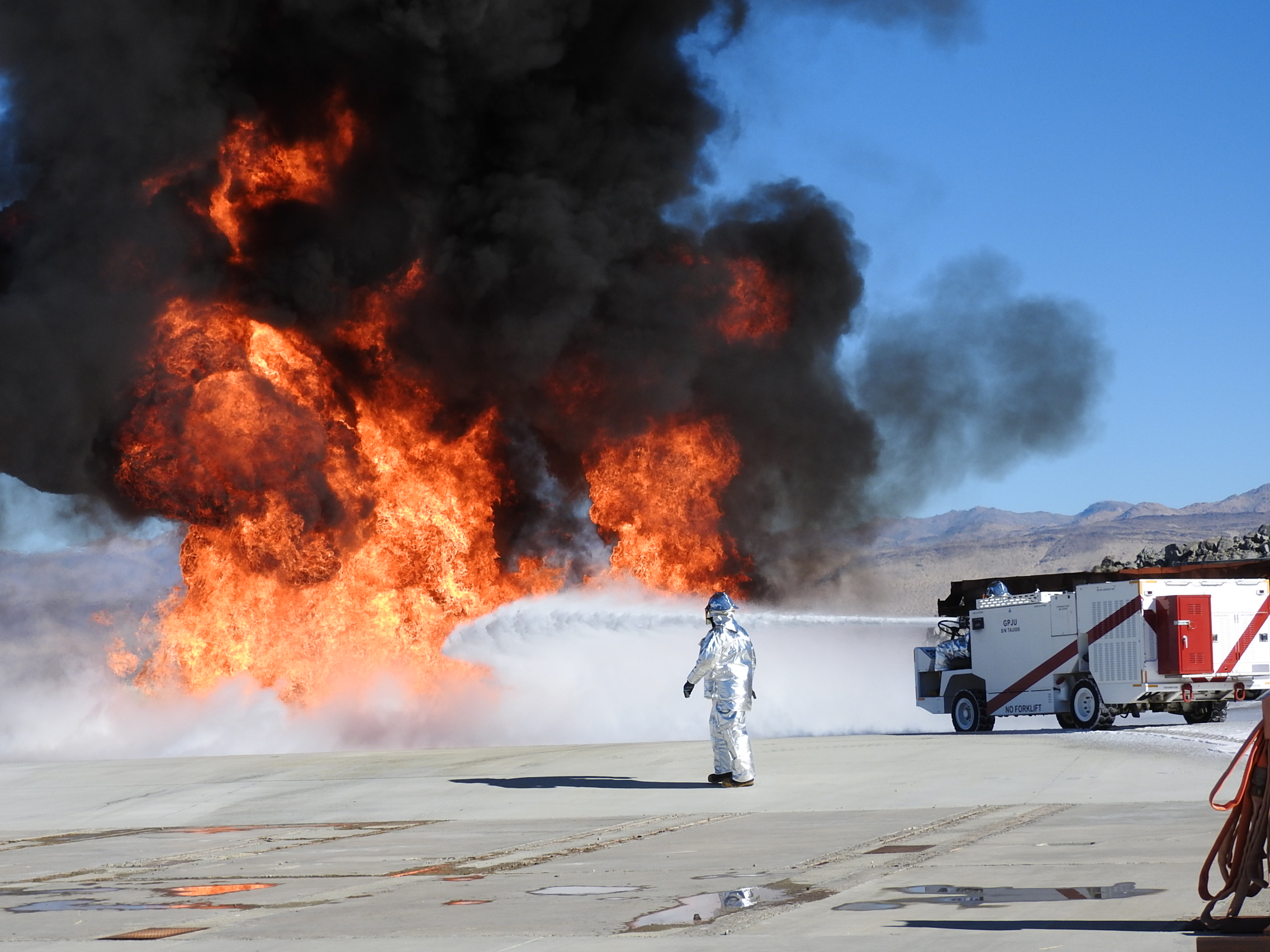
Fire Science Laboratory teammates Ross Davidson, left, and Eric Sievert, in the truck, from Naval Air Warfare Center Weapons Division demonstrate a shipboard aviation fire emergency recently at the Carrier Deck Firefighting Test Facility, or Mini Deck, in China Lake, California. (U.S. Navy photo)
NAWCWD’s Fire Science Laboratory is a hotbed of capabilities
NAVAL AIR WARFARE CENTER WEAPONS DIVISION, POINT MUGU, Calif. - According to Eric Sievert, the Fire Science Laboratory at Naval Air Warfare Center Weapons Division is a first-class facility that few people know about. In late 2016, Sievert and his team worked with the Workforce Engagement Program to hold jet fuel fire demonstrations at China Lake to help change that.
During the demonstrations, Sievert, FSL team lead, Ross Davidson, team lead and test fire supervisor, Dr. Ben Goodman, chemical engineer, and Dr. Erik Tolmachoff, mechanical and chemical engineer, allowed NAWCWD employees a front-row seat to what Sailors and Marines have to manage during a shipboard emergency. Over 60 civilians and fleet personnel watched them extinguish a large, jet fuel fire with the newly upgraded P-25A Shipboard Firefighting Vehicle.
“As a prior Marine, I’ve got a strong connection with the fleet,” Sievert said. “I’ve been at NAWCWD for 11 years working hand-in-hand with the warfighters and it’s like I never left. Their personal safety is of utmost importance to me.”
The group regularly performs fire research and testing through the use of a large-scale Carrier Deck Firefighting Test Facility called the Mini Deck and a small-scale test facility called the Burn Room. The Mini Deck can support a 6,400-square foot fire, while the Burn Room serves as an indoor space that can hold a 20-square foot fire. Additionally, they have a wet lab where they can mix and analyze agents as well as perform fume, hood-sized fire experiments. As one of few facilities of its kind in the United States and the only one belonging to Naval Air Systems Command, the Weapons Division’s FSL has the unique ability to burn directly on the deck and use jet fuel to conduct realistic testing.
“We do anything from small-scale to large-scale fire research and thermodynamic testing,” Sievert said. “We do rescue operation tactics testing and we put together our findings for the firefighting Naval Air Training Operating Procedures Standardization manuals. We work closely with the ships, so we get great input from the fleet. They help us develop what works best for them and their needs.”
Steel mock-ups manufactured in the Machine Shop help the team target specific areas of the aircraft, working with the Chemistry Department aids in their discovery of lasting materials and fire suppressants, and the FSL team does collaborative work in the command’s areas of survivability. A few of their firefighting inventions and other developments include thermal imaging camera assessments, High Mobility Multipurpose Wheeled Vehiclecrew compartment fire extinguishing system assessments for the Marine Corps and hazardous materials citing for NASA’s Vehicle Assembly Building at Kennedy Space Center.
Additionally, they’ve led assessment of battery powered rescue tools to decrease the use of gas powered equipment as well as the development of high-occupancy, helicopter roll-over procedures that will make it easier to get passengers out of a crashed aircraft while minimizing additional injuries commonly associated with rescue operations.
“The FSL has years of broad fire experience and because of that, the FSL gets the opportunity to work outside of strictly shipboard fire research,” Tolmachoff said. “Our office regularly assists with aviation fire issues that pertain to new ship construction requirements, and firefighter manning requirements for shipboard unmanned aerial vehicles and in recent months, the FSL has been approached to consult on hypergolic refueling procedures, fire extinguishment on the range and for wildland oil spill clean-up operations. I think a lot of what we do has the potential to save lives on ships and potentially move on to structural and aircraft engineering.”
Of their more recent inventions, a slide-in cooling and fire suppression device for the internal F-35 weapons bay has been used aboard ship with future deployments pending. In addition to their testing, research and development, they’re looking to provide a training program on the Mini Deck that will be open to shipboard firefighters and possibly the installation firefighters.
“When you go for firefighting training in the Navy, they train you how to put out propane fires similar to a large, modified barbecue grill,” Tolmachoff explained. “It’s a fuel source that keeps coming at you, but it’s fixed. It’s not as realistic as a fire on a ship might be where, most likely, there will be some sort of fuel spill. I think what [Sievert] really wants to do with this training is create a more realistic fire situation so that Sailors can gain experience fighting realistic fires in a controlled environment.”