
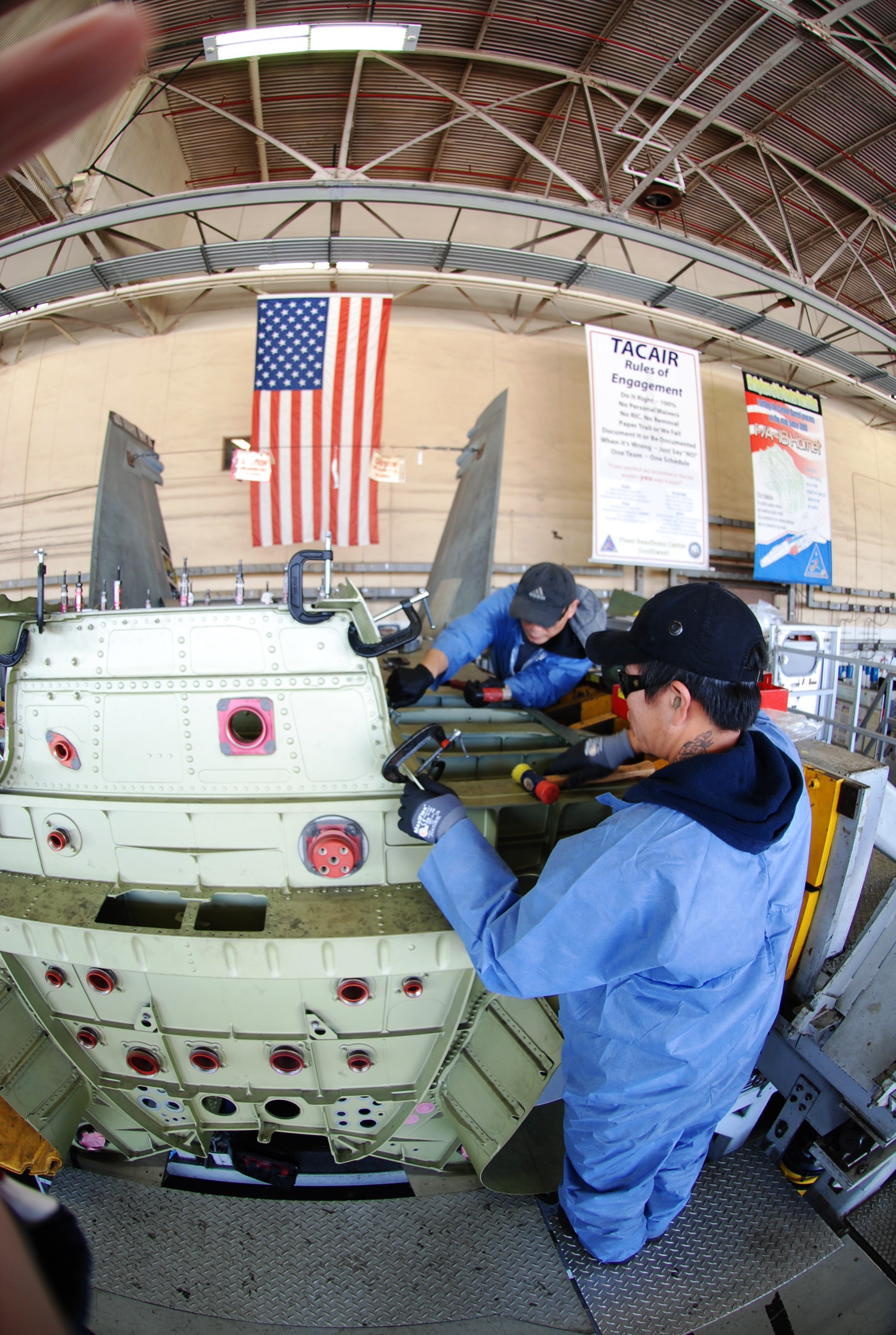
Sheet metal mechanics Vincent Do, foreground, and Van Le prepare the upper left hand skin of an F/A-18 legacy Hornet for rivet drilling and longeron creasing in the center barrel replacement program in Building 378. (U.S. Navy photo)
FRCSW Center Barrel Program: The Lifeline of Legacy Hornets
NAVAL AIR STATION NORTH ISLAND, Calif. - For more than 25 years the Fleet Readiness Center Southwest (FRCSW) F/A-18 Hornet center barrel replacement (CBR) program has been working to ensure the readiness of the Navy’s first jet designed as a dual role attack-fighter aircraft.
Some of the CBR’s 48 artisans work with aircraft older than themselves: The legacy A-D Hornet airframes entered Marine Corps service 34 years ago; the Navy, one year later.
And the CBR is essential to keeping these aircraft mission ready.
The initial CBR procedure was created in 1991when a crash-damaged F/A-18 aircraft with minimal flight hours was brought to FRCSW (then Naval Aviation Depot North Island) for analysis. The area damaged was the center fuselage section – the center barrel – where the wings and main landing gear attach.
With a price tag of close to $46 million per aircraft, scrapping the plane for parts was deemed the final option.
Instead, the engineers and artisans of FRCSW were challenged to find a way to make the repair. After a thorough examination, it was determined that replacing the center barrel was the most viable option.
In less than two years the project was complete, and at a cost of $4 million, it totaled less than 10 percent of the aircraft’s replacement value.
The capability later evolved into the CBR + program, which addresses the fatigue life expectancy (FLE) of the legacy Hornets and includes replacement of the forward and aft dorsal decks, and the forward, aft, and keel longerons (structural beams).
Originally designed as a 6,000 flight-hour airframe, the Hornet’s FLE reflects the usage history of an individual aircraft and is based upon stress-related factors affecting key areas of the airframe, such as the wing attachment points. The aircraft also contain sensors that calculate its fatigue life.
“The center barrel is replaced in aircraft with an FLE above .62,” said F/A-18 center barrel production manager Keyon Marshall. “And when a plane reaches an FLE of 1.0 or 10,000 flight hours --- whichever comes first --- it’s scrapped.”
“An aircraft’s evaluation is also driven by its periodic maintenance interval (PMI). So, we’re also performing both PMI 1 and 2 and high-flight-hour (HFH) procedures in conjunction with the center barrel.”
The HFH program began in 2006 and includes an array of airframe inspections to ensure operational safety of an aircraft to 8,000 flight hours.
Aerospace manufacturer Northrop Grumman builds the center barrels, and corresponding kits that contain about 12 components and thousands of fasteners are provided by Naval Air Systems Command’s (NAVAIR) Central Kitting Agency in Orange Park, Fla.
FRCSW and FRC Southeast are the only naval maintenance facilities authorized to perform the CBR+ procedure, Marshall noted.
The program’s disassembly and assembly phases are handled by a crew of approximately 14 artisans in Building 94, while the center barrel phases take place in Building 378.
Each CBR+ averages about 25,000 manhours at a total cost of $2.5 to $3 million per aircraft.
Since the first center barrel procedure, FRCSW gained $1 million in savings per aircraft through AIRSpeed projects that targeted cost structures such as turn-around time and point-of-use tooling issues.
AIRSpeed is a continuous process improvement program designed to increase production efficiencies and reduce turn-around times.
A point-of-use tooling AIRSpeed project 10 years ago resulted in the creation of 16-foot aluminum stands in Building 378. The two-tiered stands enable work from atop and below the aircraft and provide direct access to materials and tools used by sheet metal mechanics, saving approximately 2,000 manhours.
“We had been operating with four (CBR+) fixtures, but now we’re down to one as we introduced a Super Hornet fixture to the aft side. So our current production has been about 10 center barrels for the past two years,” Marshall said.
Unlike legacy Hornets Super Hornets do not have a third, or center barrel, section; instead, the airframe is of a modular design.
“Work with the Super Hornets would be more of an in-service repair (ISR), like replacing an aft tail section. We have the capacity to do this or Service Life Extension Program (SLEP) work on them,” Marshall noted.
About three years ago, FRCSW replaced the legacy Hornet ISR fixture in Building 378 with an alignment fixture applicable to all F/A-18 E-F models and the EA?18G Growler airframe.
Made of steel and aluminum, the fixture’s modular design allows for fuselage disassembly in segments at existing manufacturing breaks from the Y383 bulkhead forward; Y453 to the Y524; Y524 to the Y591; and from the Y591 bulkhead and aft; as well as the left and right inlet assemblies, and the forward left and right leading edge extensions.
FRCSW is using the fixture in the repair of an `E’ model F/A-18 Super Hornet by splicing an existing section of fuselage from that of a donor `F’ model Super Hornet. Like the work that created the CBR, this procedure will be the first of its kind.
Meanwhile, Marshall said that there are still about 200 legacy Hornets left in the fleet that are eligible for the CBR+.