
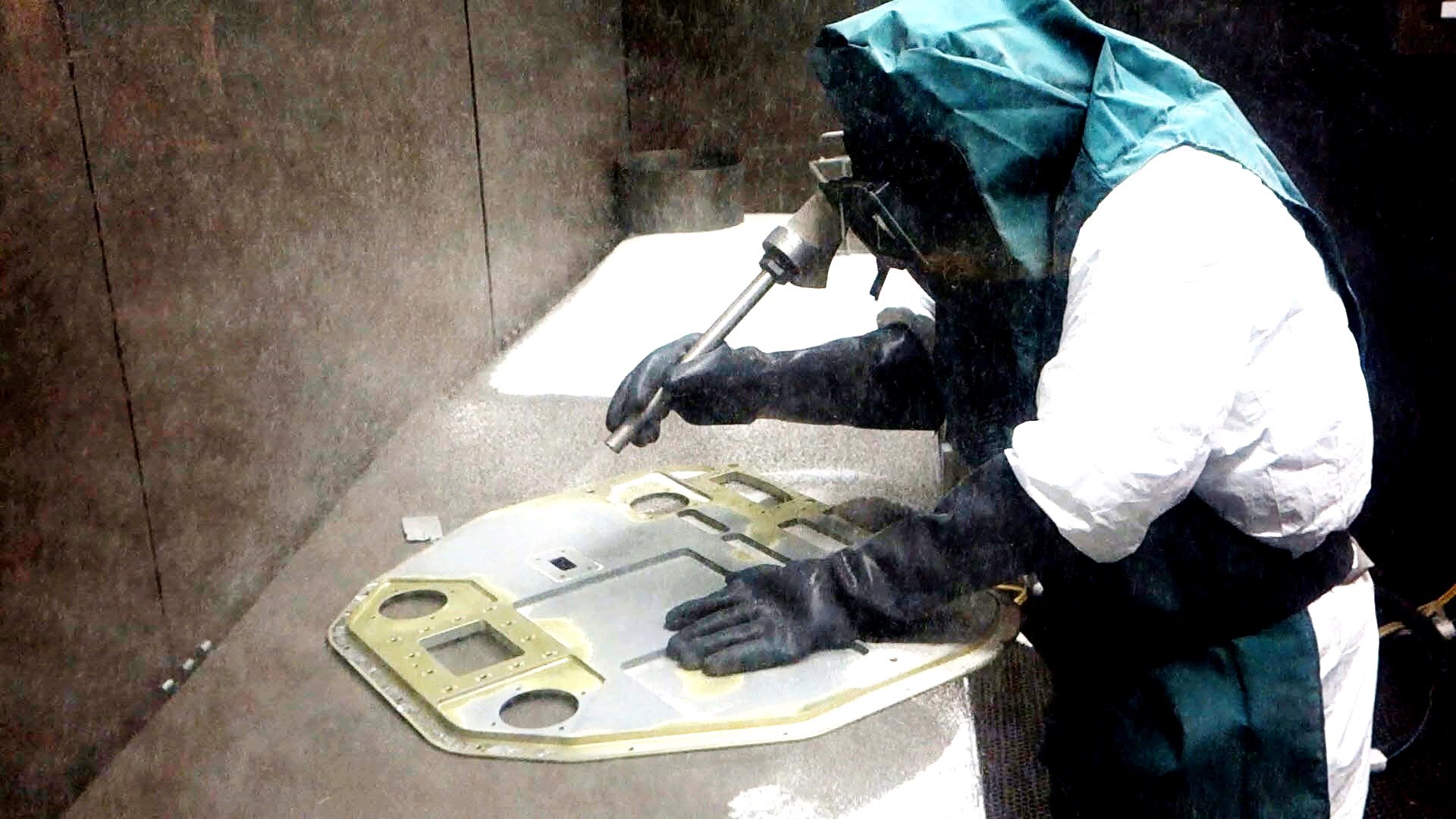
FRCSW production controller Jesus Gonzalez applies plastic media blast to an APG-73 radar rack aft bulkhead to remove paint. Gonzalez was one of more than 25 dedicated FRCSW artisans and supervisors who pooled their time and skills to repair and return 10 of the radar aft bulkheads in just three weeks to meet fleet needs. (U.S. Navy photo)
FRCSW Production Shops Step Up to Ensure Fleet Readiness
NAVAL AIR STATION NORTH ISLAND, Calif. - Exemplifying determination, teamwork and dedication to the warfighter, the artisans and supervisors of Fleet Readiness Center Southwest’s (FRCSW) production shops recently met an abbreviated deadline to overhaul 14 APG-73 radar rack aft bulkheads.
The APG-73 radar rack bulkheads, which are used by F/A-18 Hornet fighters, arrived to FRCSW on Apr. 6, 2016. FRCSW had to repair and return 10 of the bulkheads to Naval Supply Systems Command (NAVSUP) by end of the month.
Each aft bulkhead is uniquely mated to a radar rack assembly. Its metal flange is unpainted, and open to damage by corrosion. Maintenance personal often find corrosion damage when removing the radar rack assembly during Super Hornet upgrades to the newer APG-79 radar rack assembly.
Without a repair procedure, the corroded $220,000 APG-73 would be demilitarized, which NAVSUP wanted to save for F/A-18 Hornet upgrades.
When the 14 aft bulkheads arrived, the FRCSW evaluator and estimator (E&E) for the responsible shop (R shop) immediately inducted and routed them to the clean shop to kick off the overhaul process.
Preference was given to the priority 10 bulkheads. After cleaning, the R shop performed several tasks including removing corrosion, a duty they had never performed before, but were more than willing to learn.
Next, the bulkheads were transferred to the production process shops where the planner and estimator (P&E) ensured no delays occurred. Paint and adhesive were promptly removed in the blast shop, and the material lost to corrosion was restored using “Cold Spray” in the metal spray shop.
Cold Spray is a solid-state process which accelerates a fine metal powder and impacts it onto a part’s surface. Kinetic energy from the impact forms a metallurgical bond.
Skillful artisans applied Cold Spray using compressed helium, a handheld gun, and a very steady hand. Afterward, the bulkheads were sent to the machine shop for finish machining.
The machine shop ensured the parts were handled quickly, yet carefully, using fixtures and a Computer Numerical Control (CNC) program created in the shop. Excess cold spray material was milled away to return the flange dimensions to drawing specifications. With the corrosion damage repaired, the aft bulkheads were chemical-conversion coated in preparation for final paint.
The paint shop masked the bulkheads for priming and topcoating. Primer was applied immediately afterward. Once dried, the topcoat was applied.
Work in the FRCSW process shops was now complete.
The 10 priority bulkheads were returned to the R shop where artisans performed the final steps including applying markings, another new process to them.
On April 28, quality assurance (QA) verified the overhaul. FRCSW had made the deadline. The P&E updated the paperwork, and the E&E closed out the overhaul. FRCSW returned the 10 aft bulkheads to NAVSUP. The remaining four were overhauled and returned the following month.
It took three weeks to overhaul the 10 priority bulkheads. This was a reduction of 78 percent when compared to the timeline from the production pilot that occurred in 2015.
Materials engineering, Fleet Support Team (FST) engineering, and production management facilitated the process, but this accomplishment could not have been possible without the dedication of FRCSW artisans. They rose to the occasion, working through weekends, to ensure that they would not let the fleet down. It is because of them that FRCSW met the shortened deadline and $4.4 million in assets were returned to service.
NAVSUP is currently negotiating with FRCSW to repair 14 more of the aft bulkheads.