
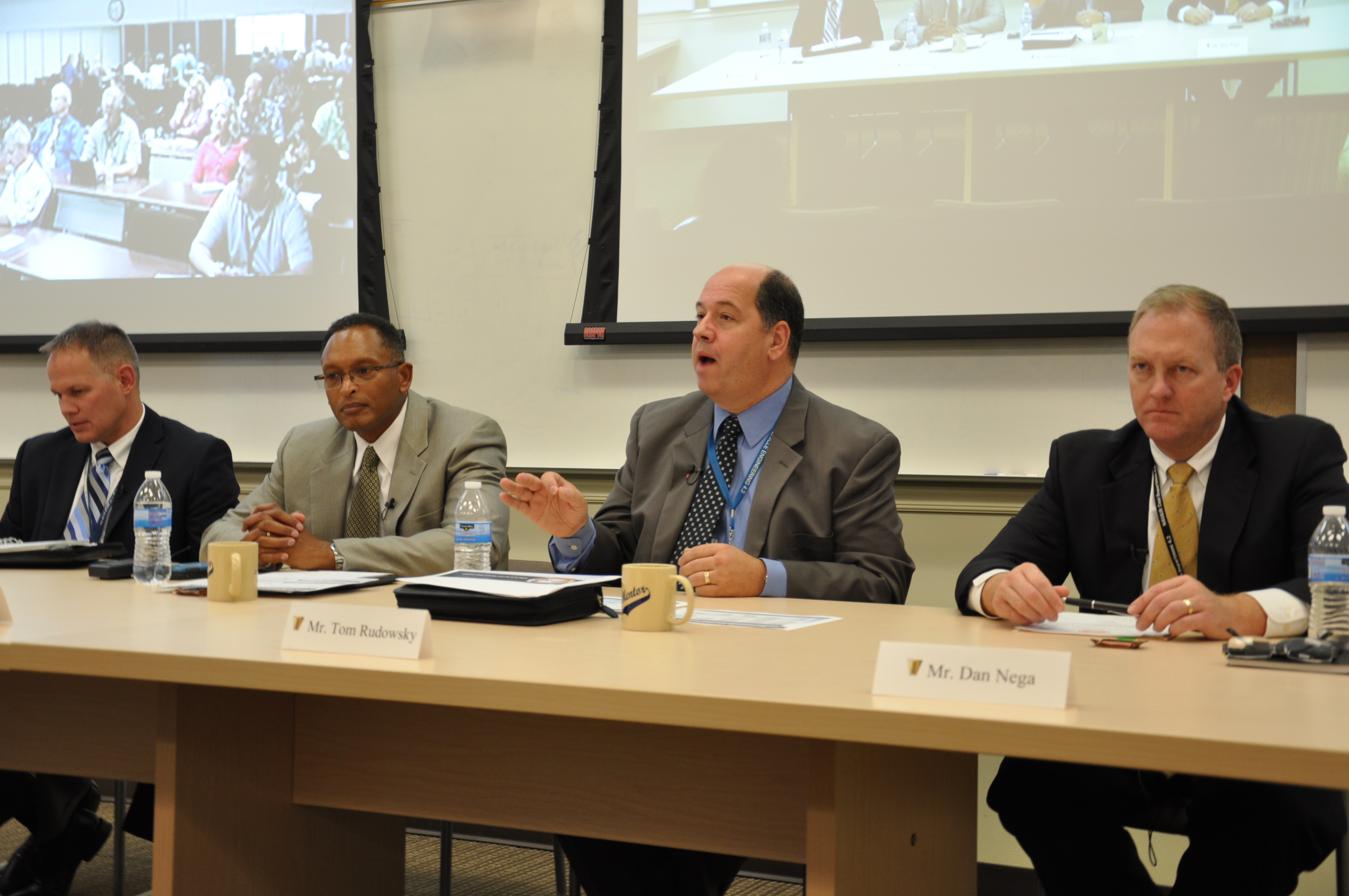
Tom Rudowsky, director, Air Vehicle Engineering Department (AIR-4.3) (center right), tells prospective Naval Air Systems Command (NAVAIR) Leadership Development Program (NLDP) Program candidates how building networks is foundational to the quick delivery of solutions Nov. 9. Pictured with him are (left to right) Roy Harris, director, Aviation Readiness and Resource Analysis Department, (AIR-6.8); Martin Ahmad, deputy Commander, Fleet Readiness Centers (AIR-6.0D); and Daniel Nega, director, Cost Estimating and Analysis Department (AIR-4.2).
Senior NAVAIR leadership share experience, advice on NLDP
NAVAIR SESs: Relationships top list of reasons to submit NLDP application
NAVAL AIR SYSTEMS COMMAND, PATUXENT RIVER, Md. -- Networking is essential the work of Naval Aviation. One of the best opportunities to establish those relationships in and outside of the command is the Naval Air Systems Command (NAVAIR) Leadership Development Program (NLDP) Program.
That’s according to four senior executive service (SES) leaders who shared their career histories and advice with potential NLDP candidates and their supervisors during a nationwide Executive Core Qualifications (ECQ) workshop panel Nov. 9. Serving on the panel were Roy Harris, director, Aviation Readiness and Resource Analysis Department, (AIR-6.8); Martin Ahmad, deputy Commander, Fleet Readiness Centers (AIR-6.0D); Tom Rudowsky, director, Air Vehicle Engineering Department (AIR-4.3); and Daniel Nega, director, Cost Estimating and Analysis Department (AIR-4.2). All four are members of teams that review and score NLDP applications.
NLDP is a three- to five-year program that provides training and educational opportunities to promote personal and professional growth for mid- to senior-level civilians, Sailors and Marines who have demonstrated leadership ability. The application period for 2017 runs from Jan. 17 to March 3.
In addition to NLDP’s required courses, seminars and shadowing opportunities, the panel said developmental assignments, which are six month-long rotations, provide participants with unparalleled personal and professional dividends. “Before I applied, I had no desire to leave the Cost Department,” Harris said. “My first lesson while in NLDP was how to get out of my comfort zone. Rotational assignments, turned out to be a career changer for me. Now, in my present job, I have to figure out how to remove barriers and overcome them. You do that through networking, by reaching out to your counterparts and working through problems.”
Candidates, they said, must also make their careers a priority. Ahmad advised workshop participants to plan their rotational schedule soon after being accepted into the program. “It’s never a good time to take rotation,” he said. “Just as the command needs to invest in the employee, the employees must invest in themselves.”
“Twenty years later,” Nega said, “I still have and use connections I made while on rotation.”
When writing ECQs, potential candidates were advised to take one example from their past experiences that reflected their leadership skills and write a narrative that shows context, challenges, actions and results. “Be sure to set the stage about your experience and convey what the challenge was,” Rudowsky said. “Communicate to the panel the thought and decision processes you took and why you made the decision to get to the action that is meaningful.”
Examples do not have to be directly related to the military or work at NAVAIR but must be ones that show how changes that were made affected the organization. One of the most impressive applications Rudowsky said he read contained a narrative about challenges an applicant faced while getting a homeowners’ association into solvency.
Having mentors is another component to a successful career and should be tapped as a resource throughout the application process. “It’s those relationships outside of where you work that benefit you the most,” Ahmad said. “A mentor will give you an introspective look and cause you to think about your strengthens and weaknesses.
“My mentor told me I needed more business acumen—to think beyond my job and better understand the business of NAVAIR,” he said. “I learned that the better I understand others, the better we can do our jobs.”
The panelist also advised potential candidates to take advantage of every opportunity that comes their way. “Have the courage to take it when it presents itself,” Rudowsky said. “Many people don’t recognize it.”
Stephanie Rice, who works in Supportability Test and Evaluation (AIR 6.7.4) took those words to heart and decided to submit a package this year based on the panel’s advice. “I attended the NLDP panel discussion and workshop in 2015 but decided not to submit a package after reviewing the ECQ process. Today, I learned that if I don’t challenge myself and submit an application, I will never know my where my shortfalls are or take the necessary steps to better my career.”
Naval Air Warfare Center Aircraft Division 6.7 competency manager/site lead Mindy Hermann, found the panel’s description of a well-written application revealing. “My goal in going to the workshop was to gather information to help strengthen my employees' packages,” she said. “It was very helpful to hear the perspective of the leadership team that rates packages. I appreciated the panel members taking time out of their schedules to help give the workforce critical information.”
Becoming a leader, Harris said, is about one’s work ethic. “Be good at what you do and be known for being good at what you do,” he said. “Be able to work with people and produce in a collaborative environment. Focus on goals and be known for producing quality.”
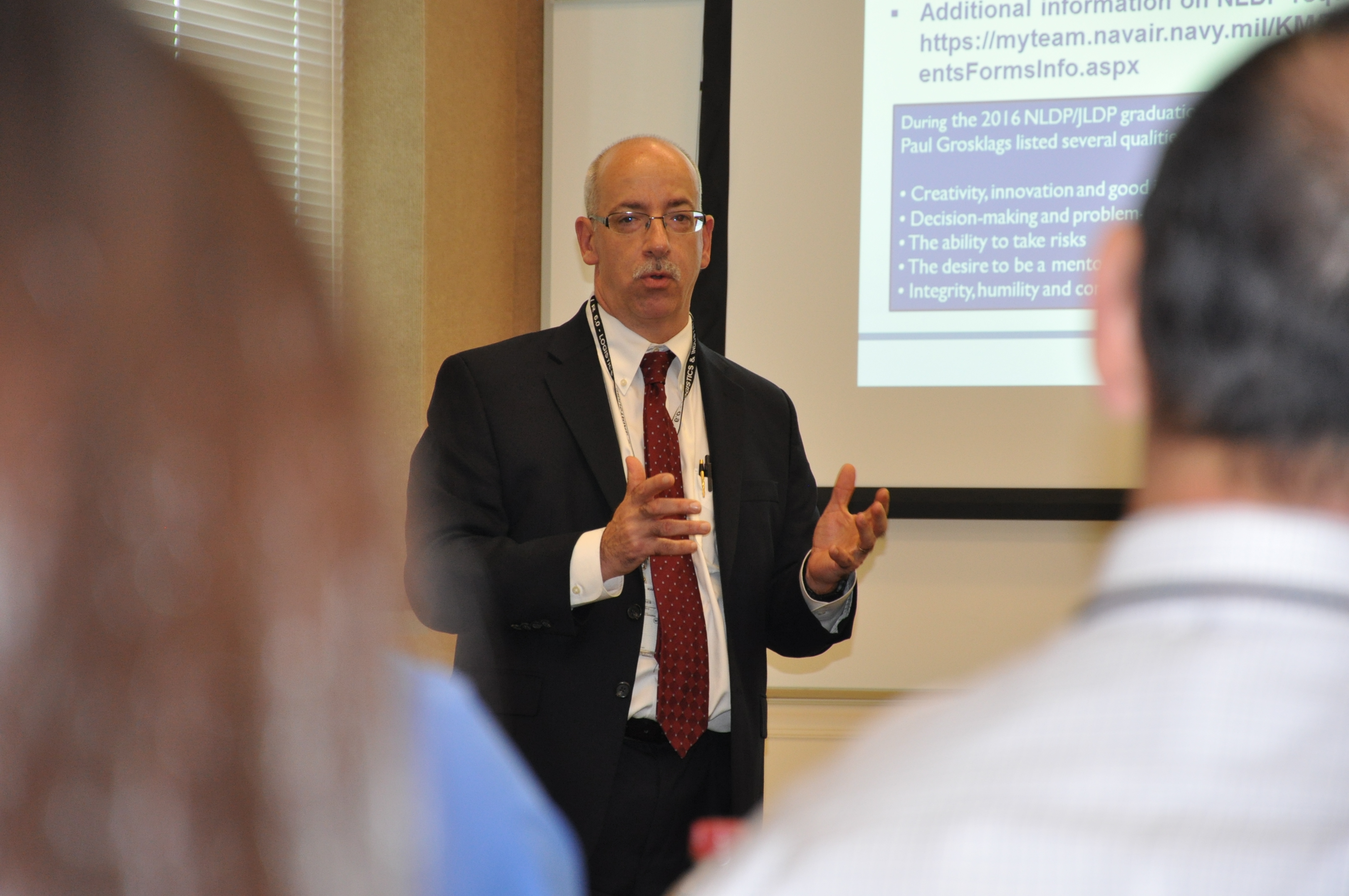
Todd Balazs, deputy assistant commander for Logistics and Industrial Operations, Naval Air Systems Command (AIR-6.0), tells prospective Naval Air Systems Command (NAVAIR) Leadership Development Program (NLDP) Program candidates how to access resources on the application process.