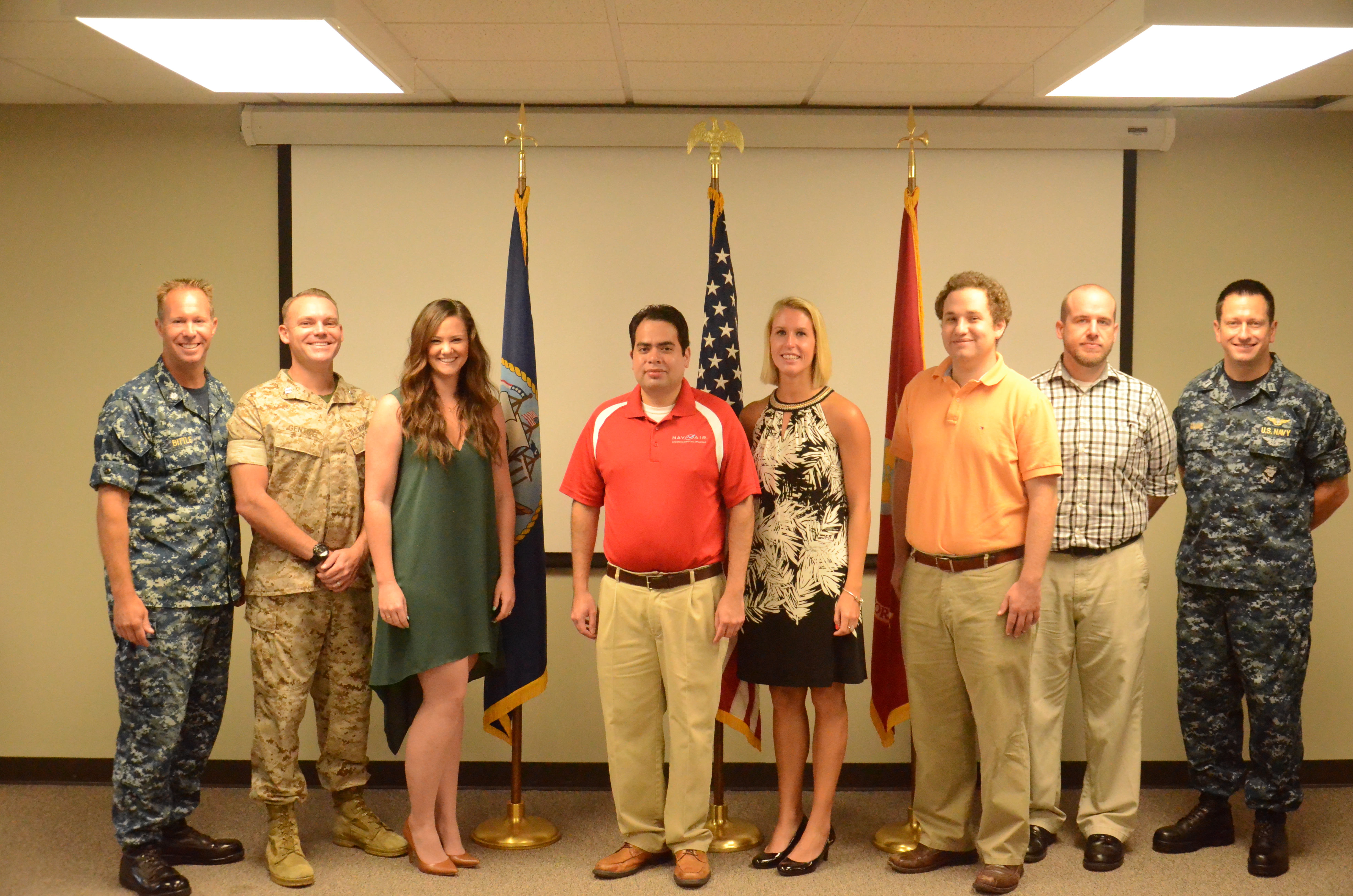
NEW CIVILIAN AMOs -- Five Naval Air Systems Command Naval Acquisition Development Program interns recently completed the Naval Aviation Maintenance Program Indoctrination Course, also known as the Aviation Maintenance Officer course. The nine-week course at Center for Naval Aviation Technical Training at Naval Air Station Whiting Field, Florida, provides newly commissioned or designated aviation ground officers or civilians with little or no aviation maintenance background with technical information and knowledge of the managerial responsibilities and the administrative duties required to perform at an entry level aircraft maintenance position. Pictured are Cmdr. Kevin Bittle, CNATT Detachment Whiting Field officer in charge; Marine Capt. Ben Gentry , instructor; Meghan Wagner, Naval Air Station Patuxent River Air-6.6 intern, David Boniche, NAS Pax River Air-6.6 intern; Rachel Meagher, Joint Base McGuire-Dix-Lakehurst Air-6.0 intern; Greyson Siegel, NAS Jacksonville Air-6.0 intern; Dustin Neill ( NAS Pax River 6.7 intern; and Lt. Timothy Maine, instructor. (courtesy photo)
NAVAIR interns graduate Naval Aviation Maintenance Program course
NAVAL AIR SYSTEMS COMMAND, NAVAL AIR STATION PATUXENT RIVER, Md. – The Naval Acquisition Development Program provides interns with the opportunity to enhance their careers and make a difference in naval aviation. Five Naval Air Systems Command logistics interns from Air-6.0 took that opportunity to the next level by recently completing the Naval Aviation Maintenance Program Indoctrination Course.
The NAMP, also called the Aviation Maintenance Officer or AMO course, taught at the Center for Naval Aviation Technical Training at Naval Air Station Whiting Field, Florida, provides newly commissioned or designated aviation ground officers or civilians with little or no aviation maintenance background with technical information and knowledge of the managerial responsibilities and the administrative duties required to perform at an entry level aircraft maintenance position. Interns David Boniche, Meghan Wagner, Rachel Meager, Greyson Siegel and Dustin Neill participated in the nine-week course.
Siegel, a data analyst based in Jacksonville, Florida, said the course helped him tie book learning to practical application.
“My biggest struggle has always been that I can read all the manuals about how this data is supposed to be entered and what it is supposed to all mean but I had no practical experience with it,” Siegel said. “While most of my coworkers are veterans who have years of practical experience, I had to learn everything second hand. Through this second hand knowledge, I've been able to put together a good concept of how to make sense of the data but certainly not a complete one. AMO school hugely helped with that. It took me step by step through the entire maintenance process and did a great job not just at filling in the holes in my knowledge but also showing why things are done certain ways and what directs them.”
Meagher is an intern at Lakehurst, New Jersey. She said appreciated the networking the class offered.
“Interacting with the Marines and Sailors in class not only provided me with contacts, it gave me insight into the experiences and struggles that the service members go through when doing their daily tasks,” she said. “I will use the knowledge gained from the school to efficiently cater to the needs of the fleet.”
While the AMO course is typically for maintenance officers, bringing civilian interns into the mix provided added benefit to the learning experience.
“The interns provide a unique and valuable perspective on Naval Aviation Maintenance and contribute in many ways to our conversations throughout the class,” said instructor Lt. Tim Maine. “Most importantly, I believe the course gives them insight as to how their daily efforts support the end-user and ultimately keep aircraft flying safely.”
One of the classes was a mock maintenance lab.
“(It) was the best experience in learning to balance the maintenance of aircraft and execution of the flight schedule,” said Boniche, who is based at Naval Air Station Patuxent River, Maryland. “Teamwork is very important in this environment. The lab was just a training exercise. In the real world, real lives are impacted. It’s amazing to see all the steps necessary to make sure an aircraft is Safe for Flight.”
In addition to schools, NADP interns are provided with rotational assignments, mentoring opportunities and tours of programs to understand the impact they can have on the future of naval aviation.
For more information on the NADP, go to http://www.secnav.navy.mil/rda/workforce/Pages/NADP.aspx.