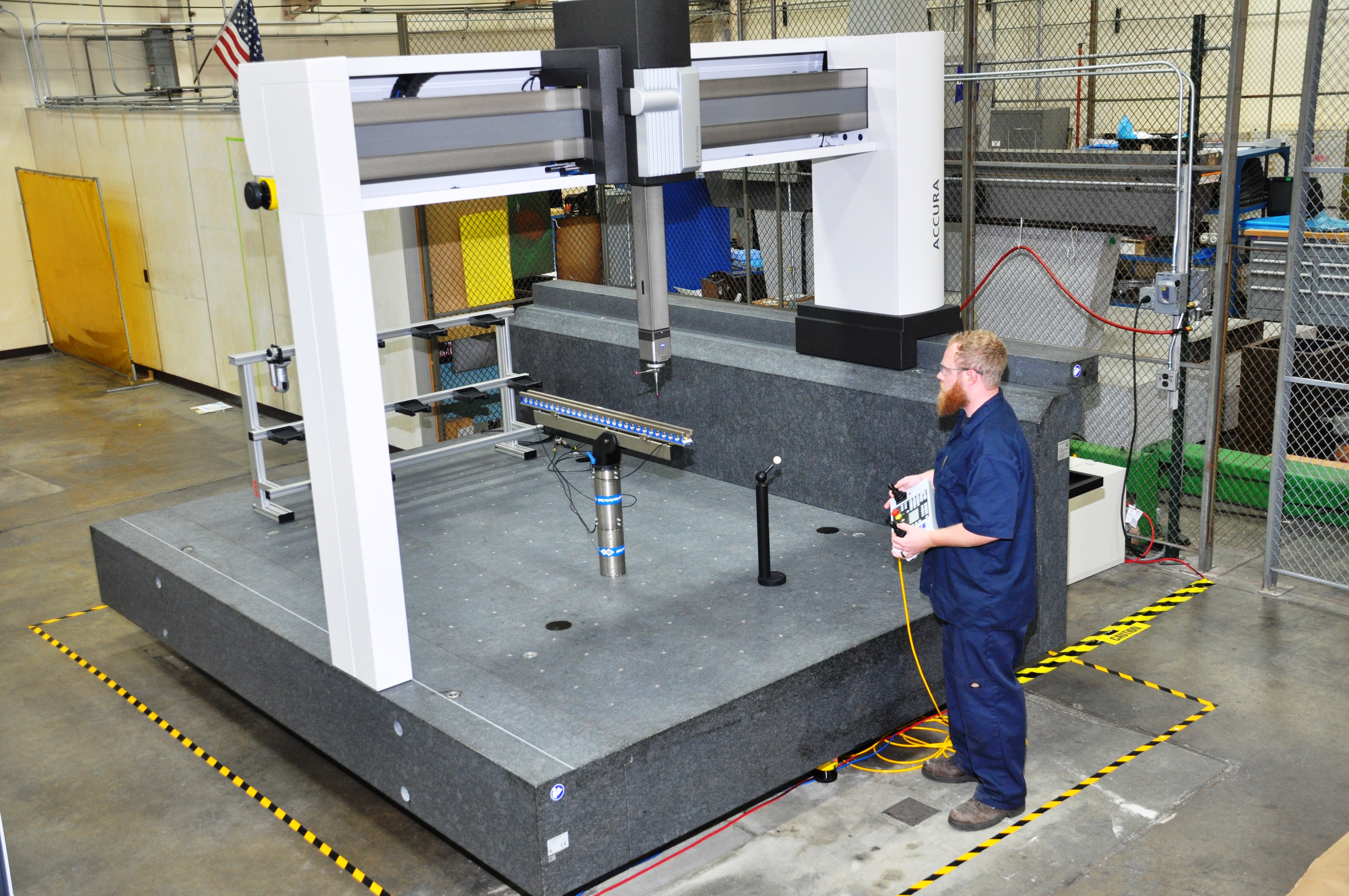
Machinist Kevin Guittar makes preparations to operate the new Zeiss Coordinate Measuring Machine in the Building 472 manufacturing department. (U.S. Navy photo)
New CMM Enhances FRCSW Manufacturing Capability
NAVAL AIR STATION NORTH ISLAND - Precision in manufacturing aircraft parts not only ensures performance as intended, but safe operation under a gambit of stresses and circumstances. Accuracy is paramount.
Fleet Readiness Center Southwest (FRCSW) recently improved the accuracy of its manufacturing measurements to 0.001of an inch by purchasing a new Coordinate Measuring Machine (CMM) through the command’s Capital Investment Program (CIP).
The CIP invests in new technology equipment that will improve the command’s efficiency.
“This project was to be completed in 12 months; it was awarded in April and completed November 4, so it was ahead of schedule and under budget,” noted CIP project manager Martha Hoffman.
Located in the Building 472 climate-controlled “cold room” and costing approximately $500,000, the CMM will not only help FRCSW meet its demand for manufacturing measurements, but will also allow for measurements of parts manufactured before installation.
Five artisans who are assigned to operate the new measuring machine recently completed a week-long certification class provided by Zeiss, the CMM manufacturer.
“Engineering will send a blueprint and 3-D model (of the part) for us to use,” said machinist Kevin Guittar.
“We program the CMM. It uses a stylus and touches different points on the part, and during the programming we can pull dimensions that will match the blueprint. So using the blueprint, we write a program to make the measurements and it will record those measurements. This will tell us if it’s a good or bad part.”
The bridge-type measuring machine uses computer-aided design and computer-aided manufacturing (CAD/CAM) software with a toolkit, and can be adapted to meet future sensor and software requirements.
“The training is pretty constant as we get more involved and deeper in the software. The goal is to get enough people trained up to run three shifts,” Guittar said. “It has all of the latest and greatest things and the tool kit has all of the accessories we need and more than enough to do the job.”
To ensure a quality product within technical specifications, parts undergo First Article Testing, or testing procedures that oversee production steps.
Guittar said that flight critical parts, like F/A-18 ribs and formers, undergo a 100 percent inspection on every dimension.
Prior to the installation of the new CMM, artisans were using an older measuring machine that was built in the early 1990s.
“And before that,” Guittar noted, “they used a lot of large fixtures for gauges so they could put the parts in and manually check everything; it was very time consuming and took up a lot of space.”
Now, artisans will use the Zeiss CMM which delivers faster results with a greater capacity.
“The new machine runs approximately six times faster than the older one and it can run multiple parts. The older machine required us to write a program and run one part and then set the next one. But with the new one, we can set all of the same parts and run at the same time. So, we can get everything done in one shot,” Guittar said.
Another advantage of the Zeiss model is its advanced scanning head.
“When we’d measure a circle on the old machine you’d take a single point, and the machine would take 8 to 16 points to make the circle. This one takes 1,000 to 3,000 points so you get a true form; if it’s a true circle, an oval, or a trimetric shape. It provides a lot more information that’s important to intricate things, like bushings.”
In the event a measurement is not within required specifications, engineering is notified and the machining modified to increase the accuracy.
The Zeiss CMM is the third measuring machine in the manufacturing department, and a fourth from the reverse engineering department will be added soon, Guittar said.
“We’ll be using all four of them, hopefully across all three shifts. All of this will result in less rework which will save manpower and money and increase readiness,” he said.
NAVAL AIR STATION NORTH ISLAND -