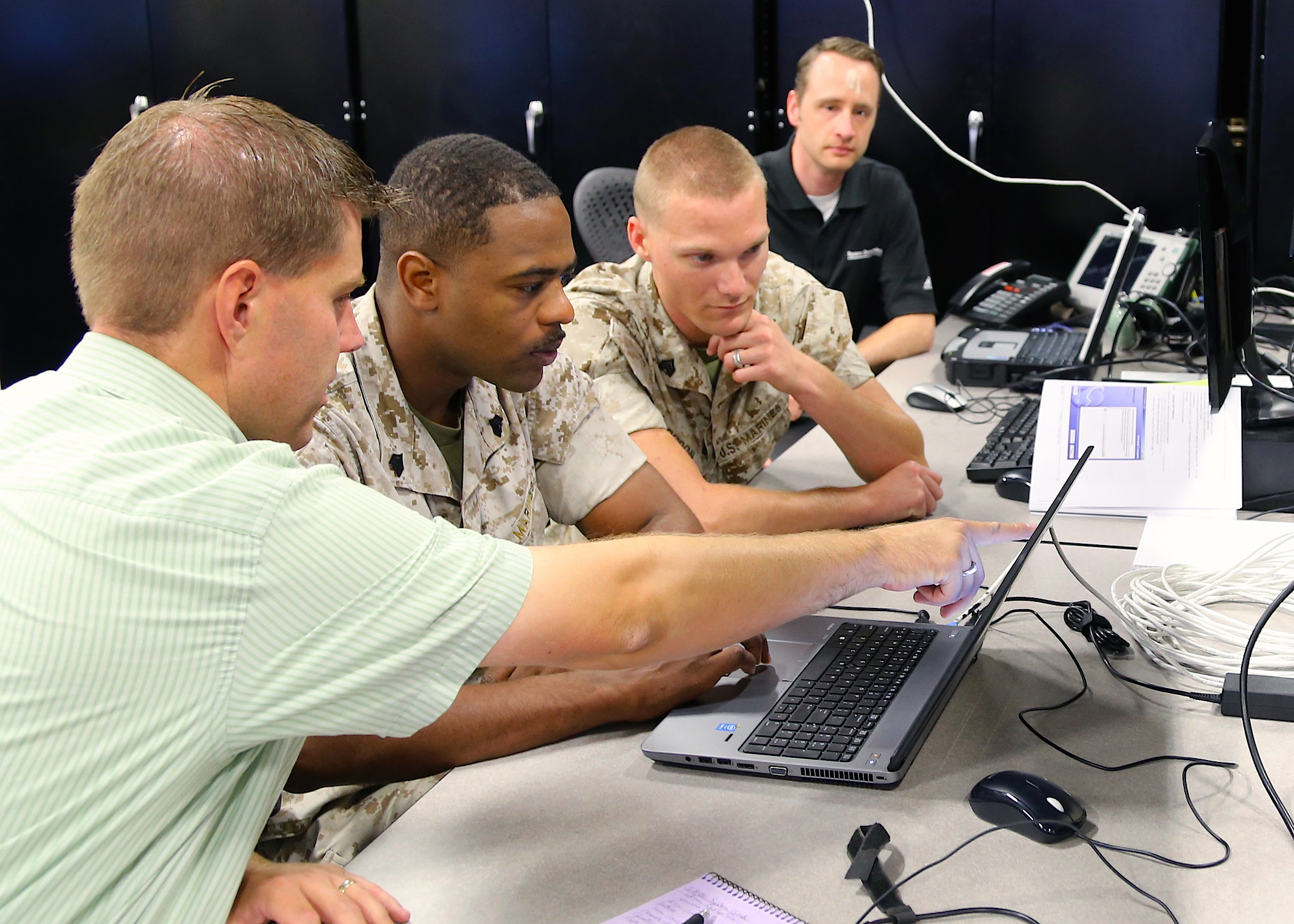
Sgt. Tommy Wilson Jr., left, and Sgt. Steven Perrow of I Marine Expeditionary Force team up with engineers from Naval Air Warfare Center Weapons Division, and Space Dynamic Labs to learn about and help improve technology systems used during the 2016 Enterprise Challenge at China Lake on Aug. 5. (U.S. Navy photo)
NAWCWD successfully completes Enterprise Challenge 2016
After a month of testing and exercises, the 2016 Enterprise Challenge wrapped up in August at Naval Air Warfare Center Weapons Division China Lake. This year’s Enterprise Challenge concentrated on collaboration between engineers and warfighters while leveraging multiple exercises, sharing information on a larger scale and providing realistic training.
“We’ve gone from five or six people last year to 30 or 40 people running it this year,” said Steve Green, Enterprise Challenge 2016 program manager. “Basically, what we’re trying to do is share intelligence data among our military services and coalition partners. It’s a small effort now, but it will grow into something bigger if we’re all proactive and listen to what the needs of the warfighter are.”
With sponsorship and support from the National Geospatial Agency, and the Marine Corps System Command (MCSC), who provided tactical gear from their Tactical Exchange Group Family of Systems, the Enterprise Challenge maintained its theme of testing new and existing technologies with an emphasis on Intelligence, Surveillance and Reconnaissance data collection. This year’s Enterprise Challenge aimed at producing continuous work for engineers and developing training tools for warfighters in support of the Defense Intelligence Information Enterprise.
One area in particular revolved around the Tactical Wideband Interoperable Surface Terminal (TWISTER), a system provided to China Lake by MCSC. The TWISTER is a tactical antenna used to communicate with unmanned aerial vehicles such as the U-2 and Global Hawk and transmit the data to the Virtual Imagery Processing – Marine Corps system for imagery processing, exploitation, data collection and dissemination. While the equipment rests at NAWCWD, Marines stationed in other locations can remotely receive information from the flying aerial assets in or near the China Lake area.
“Having TWISTER [at China Lake] not only gives engineers opportunities to integrate better products for the Marines, but now it gives them an alternate training site where they can come to or connect to from remote sites when those aerial assets are available,” said Yancy Jeleniewski, a MCSC acquisition lead engineer. “It’s beneficial to the Marines having the ability to test and train on the real system here at home and helps them get ready and be prepared for when they have to go to battle using that same equipment and aerial assets.”
Through the Enterprise Challenge, NAWCWD was able to collaborate with other locations for the availability of aerial assets and data to be picked up by the Combined Fires Integration Center, which was set up within the Weapons System Center for Integration Lab.
This year, one of the efforts of the Undersecretary of Defense for Intelligence was cyber. NAWCWD supported three of their seven insider threat objectives to work on during the Enterprise Challenge with help from Fort Meade and Defense Information System Agency, who provided and administered networks at no cost. The Enterprise Challenge’s visibility also attracted the interest of the Small Unmanned Aircraft Systems Program Office (PMA-263) who expressed an interest in having NAWCWD integrate an ISR radio into China Lake’s commercial integrator for testing and risk mitigation.
Green looks to increase international coalition participation in the years to come as well as be able to continue sharing resources and data amongst other U.S. military agencies using the Department of Defense Distributed Common Ground/Surface Systems for the Army, Air Force and others.
“We want to combine as many of these exercises together as we can,” Green said. “As far as the Combined Fires Integration Center, I want to eventually create a reference model where people can bring their systems in and, if they go by a reference model, they should be interoperable immediately. That’s one of my goals and what we accomplished this year is going to help us get there.