
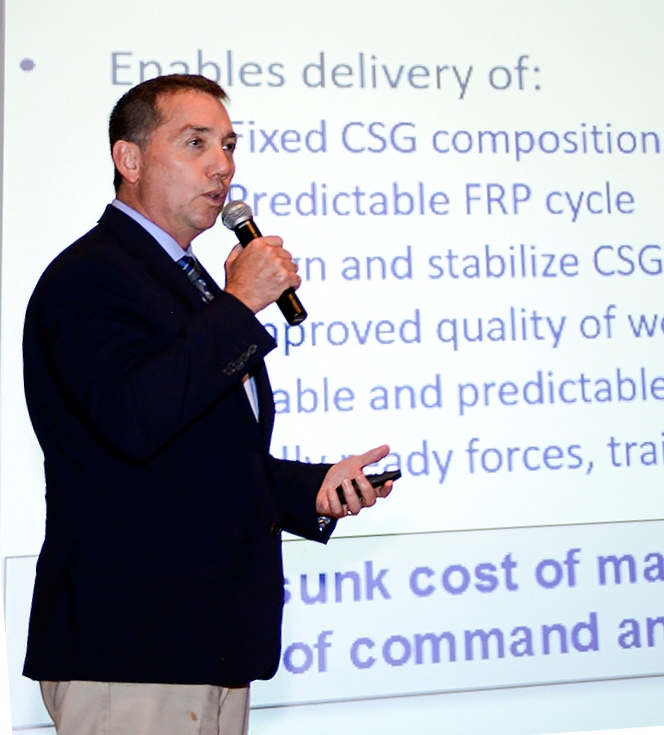
Keeping enough aircraft on the flightline ready to fight is a challenge for the Navy, and members of the Naval Air Systems Command (NAVAIR) Logistics and Industrial Operations (Air-6.0) competency discussed initiatives Aug. 24 at the Naval Air Station Patuxent River theater to improve aircraft availability. Guest speaker Brian Scurry, executive director of Commander, Naval Air Forces (CNAF), U.S. Pacific Fleet, spoke about how not having enough aircraft was negatively impacting training and readiness. (U.S. Navy photo)
Countering the Readiness Challenge
NAVAL AIR SYSTEMS COMMAND, PATUXENT RIVER, Md. -- Keeping mission-capable aircraft on the flightline for pilots to be ready for tasking, also known as Ready Basic Aircraft (RBA), is a never-ending challenge for logisticians and maintainers. And for a variety of factors, there are many aircraft on flight lines that are not available to fight tonight.
Logisticians from across Naval Air Systems Command (NAVAIR) Logistics and Industrial Operations (Air-6.0) at Naval Air Station Patuxent River gathered in the installation theater Aug. 24 to talk about countering the RBA challenge and some of the planning tools available to get more aircraft accessible to pilots.
The forum was part of a regular discussion series of hot topics for logisticians to discuss challenges and share solutions.
“The Marine Corps has … one third of its aircraft that are down that should be flying,” said Todd Balazs, deputy assistant commander of Air-6.0. “The Navy has between 10 and 11 percent down. We have a problem.
“The pilots who need to maintain proficiency can’t do so if their aircraft are down,” he said.
The logisticians heard from guest speaker Brian Scurry, executive director of Commander, Naval Air Forces (CNAF), U.S. Pacific Fleet. CNAF is responsible for the Navy’s 11 aircraft carriers, 3,800 Navy and Marine Corps aircraft and more than 100,000 professionals supporting naval air forces.
“We don’t have all the funding and resources we need and we don’t have as many aircraft on the flightline that are mission capable, so about 10 years ago we started a tiered readiness concept,” Scurry said.
Tiered readiness calls for squadrons to typically reduce training and increase maintenance following deployments. However, with the lack of RBA and as squadrons lose aircraft to maintenance, repair, overhaul, or other reasons, the ability to keep pilots and crews proficient is reduced.
“When they get ready to deploy, pilots have this ‘Mount Everest’ slope (of proficiency) to get back up on to get ready to go,” Scurry said. “We have noticed the performance … is noticeably lower than it was five, 10 years ago. We directly attribute this to the reduction of RBA.”
Toni Meier, NAVAIR director of Logistics Management Integration, talked about some of the lines of effort her division is undertaking to address the RBA shortage.
Some of the initiatives including building RBA playbooks to help achieve and sustain fleet operational capability requirements, understand and communicate current and forecasted weapon system availability and identify the funding necessary to execute the plans.
“We’re trying to pull all this together and put it in the plan and figure out how much will it cost to get there,” she said.
Meier said one funding solution includes finding ways to decrease the time needed for funding maintenance and materials by using a portfolio of Navy-wide, multiple award contracts for the acquisition of aviation industrial support.
Tracy Moran, director of the NAVAIR Industrial and Logistics Maintenance Planning/Sustainment Department, said among other initiatives, her department is working to improve Bills of Materials (BoMs), which are lists of parts or components that are required to build a product.
“BoMs build the (spare parts and supplies) forecast,” Moran said, which helps ensure materials are available when needed.
The Aviation Readiness and Resource Analysis division, led by Roy Harris, is working to understand trends to help better address the RBA gap by being more proactive with readiness and resource analysis.
“In the past we had monthly snap-shots of data that was looking in the rearview mirror,” Harris said. “It was good information, but it was maybe not as effective as we wanted.”
The new initiatives with “allow us to get ahead of issues in enough time to where we can wholly impact what happens on the flight line,” he said. “Stopping aircraft from going down before they go down, that is the ultimate end-goal.”