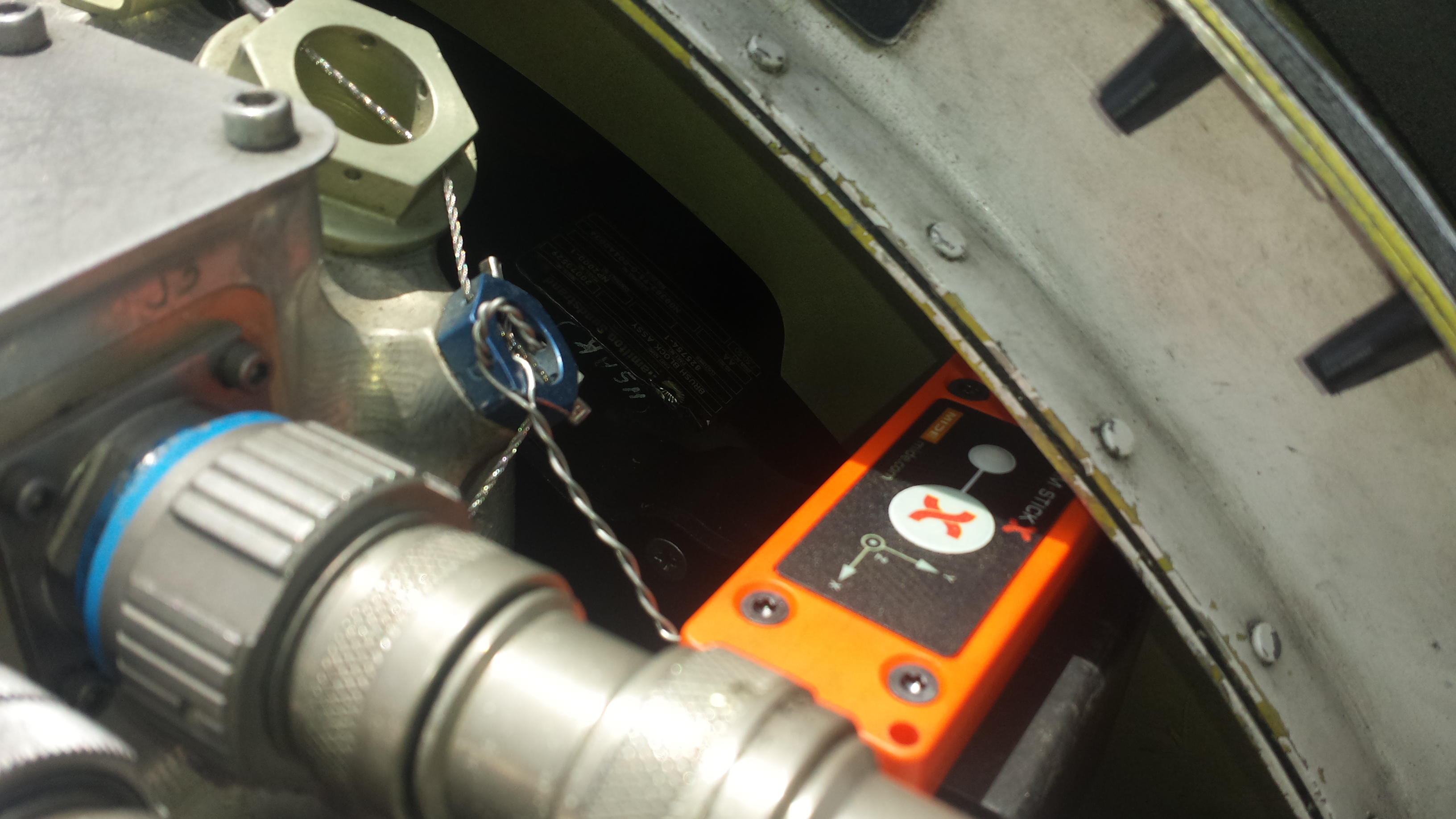
A Midé “Slam Stick”™ is pictured in the engine housing of a C-2 Greyhound. The device was used last year to locate and correct a vibration that prevented the aircraft's availability to the fleet.
 (U.S. Navy photo)
“Slam Stick”™ Helps NAVAIR Engineers Troubleshoot Aircraft
NAVAL AIR STATION NORTH ISLAND, Calif. The proverb “Good things come in small packages” may well be the new mantra of the avionics department of Naval Air Systems Command’s (NAVAIR) In-Service Support Center-North Island.
An engineering tool called “Slam Stick”™ is helping to identify some of the most perplexing maintenance, repair and overhaul (MRO) issues NAVAIR engineers face every day.
Manufactured by Midé and designed to measure and record vibrations, temperature and air pressure, the lightweight Slam Stick is a sensor that is 3 inches in length and less than 2 inches in width. And with a depth of slightly over one-half an inch, the device can be placed virtually anywhere in an aircraft from the pilot’s shirt pocket, to the least accessible bay.
“It has a three axes accelerometer which basically measures acceleration and vibration. It also has a DC accelerometer which means that it measures gravity,” said avionics engineer and Avionics Advanced Technologies Investment (ATI) Team Lead Brett Gardner.
“I saw this technology at a Small Business Innovative Research conference. The device there was just the accelerometer. It didn’t have the pressure or temperature capacity and was a 16 gigabyte model that was basically useless to us,” he said.
To adapt to NAVAIR’s purposes, Gardner contacted the Defense Information Systems Agency in 2012 and secured backing through a Rapid Innovation Fund (RIF). The RIF program funds innovative technologies that support warfighters.
Modification and development of the Slam Stick took about one year and was held in conjunction with Midé at Fleet Readiness Center Southwest (FRCSW). Cost was approximately $450,000.
The device is now available in four different models: 25, 100, 500 and 2,000 gigabyte. Each model is applicable to the range of acceleration to be measured.
“We use all models,” Gardner said. “The idea behind these was to give the engineers a way to go out and look at the environment on the aircraft. For example, what kind of G loading is there in the avionics bay? Is there a pressure or a temperature problem?”
The Slam Stick is used in a variety of airframes including the F/A-18 Hornet, T-45 Goshawk, F-35 Joint Strike Fighter and the E-2/C-2.
The maiden use of NAVAIR’s Slap Stick at FRCSW was last year in locating the cause of a vibration reported by a C-2 Greyhound pilot during ground turns at the flight line.
Team lead engineer Vu Buu placed nine Slam Sticks throughout the aircraft and after the first application, ruled out the vibration as being caused by the plane’s engines.
The second application led the team to focus on the tail of the airplane where they found a faulty dampener on one of the flight surfaces. The dampener muffles the vibrations from the flight control surface to the yoke, or stick of the aircraft. Once replaced, the vibrations stopped.
Gardner said that locating and correcting the vibration took about two weeks.
The Slam Stick is manufactured in either a plastic or metal version. NAVAIR uses both.
Because the metal version is stiffer, it has a tighter tolerance on vibration profiles making it more accurate than the plastic model.
“We came up with the metal version because it’s fully qualified for electromagnetic interference (EMI),” Gardner said. “The plastic one was coated on the inside with a conductive material so any EMI would be absorbed.”
In addition to initially designing its specifications, Gardner also contributed to the software development of the device.
“We had a basic version of the software. The original accelerometer was highly inaccurate and was a three channel device. The one we have now is an eight channel. It has two different accelerometers in it, so that’s six channels and a channel for the temperature and one for the atmospheric pressure,” he said.
NAVAIR engineers are currently using Slam Sticks to investigate physiological events in F/A-18 Hornets. Specifically, they are targeting the aircraft’s cockpit pressurization system by examining the aircraft’s oxygen generating systems, canopy systems and the cockpit pressure systems.
Because the F/A-18 is a closed-loop self-regulating pressure system, measuring cockpit pressure during flight is not possible.
“There’s no way to record that data because there’s no computer hook that you can record. It’s a stand-alone system,” Gardner said. “However, there is a stand-by analogue meter that the pilot can look at to see what the cockpit pressure is, but it isn’t recorded anywhere. And it’s slow and inaccurate.”
Slam Sticks may be placed in an aircraft by using two-sided tape. After the flight, the Slam Stick’s data is matched to the aircraft’s file by layering one on top of the other to reveal the profile the aircraft flew and the profile of the cockpit pressurization system. The data reflects a real time tracing of the factors.
“This way we know what the cockpit pressurization theoretically should schedule to and layer that over the top and look to see if there were any anomalies,” Gardner said.
This summer Slam Sticks were used to gain data on F/A-18 Hornets of Strike Fighter Squadron 37 (VFA-37) at Naval Air Station Oceana, and the physiological event pilot program will conclude soon at Marine Fighter Attack Squadron 232 (VMFA-232) aboard Marine Corps Air Station Miramar. Data from both events are currently being analyzed.
“We’re finding that the aircraft don’t exactly regulate the way we thought they were designed to regulate. There are small anomalies that are probably going to be the new normal,” Gardner said.
Downloading and retrieving Slam Stick data currently requires use of a stand-alone computer. To improve the process, Gardner said that efforts are underway to establish research, technology and development (RT and D) network authorization across the industrial side of the FRCs.
“The pilots bring back the memory unit to download all of the data from the aircraft and plug it into a laptop. We’re in the process of getting the Slam Sticks approved to plug into those computers so the squadrons can upload the data to the servers for the engineers to access directly,” Gardner said.
Data compiled from the F/A-18 cockpits is passed to the Environmental Control Systems (ECS) F-18 subsystems that is not only responsible for overseeing the processing, but for creating solutions, as well.
The ECS team created software in a .matlab file which syncs the Slam Stick data to the aircraft file.
“Data such as weight off wheels and the cockpit canopy opening and closing allowed measuring of some of the different events to the duration of the flight. We could see when pressure was changing and then returning to normal. Then we could estimate a time and measured the time the flight was to the aircraft files, then weight on wheels, and the .matlab program matches up the files so the engineer can fine tune them,” Gardner said.
NAVAIR’s F/A-18 and EA-18G Program Office (PMA-265) purchased approximately 160 Slam Sticks.
Midé has sold approximately $500,000 worth of the devices, Gardner said.