
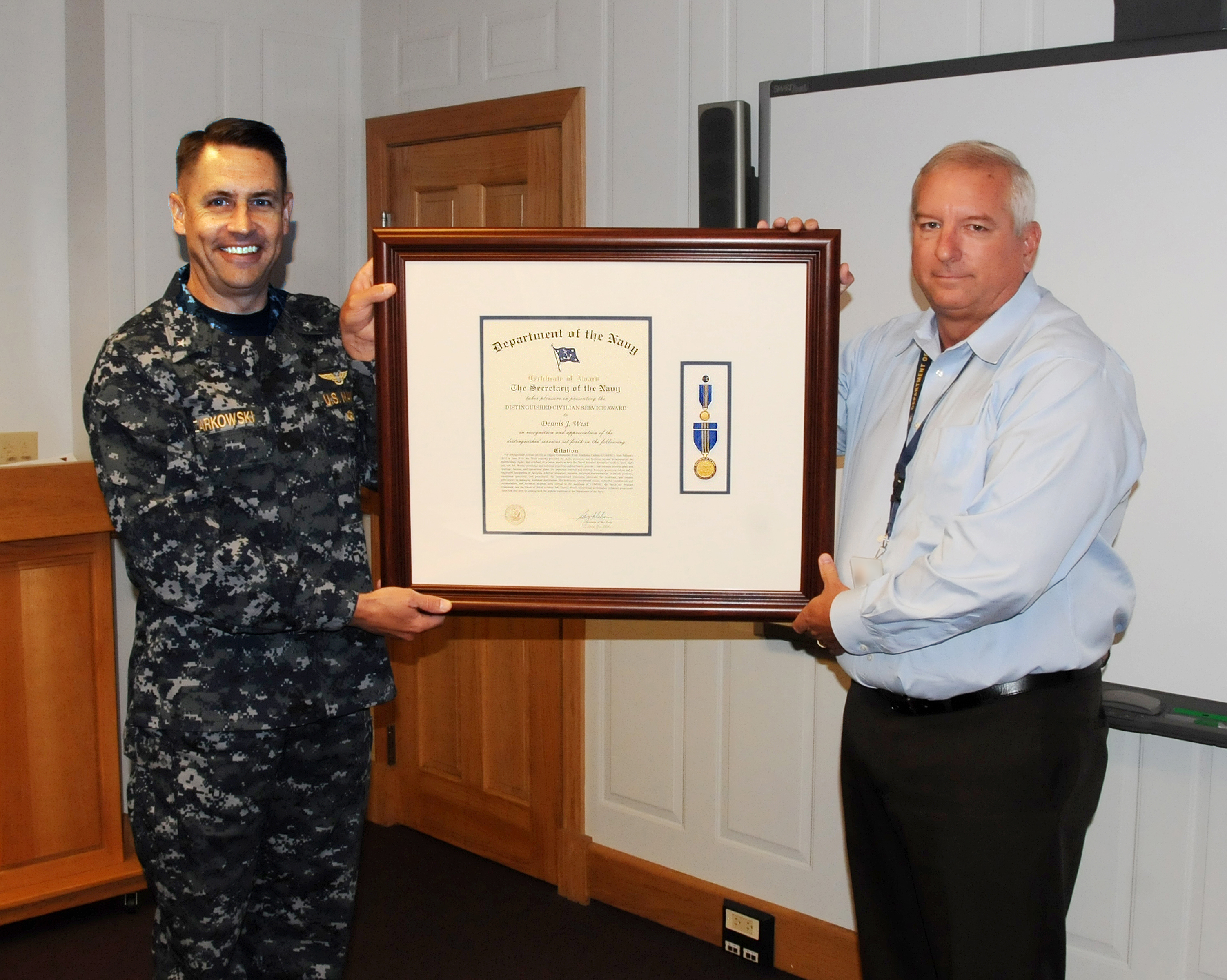
Rear Adm. Mike Zarkowski (left), Commander, Fleet Readiness Center (COMFRC), presents the Distinguished Civilian Service Award to Dennis West (right), deputy commander, COMFRC, Aug. 26 at Marine Corps Air Station Cherry Point, North Carolina. West is retiring after 32 years of civilian service. (U.S. Navy photo)
Mission mattered most in West’s work for warfighter
MARINE CORPS AIR STATION CHERRY POINT, N.C. -- Accomplishing the mission by getting capability and capacity to the warfighter was Dennis West’s raison d’etre over the course of his 32-year career.
On Aug. 31, West departed his position as deputy commander, Commander, Fleet Readiness Center (COMFRC), Naval Air Systems Command (NAVAIR), and leaves as his legacy a resource sharing organizational system, a competency aligned organization/integrated program teams (CAO/IPTs) in the Fleet Readiness Center (FRCs), a strategic plan for readiness named Vision 2020 and sound advice for the next generation.
West began his career as a General Service-5 aerospace engineer at what was then the Naval Air Rework Facility (NARF), Cherry Point, North Carolina, and is now FRC East (FRCE). During the course of his service, he worked in many capacities at FRCE: starting as a pneumatics engineer on the shop floor; production support engineer for aircraft and support equipment; research and engineering group head; director of logistics; and the industrial group head.
“My career has been very, very rewarding,” he said. “Every job I’ve had, I’ve really enjoyed and have enjoyed every subsequent job more than the last one.”
In 2012, West was appointed to the Senior Executive Service and became deputy commander, COMFRC.
Rear Adm. Paul Sohl, Commander, Operations and Test Evaluation Force (COMOPTEVFOR), Norfolk, Virginia, came onboard as COMFRC in Aug. 2013 and served with West through June 2016.
“When I first met Dennis,” Sohl began, “I could tell right then he thought, not from an engineering standpoint, but from an FRC one, and he always had in his mind, ‘What do the fleet and the warfighter need and how can I get it to them?’ There were times you could see him get impatient because some of us were just thinking in terms of getting the warfighters what they needed today. And he was thinking one step ahead, thinking ‘What will they need tomorrow?’”
This forward-thinking led West to lay the foundation for Vision 2020, a strategic plan for regaining readiness across naval aviation and for optimizing capability and capacity. The ultimate achievement of Vision 2020 will be the inception of a global maintenance management system, which will recognize a failing aircraft as soon as it happens and immediately route parts, materials, artisans, equipment -- whatever is needed -- to the aircraft to fix it in real time.
“We’ve got to progress the sustainment system to operate near real time, like the airlines do, if we’re going to fix the future readiness issues,” West said. “Even though we have readiness issues now, if we don’t fundamentally change the way we’re doing sustainment, we’re going to have a serious problem going into the future.
West considers a few of his accomplishments to be key enablers that have paved the way for a plan such as Vision 2020 to succeed: the FRC resource sharing effort that led to the implementation of the workload management system (WMS), enabling prioritization and task management across sites; the completion of the NAVAIR Depot Maintenance System (NDMS) that ended more than 38 FRC-unique systems and shut down three FRC data centers, going from 484 servers to fewer than 90, resulting in a 34 percent reduction in cost and no degradation in service, thus paving the way for faster upgrades, more consistent maintenance processes and supporting cyber security.
Also important is the implementation of the digital thread infrastructure across the FRCs which allows for the seamless movement of digital data from an engineer’s desk directly to the industrial manufacturing environment, regardless of the site in which either reside. And, a significant accomplishment is the implementation of Critical Chain Project Management (CCPM), a theory of constraints tool to improve line production, at three of the FRCs, which has increased the speed of F/A-18 Hornet throughput significantly as well as other aircraft lines.
West is also credited with helping to grow the next generation of technical leaders through his personal involvement and professional development events where he shares his philosophy for being successful.
To those just beginning their careers and facing roadblocks, West said you should “recognize that every rule, every process you encounter as a barrier, was written by somebody. The key to your success in removing these barriers and moving forward is to find out who wrote the rule or process that is holding you up, and then have some discussions with that person to try to figure out what you can do. Don’t get stopped dead in your tracks; don’t let it keep you from accomplishing the mission. Some human somewhere wrote it and all you have to do is find out who. Usually, they wrote it for a specific reason, for a specific case, and if yours doesn’t fit, they’re most likely willing to rewrite it so you can do what you need to do.”
West also said managing your own career is vital.
“Do not expect anyone to be wake up every morning trying to figure out how they can help you,” West said. “It’s your responsibility to manage your career and figure out where you want to go and then enlist the help of people who can help you do that.”
To the COMFRC workforce, West offered parting guidance: “Keep up the fight; keep working on cross-site coordination and relationships; and continue to centralize functions where it makes sense and where it benefits the whole. Everyone should continue to work to understand where what they do fits into the mission. ”
West said what he will miss most is “Working with people and working to make sure the mission is successful.”
“I can’t overstate all he has brought to COMFRC,” Sohl said. “He was my close confident at COMFRC, and we were able to talk deeply on a great many and wide variety of topics and not just things in the FRC world. He is a man of great intelligence. All of us will miss him greatly.”