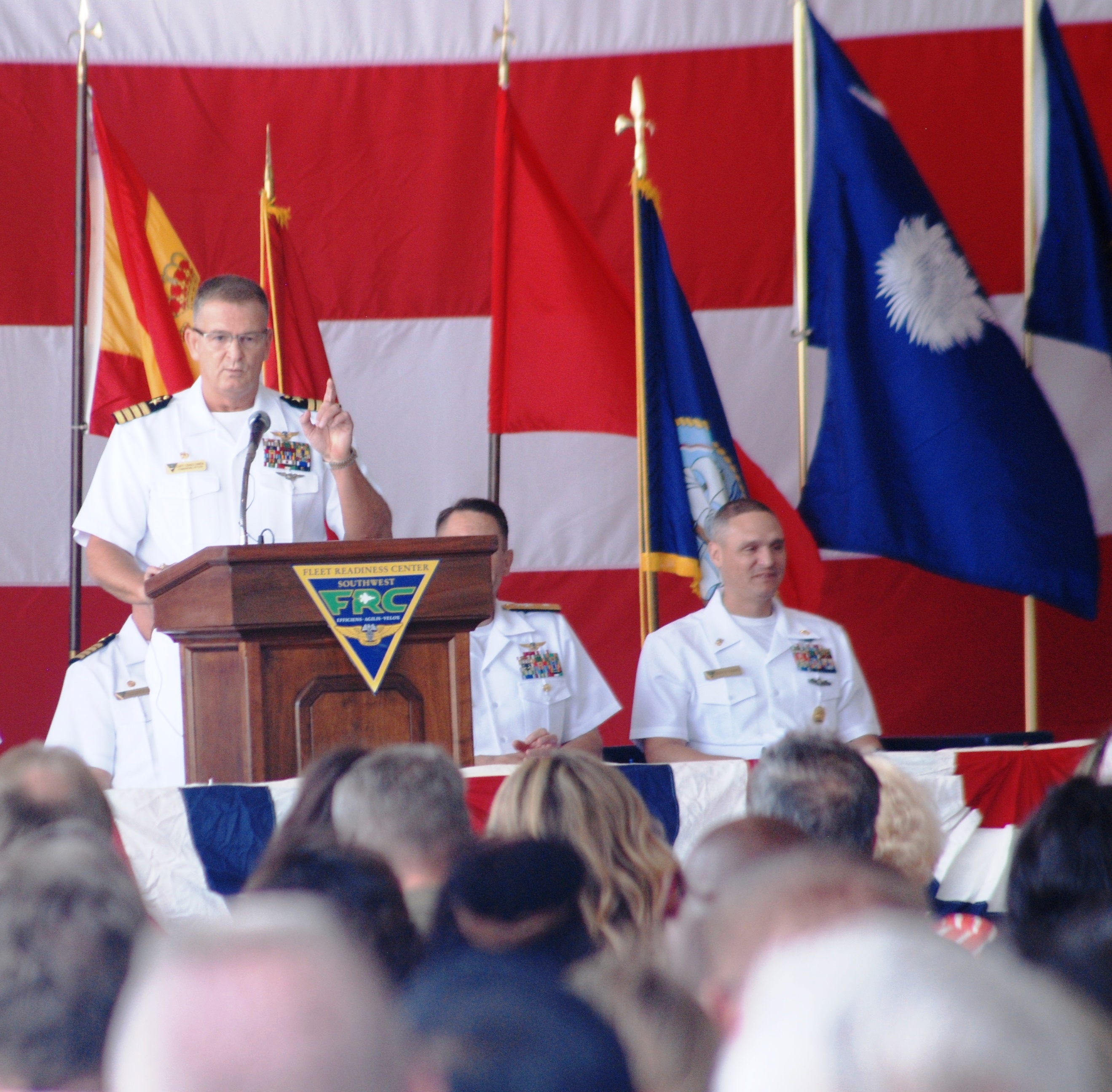
Fleet Readiness Center Southwest (FRCSW) Commanding Officer Capt. Craig Owen gestures to the audience during his remarks at the 62nd FRCSW change of command ceremony in Building 325 aboard Naval Air Station North Island on August 11, 2016. (U.S. Navy photo)
Owen Assumes FRCSW Skipper's Chair
NAVAL AIR STATION NORTH ISLAND, Calif. Capt. Craig Owen relieved Capt. Timothy Pfannenstein as Fleet Readiness Center Southwest (FRCSW) commanding officer Aug. 11 in ceremonies held at the new FRCSW helicopter maintenance facility in Building 325 on Naval Air Station North Island. Capt. Owen previously served as the command’s executive officer.
Following the arrival of the official party and national anthem, Capt. Pfannenstein opened the ceremony with welcoming remarks and introduced the presiding officer Rear Adm. Michael Zarkowski, commander, Fleet Readiness Centers and guest speaker, Rear Adm. Paul Sohl, commander, Operational Test and Evaluation Force.
During his remarks, Rear Adm. Zarkowski spoke of the continued demand upon naval aviation forces and the crucial role the Fleet Readiness Centers play in providing assets to the warfighters.
“Across naval aviation the goal remains the same: Improving readiness of aircraft currently in the fleet by becoming more predictive, less reactive; improving the affordability and speed of delivery of these capabilities to our Sailors and Marines,” he said.
Zarkowski turned his focus to Pfannenstein’s tenure as FRCSW’s commanding officer and efforts to improve readiness and service to the fleet.
“Capt. Pfannenstein achieved breakthrough results in plant operations and overall throughput of depot repair modifications,” he said. “He leveraged intra-service logistic support to expand the scope of FRCSW’s support to the fleet, and led efforts to expand maintenance, repair and overhaul (MRO) services with joint international agencies, and to identify new partnership opportunities within the Navy and Marine Corps and Air Force.”
Addressing the command’s employees, Zarkowski said: “The lines of effort you are pursuing here provide critical support to our warfighters, you extend the service life our platforms, you perform in-service repairs forward deployed and you are our back force multiplier.”
After his concluding remarks, Zarkowski introduced Rear Adm. Sohl.
Under Pfannenstein’s leadership, Sohl noted, FRCSW earned the fiscal year 2015 Chief of Naval Operations (CNO) Aviation Safety Award and the CNO’s FY 2015 Environmental Award for Sustainability, Industrial Installation.
“Capt. Pfannenstein made workforce development a priority,” Sohl said. “He began or jumpstarted numerous professional training and development initiatives including reinvigorating the command apprenticeship program in partnership with Puget Sound Naval Shipyard.”
Addressing Level Two achievements during Pfannenstein’s leadership at North Island and FRCSW Site Point Mugu, Sohl noted their selections as the CNO’s nominee for the Secretary of Defense’s Phoenix Award for field-level maintenance performed by a medium-sized organization.
He pointed out that the Level Two shops repaired 37,500 components worth $442 million, and achieved an overall ready-for-issue (RFI) rate of 91 percent, and a 100 percent RFI rate for T-56 and T-700 engines and axillary power units.
Following Sohl’s remarks, Zarkowski presented Pfannenstein with the Legion of Merit Award for outstanding achievement as FRCSW commanding officer.
In his farewell remarks, Pfannenstein referenced the hosting site of the ceremony --- the command’s 100,000 square-foot helicopter maintenance facility that was completed on January 21.
“This building represents the future of naval aviation. It is an impressive facility and it is where our vision of 2020 and beyond will take us in the FRC and NAE enterprise,” he said.
Afterward, he thanked the command’s artisans and support staff for not only their steadfast work during his tenure, but also for their support in creating a successful safety program which has pervaded the workplace culture.
He also noted the professionalism and personal conduct of the Sailors who served under his command.
After the reading of orders and the exchanges of salutes and during his opening remarks, Owen pointed out the rarity of civilian FRC workers in the nation’s workforce.
“In the United States the entire labor force is approximately 160 million people,” he said. “Compare that 160 million to the less than 4,000 civilian employees of the FRC. The FRC employees make up .007 percent of that total labor force of our country.”
“Our employees are masters and doctors of their trades, and what these professionals do every day for the Naval and Marine Corps aviation is truly remarkable,” he added.
Owen then turned his attention to the Naval Aviation Enterprise (NAE) and said that continuing successful NAE operations must rely upon the application of the existing 12 Integrated Product Support Elements (IPS).
The IPS is comprised of three management categories with four subcategories each that target production processes from infrastructure to technical support.
"We must understand all 12 elements and execute them in our everyday business,” he said. “And by following the 12 elements, we will solve many of our challenges.”
Also contributing to the ceremony were the FRCSW Color Guard and the Navy Region Southwest Band.
Pfannenstein assumed command of FRCSW on August 8, 2014. His next assignment will be as the 6.0B logistics head for Naval Air Systems Command.