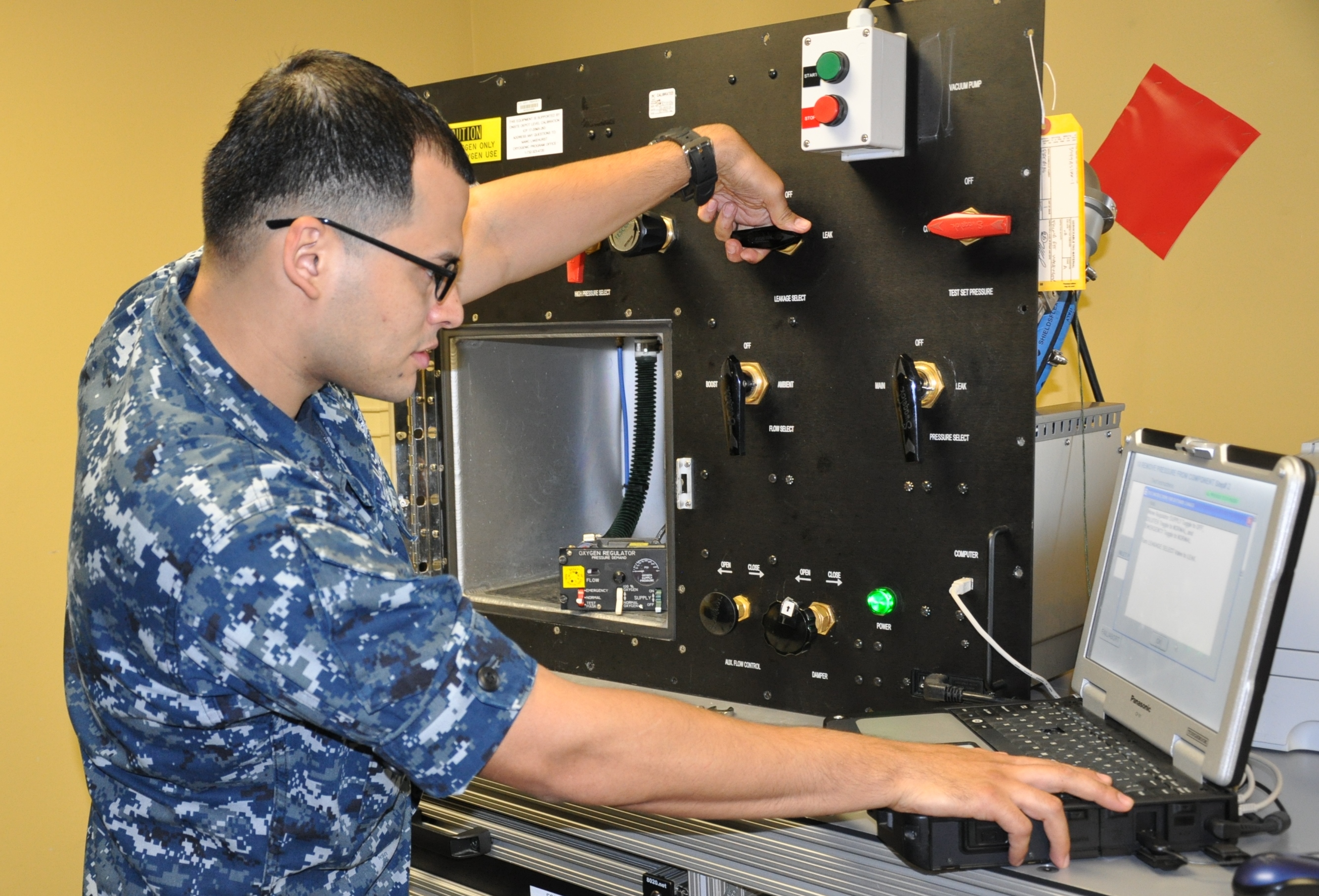
Petty Officer 2nd Class Yithzack Licona tests crew oxygen regulators for a C-130 Hercules aircraft at Fleet Readiness Center Mid-Atlantic Detachment Washington. (U.S. Navy photo)
Reserve Maintenance Support: A Growing Partnership
As the Navy engages in missions around the globe, the demand for aircraft and aviation components increases. Likewise, so does the demand for aviation maintenance. To help meet this need, Naval Air Systems Command (NAVAIR) and Commander, Fleet Readiness Centers (COMFRC), through the NAVAIR Reserve Program (NRP), ensures flexible support using Reserve Sailors to augment support to the fleet.
NRP supports NAVAIR and COMFRC with a mobilization-ready force of qualified acquisition professionals providing deployable capability and expertise.
There are two types of Reserve Sailors supporting COMFRC, Full-Time Support (FTS) and Selected Reserve (SELRES). FTS are Reserve Sailors, chiefs and officers who work full-time for their activity, while SELRES are traditional Reserve Sailors who typically serve one weekend a month and two weeks a year. SELRES may also volunteer for temporary mobilization in specialized active-duty assignments.
There are several units within NRP to support various functions within NAVAIR to include the In-Service Engineering and Logistics unit, the Program Executive Officer Support unit, the Rapid Research and Development unit, the Maintenance, Modification and Overhaul (MMO) unit and the Naval Air Warfare Center Weapons Division unit.
MMO, commanded by Capt. Robert Mark, supports COMFRC. Headquartered at Patuxent River, there are two MMO Detachments; Detachment A at China Lake, California, and Detachment B at Jacksonville, Florida. A third detachment is being planned. Mark is a SELRES officer who in his civilian career is a readiness analyst for Naval Sea Systems Command in California, where he assesses the readiness of complex combat systems. He was also an airline pilot for several years.
“It may seem rare that such skillsets and experiences could be aligned to support [NAVAIR and COMFRC], but in the Reserve it’s common,” Mark said. “It’s our job to utilize each of our Sailor’s unique capabilities.”
The primary mission support areas of the MMO detachments are Fleet Readiness Center (FRC) support, Radiological Reclamation (e.g. Operation Tomodachi), assisting with developing the Additive Manufacturing mission in the fleet and professional development/readiness of NRP personnel. This includes intermediate-level maintenance support to FRCs worldwide and operational maintenance support to Air Test and Evaluation Squadron Nine (VX-9) at China Lake.
“Additionally, NRP reservists have supported NAVAIR’s forward deployed missions such as Forward Deployed Combat Repair, Radiological Reclamation, Joint Combat Assessment Team (the NCIS of aircraft battle damage in Iraq and Afghanistan), Persistent Ground Surveillance Systems (PGSS), to name a few,” Mark said.
Within COMFRC, there are eight FRCs, with detachments strategically placed to speed support to the fleet. Four of those detachments, FRC West Detachment Fort Worth, FRC Mid- Atlantic detachments, New Orleans and Washington, and FRC East Detachment McGuire, are managed and staffed primarily by FTS Sailors and government civilians.
“We’re not just building aircraft (components); we’re building Sailors,” said Cmdr. Debra Vavrus, officer in charge, FRC Mid- Atlantic Det. Washington, near the District of Columbia. “These Sailors want to work, and they want to be here, and we work hard to set them up for success; to be stronger, more viable Sailors for the fleet.”
Two of Vavrus’ primary customers are Fleet Logistics Support Squadron (VR) 1, which provides executive transport services to senior leaders of the Navy and Marine Corps, and VR-53, which provides high-priority logistics support.
“We are doing a job that matters,” said Aircrew Survival Equipmentman 1st Class Samuel Carpenter, at FRCMA Det. Washington. “People’s lives are at stake.”
The Sailors of FRC West Det. Fort Worth have the additional flexibility to support the fleet by working alongside their active Marine Corps Reserve counterparts of Marine Aviation Logistics Squadron (MALS) 41.
“We’re collocated and integrated right down to the work center,” said Cmdr. Shawn Noga, officer in charge of Det. Fort Worth. “We’re working shoulder-to-shoulder with the Marines; which gives us more flexibility in terms of resources and knowledge sharing, in support of the warfighter.”
Operation Tomodachi Reclamation is another major program NRP supports.
During the devastating 2011 Tohoku, Japan earthquake and tsunami, the Fukushima Daiichi nuclear power plant was damaged, exposing rescuers and military equipment to radiation contamination.
The Navy took proactive measures to mitigate the impacts then, and efforts are continuing through the Operation Tomodachi Reclamation program today as aircraft and components are being inducted into COMFRC facilities for maintenance, repair or overhaul.
From December 2011 to September 2015, NRP Reserve Sailors involved in radiological reclamation project inspected and released or disposed of more than 250 aircraft, 800 engine modules and auxiliary power units and 42,000 repairable components. This saved taxpayers nearly $67 million in component cost and more than $2.4 billion in aircraft cost, as well as ensured the safety of the Sailors and technicians working on the components.
FRC Mid-Atlantic began inspecting Allison T56 turboprop engines and General Electric T700 turbo shaft engines in May 2015 and work is expected to continue through fiscal year 2017.
The T56 is used in the venerable Lockheed C-130 Hercules military transport aircraft, while the T700 is used in several rotary aircraft, to include the Sikorsky SH-60 Seahawk.
COMFRC is also working a plan, dubbed Vision 2020, that will transform the way the Navy performs aircraft maintenance by leveraging “best practices” of the commercial airline industry to increase the number of aircraft available for missions. SELRES Sailors could play a key role in the success of the plan.
“The (SELRES) maintainers would be used for surge maintenance requirements,” said Rich Bomhold, COMFRC technical director. “They would be called upon to augment the active force when peak or emergent workload occurs.
“During their drill time, they will use active-duty sites and depot sites to maintain proficiency in special skills and certifications,” Bomhold said. “The skills they will obtain and maintain will have a significant impact on active force readiness as well as Reserve force readiness.”
All this points to the continued and increasing reliance on Navy Reserve expertise within NAVAIR and COMFRC.
This story also appeared in TNR magazine, Summer 2016 issue (https://www.navyreserve.navy.mil/Documents/tnr_current/tnr_magazine_current.pdf).
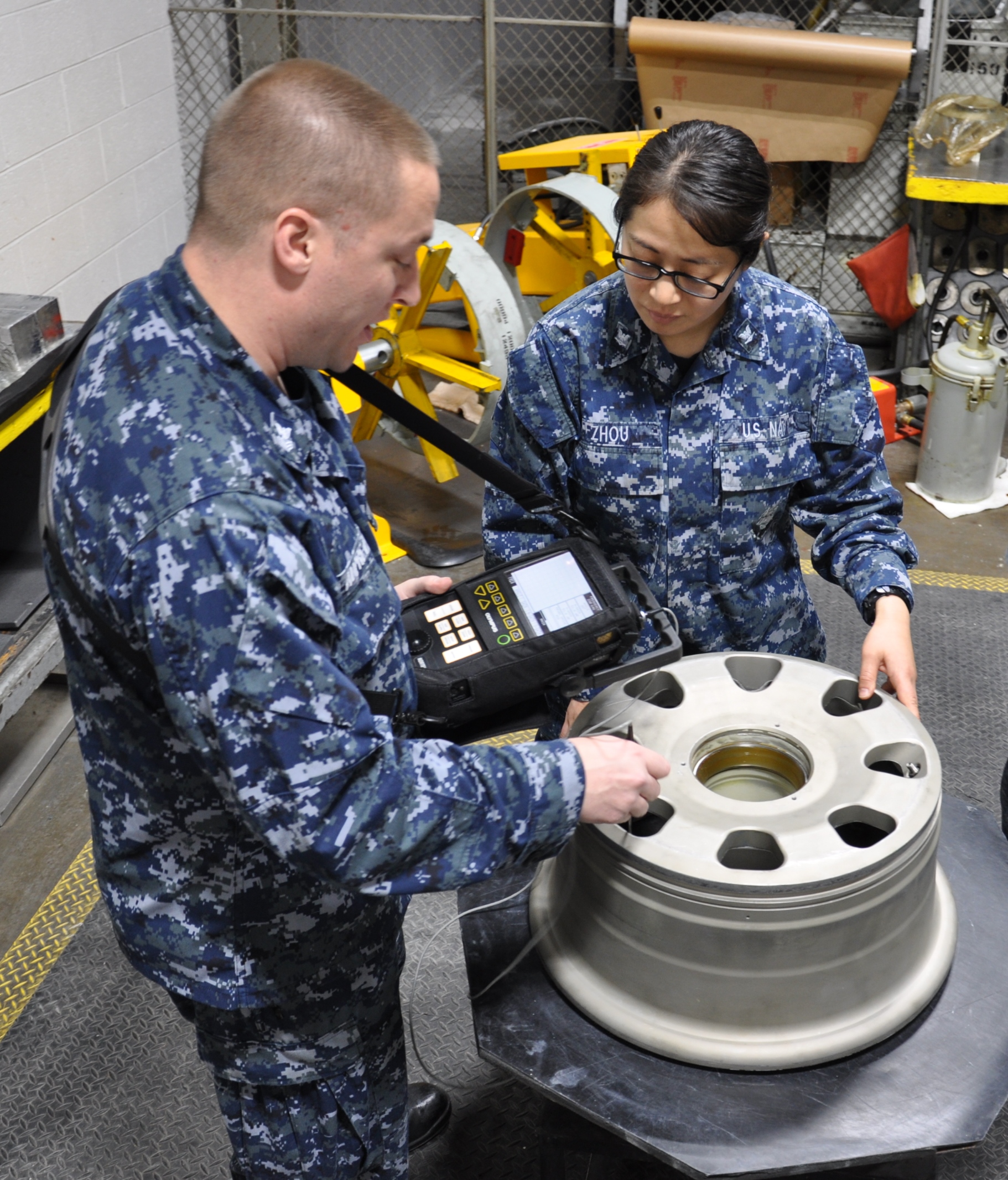
Petty Officer 1st Class Travis Beauprez, left, and Petty Officer 3rd Class Yi Zhou, both of Fleet Readiness Center Mid-Atlantic Site Washington, conduct a test of a C-130 Hercules wheel. (U.S. Navy photo)