
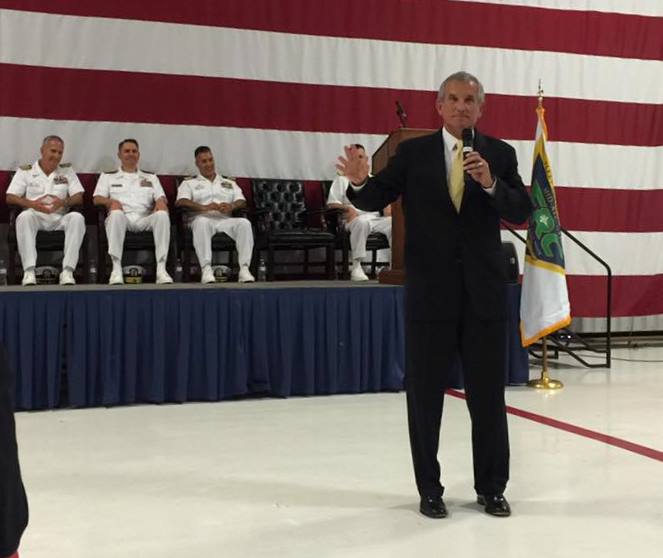
Retired Rear. Adm. Gregory Nosal speaks to the audience about the accomplishments of Capt. Joseph Rodriguez and Fleet Readiness Center Mid-Atlantic during the FRCMA change of command Aug. 5. Under Rodriguez’s leadership, FRCMA has become a leader in innovation within the Navy. Rodriguez, who will become vice commander for Commander, Fleet Readiness Centers, was relieved by Capt. Charles K. (Keith) Nixon. (U.S. Navy photo)
Fleet Readiness Center Mid-Atlantic command changes hands
NAVAL AIR STATION OCEANA, Va. --- With the restrained dignity that accompanies an orderly assumption of leadership, Capt. Charles K. “Keith” Nixon became the commanding officer of Fleet Readiness Center Mid-Atlantic (FRCMA) Aug. 5, relieving Capt. Joseph A. “J.R” Rodriguez.
Rear Adm. Michael Zarkowski, Commander, Fleet Readiness Centers (COMFRC), was the officiating officer, and retired Rear. Adm. Gregory Nosal was the guest speaker for the event that took place at the Center for Naval Aviation Technical Training Unit in Oceana.
“Where did the time go,” Rodriguez said. “It’s been a fast ride. Two years ago we were just getting started here, and I’m ready to do it again.”
Under Rodriguez, FRCMA found new ways to provide its’ customers with readiness, speed and innovation.
“With his direction, FRCMA provided critical readiness support to the fleet,” Zarkowski said. “The activities executed 92 process improvement events which yielded more than $28 million in cost savings, and some of those savings will continue to be realized annually. J.R. made it clear that deckplate leadership and innovation are at the top of his priorities.”
Zarkowski also lauded FRCMA’s support to the USS Harry S. Truman (CVN 75) strike group before it set sail for a successful deployment in the Middle East in support of Operation Inherent Resolve that included periodic maintenance inspections and modifications to a variety of aircraft.
“The work you do here enables our force to be ready to fight tonight,” he said. “This command truly does set the bar for flawless execution of the basics.”
During his remarks, Nosal, a retired fighter pilot, said that Navy’s mission is to deter aggression. If deterrence fails, it is to win our nation’s wars.
“That is what naval aviation has been doing for the last 100-plus years,” he said. “But without combat capable aircraft, there is no mission. Flying airplanes is cool. Pilots are cool, and pilots think they are cool. But pilots without planes are just pedestrians.”
Nixon, who has served as FRCMA executive officer for the last two years, has 40 years of service, starting as an Airman Recruit in August 1976 and rose through the ranks to become a chief petty officer. In 1991, Nixon was commissioned as a limited duty officer and laterally transferred to the Aerospace Maintenance Duty Officer in 1995.
“We may be smaller than other FRCs,” Nixon said. “But what we lack in footprint we make up for in experience, a stable and motivated workforce, and great leadership on the deckplates and hangar bays.”
Capt. Christopher Couch, a native of Macon, Georgia, is the new executive officer.
Rodriguez’ next assignment will be as COMFRC vice commander at Naval Air Station Patuxent River, Maryland.
Established in October 2005, FRCMA is one of eight Fleet Readiness Centers devoted to the maintenance of naval aircraft. There are more than 2,500 military, civil service and contractor personnel assigned to the command and provide a full spectrum of maintenance operations employing all of the key capabilities required to maintain high performance tactical aircraft and Aircraft Launch and Recovery Equipment (ALRE) on air capable ships supporting war fighter readiness.