
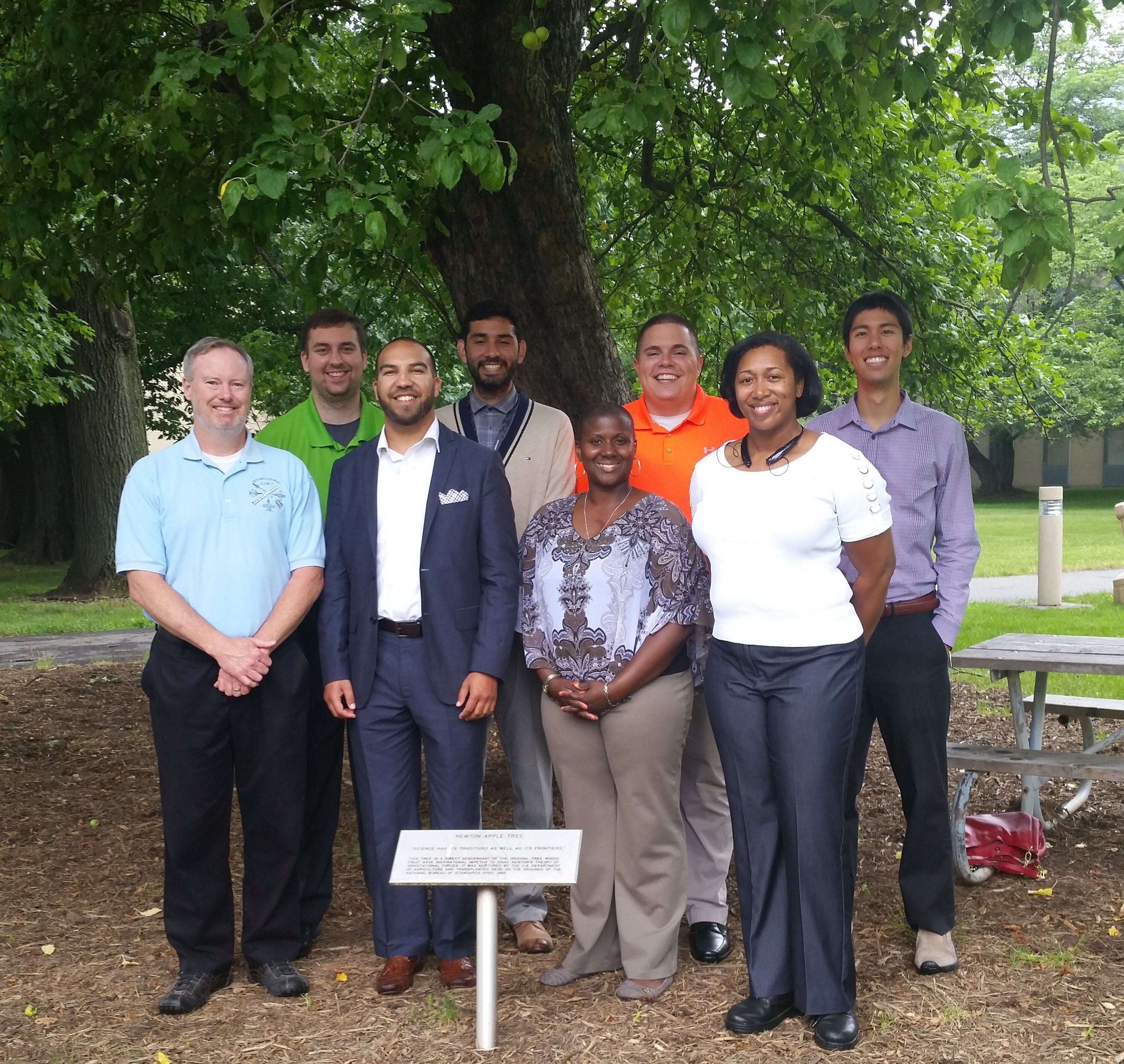
NADP participants take a break from their tour of the National Institute of Standards and Technology. The tree they are standing under is said to have grown from a cutting of Isaac Newton's famous apple tree. Front row (from the left): Matthew Stevenson; Arthur Flood; Wynette Perry; and Laquisha Thomas. Back row (from the left): Nicholas Long; Cristobal Ceron; Steven Dittmer; and Jonathan Rosen. (U.S. Navy photo)
Logistics interns tour NIST and learn of innovations that are improving life
NAVAL AIR SYSTEMS COMMAND, PATUXENT RIVER, Md. -- Naval Acquisition Development Program (NADP) participants from Naval Air System Command’s (NAVAIR) Logistics and Industrial Operations (AIR 6.0) toured the National Institute of Standards and Technology (NIST) June 16.
The participants received an overview presentation of the facility in Gaithersburg, Maryland, toured several working labs and visited the NIST museum.
“We learned about the surprising impact the organization has on our lives, at both a personal and professional level,” said Jonathan Rosen, operations research analyst. “The NIST creates thousands of its own consumer products (such as peanut butter and detergent), all precisely measured, so that industries can properly measure and calibrate their own production lines. We toured the low-background infrared facility (LBIR), which tests infrared sensors and is responsible for standards that many of contractors use in producing Navy aircraft's forward laser infrared (FLIR) pods.”
Laquisha Thomas, logistics management specialist, said she didn’t realize the work of the NIST “dealt with almost everything in our everyday lives. I liked the lab that dealt with Transportation Security Administration (TSA) screening methods. They're trying to develop new methods to screen us where we won't have to remove our belts, shoes, etc.”
Arthur Flood, logistics management specialist, said he, too, “learned a lot about the history and the vital role that NIST plays in our everyday lives. NIST does a lot of testing and measuring to help set a standard. From the foods we eat, to the standards for car safety and detection of trace explosives or drugs and countless other things that can be measured or tested for a vast amount of government agencies and the private sector.”
Nicholas Long, logistics management specialist, was impressed with the ballistics traceability lab where the NIST is “using 3-D printing in order to create better technology to detect chemical or ballistic residue.”
The tour was one of many set up to expose NADP participants to different naval acquisition and NAVAIR program offices and activities.