
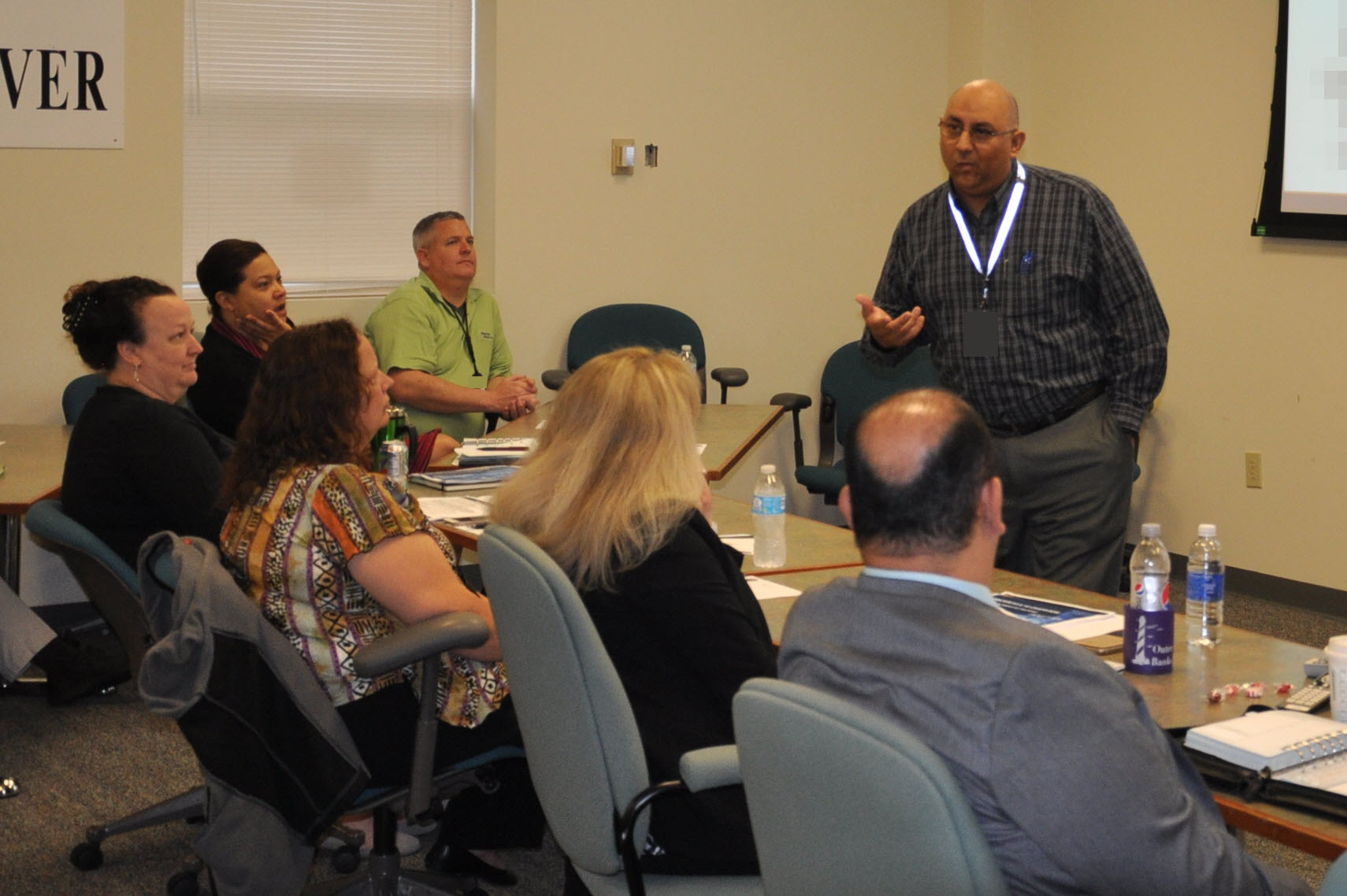
Carlos Carcamo, Commander, Fleet Readiness Centers (COMFRC) N42's Production Performance Improvement Critical Chain Project Management Lead, gestures to make a point during a presentation May 4 about CCPM and Theory of Constraints (TOC) within Commander, Fleet Readiness Centers (COMFRC). COMFRC is implementing CCPM and TOC within its eight Fleet Readiness Centers in order to speed production and return much-needed aircraft and components to the fleet.
COMFRC holds mentoring sessions to discuss CCPM
NAVAL AIR STATION PATUXENT RIVER, Maryland --- Increasing the speed of service to the fleet is a never-ending quest for Commander, Fleet Readiness Centers (COMFRC). This includes exploring and implementing state-of-the-art business practices to improve production efficiency of much-needed aircraft, components and equipment.
To help with the understanding of the concepts and processes of Critical Chain Project Management (CCPM) COMFRC's Carlos Carcamo, N42's Production Performance Improvement CCPM Lead and Senior Chief Petty Officer Nana Boakye, N42's Performance Improvement Military Lead held mentoring sessions on CCPM theory, management techniques and Fleet Readiness Center (FRC) implementation on May 4 and May 11 at Naval Air Station Patuxent River. Also at the May 4 session, John Gatt, COMFRC Optimized Production System Team Lead, provided technical insight and lessons learned regarding CCPM and implementation of Drum-Buffer-Rope (DBR) in Components, Engines and back shops.
"Feedback from the attendees was very positive," said Yvette Bose, COMFRC AIR-6.0 Logistics and Industrial Operations Group lead. "Everyone appreciated how the mentors shared a wide-range of scenarios from Naval Air Systems Command (NAVAIR)/COMFRC, external agencies and commercial entities and made CCPM theory and technical terminology easier to understand."
COMFRC is implementing CCPM and DBR across its eight Fleet Readiness Centers in order to speed production and return much-needed aircraft and components to the fleet. CCPM is a method of planning and managing projects that emphasizes the resources (people, equipment, physical space) required to execute project tasks. DBR details a work schedule for the constraint (Drum), buffering the constraint so that it is never starved (Buffer), and setting a release mechanism to ensure that work gets released into the system at the right time (Rope). This systematic approach protects the weakest link in the production system against process variation and dependency, which maximizes the system's overall effectiveness.
More than 50 logistics, production, quality assurance and financial professionals attended the presentations and actively engaged in questions and answers and sharing of their personal military and civilian experiences with CCPM and DBR.
COMFRC 6.0 is working with the College of Logistics and Industrial Operations (CLIO) to establish these CCPM/DBR sessions as course offerings for Programs and Teams with additional information to be announced on the CLIO and NAVAIR University sites.