
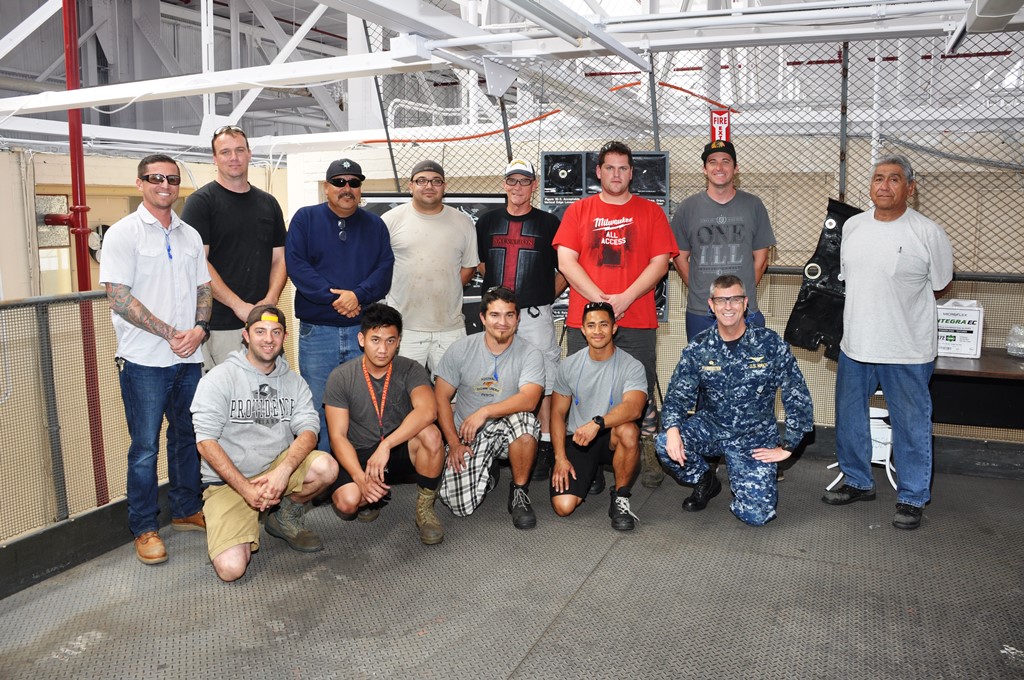
FRCSW Commanding Officer Capt. Timothy Pfannenstein is joined by the artisans of the F/A-18 fuel cell installation shop June 1 in Building 94 after presenting the shop with the FRCSW Golden Wrench Award. The award recognizes outstanding achievements in support of the command's mission.
FRCSW Fuel Cell Shop Fuels Readiness
“We were the number one assembly constraint in the F/A-18 program,” said Fleet Readiness Center Southwest (FRCSW) F/A-18 fuel cell supervisor Shane Hanson. “We were about four aircraft behind.”
Not anymore.
In the past six months, the fuel cell installation shop in Building 94 has resolved one of the major issues hampering its efforts in the Hornet maintenance pipeline: Personnel shortages.
The shop has increased its staff of nine federal artisans to 14, and added two more contractors bringing their total to five.
“We now have some federal guys who were previously contractors, and contractors who were previously Marines who have experience in the trade,” Hanson said.
Recruitment/classification division director Sharon Leeds said that in addition to the “USAJOBS” website and internal hiring, the Veterans Recruitment Act (VRA) is another tool used by FRCSW to hire qualified applicants.
Under the VRA, preference-eligible vets can be hired without the command announcing the positions.
“We also recruit veterans from job and career fairs and presentations at transition assistance program classes,” Leeds said.
Although the fuel cell shop is now fully staffed, FRCSW currently has more than 250 open billets.
Hanson said that the knowledge and drive of the shop’s recently hired artisans was instrumental in bringing the workload current, and “…catching up to stay ahead of the curve.”
“When we were behind the curve, instead of having just fuel mechanics on the aircraft, there were also assembly mechanics using the same self-retracting lifelines for fall protection, and there’s a certain amount of those per aircraft, so that was causing issues,” Hanson said.
Fuel cell personnel must be finished with the aircraft before it continues through assembly. Power runs, check tests and operations are not possible with an artisan working in the cell.
Artisans enter the fuel cell through a 17-by-12 inch hatch where they remove and install the fuel bladder and work among the cell’s components.
“To bring someone up to speed to do a cell at least once --- assemble and disassemble --- is about six months. But it takes more than once to get this down, at least a year to get to the point where you’re comfortable with this process,” Hanson said.
Legacy Hornet fuel bladders were made of thick rubber, while the Super Hornet bladders are made of polyurethane.
“The old style bladders are very durable, very expensive to make. We still get some that come in that were made in 1986, the same as my birth year,” Hanson noted.
“The new bladders are paper thin and can tear more easily. They’re cheaper to make, but easier to fold.”
The shop services all of the Hornet’s five fuel tanks: four main tanks and one vent tank which serves as an overflow. Areas of the left and right hand wings where fuel is held and transferred are also maintained by the shop.
Hanson said that approximately 10 percent of the shop’s workload is resolving fuel leakage issues that are noted during an aircraft’s induction. The remaining workload is done for maintenance purposes or modifications.
“Most of our work is to give access to the metal shop. For example, on the center barrel process we take out all four fuel cells so the center barrel replacement can get done. We have 262 hours to do this. We have to remove the number four fuel cell so the upper longeron, (left or right) can be replaced,” he said.
“Airframe Change (AFC) 494 is a floor modification in the number two and three fuel cells; they were corroding. So for every Preventive Maintenance Interval (PMI) aircraft that comes in, we remove these fuel cells so they can do the corrosion floor change. Now that’s part of our process.”
The largest fuel cell --- number four --- averages 10-15 days for assembly and requires three artisans for the installation procedure. The remaining cells require at least two artisans: One acts as a safety observer to the cell entrant.
Hanson said that it can take up to five days to prep the cell before the bladder is installed. The cells must be outfitted with anti-friction tape that covers all edges and corners to protect the bladder from rubbing against the cell.
When the cell is ready, the bladder is laced to the wall to prevent sagging so it won’t interfere with any components inside of the cavity when operating. The process takes about one day.
“All of the cells also have foam padding in them to prevent the bladder from rubbing on any metal. Depending on what we’re removing for metal access, we may not remove any of the foam padding. That will save about four days of prep work before installing the bladder for assembly,” Hanson noted.
In addition to more artisans, another timesaving initiative in the fuel cell shop is the upgrade to its pressure test systems.
Prior to the installation of components to the fuel cell, the bladder is installed with all fittings capped off, filled with air, and monitored for signs of deflation.
If a leak is detected, artisans usually either repair or replace the o-rings or replace the bladder.
“This saves a lot of manhours because when the aircraft goes to the test line, it’s full of fuel. So if it leaks we have to drain the fuel, which costs money, invest manhours to disassemble everything, pull the bladder to find what the damage is, then put all of it back in,” Hanson said.
“The old pressure tester had failed and the process to repair the equipment was broken. The readings were showing that the bladders were failing, but it was the tester that was failing,” he said.
Hanson attributes a two-year Greenbelt AIRSpeed project to the turnaround of the fuel cell shop.
“The fuel cell shop was the only shop that didn’t have an evaluator and estimator, or production control. We had a lot of manpower shortages and no pressure tester. These were our biggest head-hurters. Overall, it took about a year to start to see the results of our project,” he said.
“But now we have the people who know the work, know what they’re getting into, and aren’t afraid to work hard to meet certain deadlines to get the aircraft to the next step or to the assembly mechanics to move things along.”
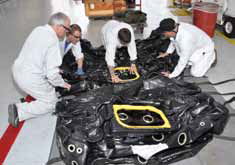
Prior to installation, fuel cell artisans spread the bladder flat to prepare it for installation in the Hornet’s fuselage cavity.