
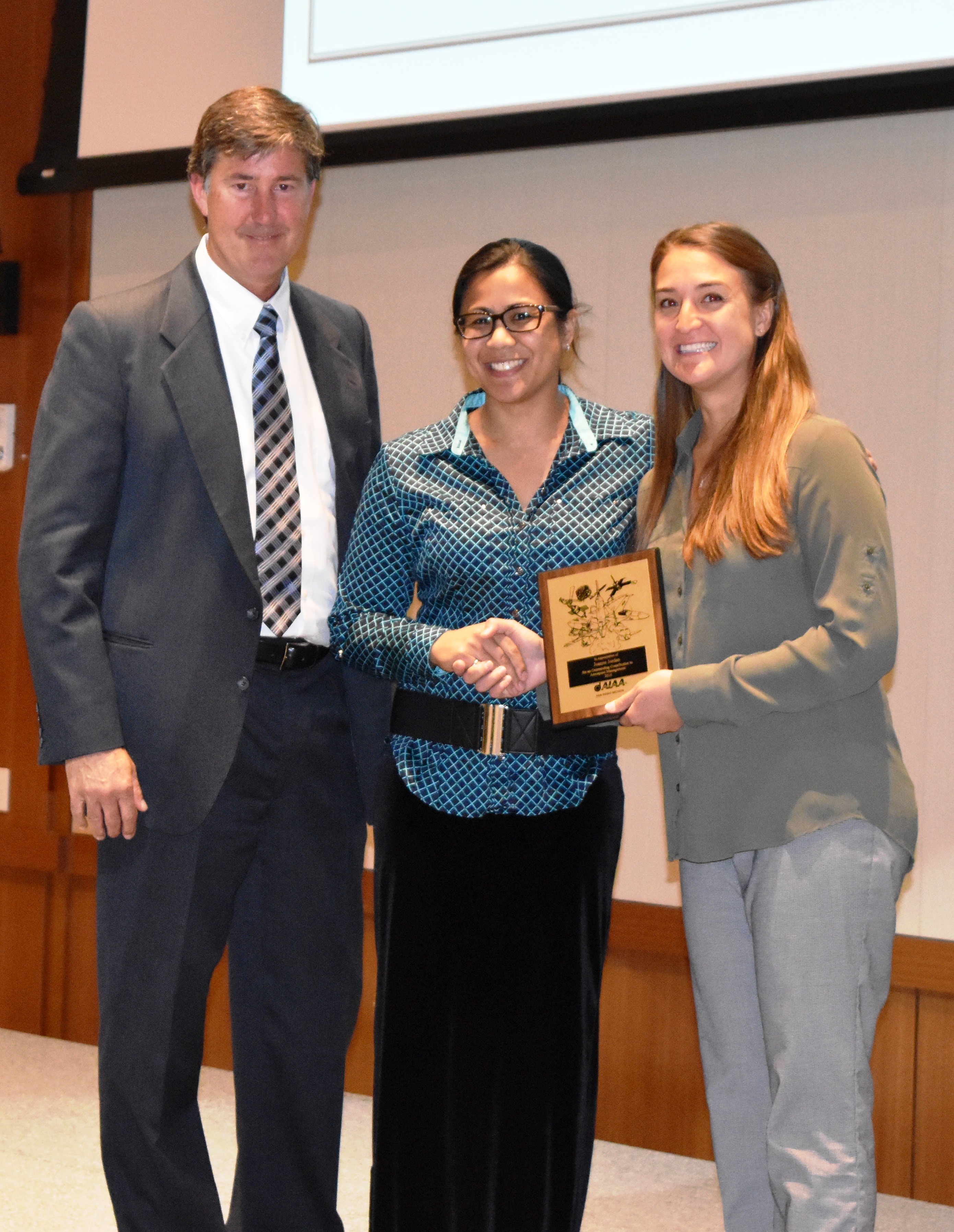
Aerospace engineer and interim stress lead for the F/A-18Hornet A-D program Joanne Jordan (center) is joined by Naval Air Systems Command's (NAVAIR’s) Advanced Aircraft Technologies Integrated Program Manager Chris Root (left) as she receives the American Institute of Aeronautics and Astronautics (AIAA) award for "Outstanding Contribution to Aerospace Management" from AIAA Chair Kathy Kucharski (right). (U.S. Navy photo)
NAVAIR Engineers Recognized by AIAA
NAVAL AIR STATION NORTH ISLAND, Calif. – Two Naval Air Systems Command (NAVAIR) engineers were honored by the American Institute of Aeronautics and Astronautics (AIAA) at the association’s San Diego Section banquet at San Diego State University (SDSC) Apr. 25.
Joshua Rivera, aerospace engineer, F/A-18 Hornet Fleet Support Team, received the AIAA’s “Outstanding Contribution to Aerospace Research” award for his work in conjunction with the University of California San Diego (UCSD) and SDSU to understand, manage and potentially resolve delamination issues within fastener holes of composite skins found on legacy F/A-18 Hornet fighter aircraft.
“We want to get a logistics or structural solution to this problem. We don’t do any structural repairs to these currently,” Rivera said. “The way we mitigate risk is a logistics solution -- that is to inspect more -- and make sure the damage isn’t growing. So, we’re managing the problem now but it still doesn’t answer why or when this happens and when it does, if these [delaminations] grow and if so, how.”
Sponsored by the Office of Naval Research (ONR), much of the multi-year project is being done aboard Fleet Readiness Center Southwest where fabrication, failure analysis and non-destructive inspections are being conducted. Meanwhile, mechanical testing is performed at UCSD and modeling and simulation analysis at SDSU.
Joanne Jordan, aerospace engineer, received the award for “Outstanding Contribution to Aerospace Management.” In her position as the interim stress lead for the F/A-18 Hornet A-D program, Jordan oversees the work of 15 or more stress analysts and contractors, performing 200 stress analyses for ten different Navy repair sites. The team she coordinates ensures the F/A-18 A-D fleet, originally designed to fly 6,000 hours, can potentially fly safely to 10,000 hours in the demanding corrosive environment inherent to naval operations.
In spite of maintaining long work hours, Jordan finds time to participate in the Navy STEM programs and as a mentor for the FIRST Robotics Program at local high schools.