
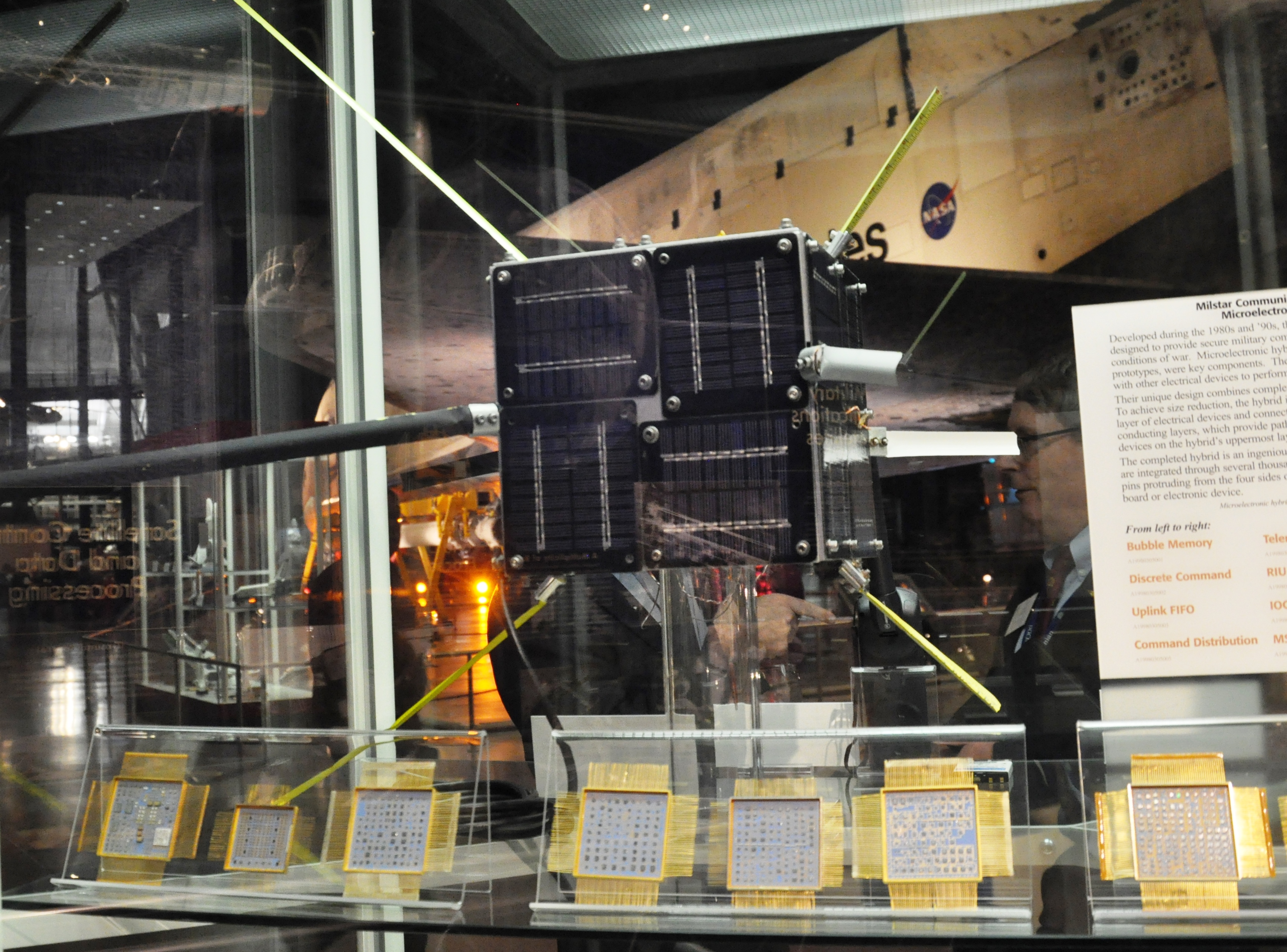
Prototype Communications Satellite (PCSat) designed, built and tested by U.S. Naval Academy astronautics majors from the class of 2000 is on display at the Stephen F. Udvar-Hazy Center a companion facility to the Smithsonian Museum. (U.S. Navy photo)
Capstone project goes to infinity and ... the National Air and Space Museum's annex at Dulles airport
NAVAL AIR SYSTEMS COMMAND, PATUXENT RIVER, Md. – Sixteen years ago, eight U.S. Naval Academy (USNA) midshipmen initiated a capstone project that would serve as a launching pad for the future of the astronautics track, providing up-and-coming seniors hands-on experience to expand the knowledge they gained at the academy.
Lt. Cmdr. Lester “Farva” Melanson, military class desk for the Air-to-Air Missile Program Office (PMA-259), here, was one of those eight college students in the USNA aerospace engineering program’s astronautics track that participated in this pioneering effort.
“The capstone project was typically done on paper only,” Melanson said. “It was intended to show the development and systems engineering that would go into building a space system. At the beginning of our final year, the instructors asked if anyone was willing to put in extra time and actually produce the final product, which we did in the form of a satellite.”
A grant from Boeing Corporation, as well as funding by USNA, financed the project that provided students firsthand experience in satellite design, testing, operations and launch, which was secured through the Department of Defense Space Test Program in cooperation with NASA.
Melanson and seven classmates teamed up to tackle the project labeled PCSat, short for Prototype Communications Satellite, and designated it USNA-1. The mission was a proof-of-concept design to provide mobile and handheld satellite digital communications for amateur satellite operators using Automatic Position Reporting System. Melanson explained in laymen’s term that it was a small solar-powered repeater that you could contact with a ham radio.
From across the room I saw it. I thought ‘Wow! Someone else used measuring tape for antennas on a satellite.’ I walked up to it and as I got closer, I realized it was actually our satellite.
“I was specifically working on the mechanical engineering for the satellite: designing the framework, component placement, center-of-gravity specifications and mechanisms for the antenna,” Melanson said.
He came up with the idea of using a metal measuring tape for the communications antenna. The measuring tape was flexible, yet sturdy, and made from a material that would not degrade over time the way rubber could. The flexibility allowed it to fit neatly into the tube on the day of launch. Once in orbit, the measuring tape unfolded exactly as planned and the satellite was operational.
It was the measuring tape that caught Melanson’s eye seven years later as he was browsing the exhibits at the Steven F. Udvar-Hazy Center in Chantilly, Virginia, a companion facility to the Smithsonian Museum on the National Mall in Washington, D.C.
“From across the room I saw it. I thought ‘Wow! Someone else used measuring tape for antennas on a satellite.’ I walked up to it and as I got closer, I realized it was actually our satellite,” Melanson said.
A typical capstone class at the academy meets three times a week for a single semester during the student’s senior year. The students involved in the proof-of-concept project spent two full classes for two semesters. Participation was on a volunteer basis due to the amount of time involved in producing an operational satellite.
“The one that’s in the Smithsonian is the test model that we actually built,” Melanson said. “The one we launched in 2001 was the second one that was built; the class of 2001 did most of the work on that one after I graduated.”
The thermal/mass model, built by the class of 2000, underwent extensive testing by NASA to ensure survivability and operation in space environment prior to launch. Other than testing, NASA was hands-off in the concept, design and construction of the satellite.
The launch model was sent into orbit at the Kodiak Launch Complex, Kodiak Island, Narrow Cape, Alaska, aboard NASA’s Athena-1 rocket on Sept. 30, 2001. USNA-1 was expected to leave orbit after approximately two years.
“It was actually still operational in 2006,” Melanson says. “You could still contact it with an amateur radio and it was performing exactly as we designed.”
The program was a success, and the academy has launched four more satellites since 2001. The process is a multi-semester effort taking approximately two years from start to finish. It requires graduating seniors over the course of several years to work together through initiation, mission identification, requirements, development, testing and launch of the satellite.
PCSat (USNA-1) is on display in the James S. McDonnell Space Hangar at the Steven F. Udvar-Hazy Center in Chantilly, Virginia.