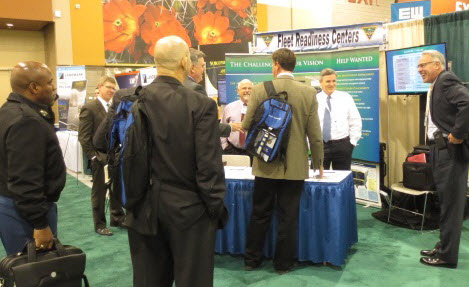
Harris Cooper (left, behind table), director, Requirements and Capabilities at Commander, Fleet Readiness Centers (COMFRC), and Rich Bomhold (right, behind table), technical director, Industrial Operations, Naval Air Systems Command Logistics and Industrial Operations (NAVAIR AIR 6.0), discuss ways industry and other naval agencies can help Fleet Readiness Centers (FRCs) support readiness and modernize at the Defense Maintenance and Logistics Exhibition held in conjunction with the Department of Defense (DoD) Maintenance Symposium in Phoenix, Arizona, in December. (U.S. Navy photo)
Maintenance community strategizes to innovate, collaborate for future
PHOENIX CONVENTION CENTER, PHOENIX, Ariz. -- Demand for naval aviation forces is high – and has been for the past 14 years. Operational demand is considerable and the complexity of the missions is increasing.
For Commander, Fleet Readiness Centers (COMFRC), the challenge is especially great as budgetary pressures continue to challenge the ability to support current readiness while simultaneously preparing the Navy for potential future conflict. Fleet demand has changed as well -- the fleet needs more, faster and for less.
To strategize on the best ways to meet future requirements and readiness, COMFRC representatives attended the 2015 Department of Defense (DoD) Maintenance Symposium held in Phoenix, Arizona, in December.
“Achieving Uncommon Results through Innovation, Collaboration and Leadership,” the theme for the event, brought together participants from the military, government and industry for networking and content sharing to identify critical issues, discuss key topics and increase awareness of DoD maintenance initiatives.
“Our existing sustainment system has increasingly struggled to meet fleet demand for ready basic aircraft (RBA) with Fleet Readiness Center (FRC) facilities that are themselves between 50 and 100 years old and sorely in need of modernization,” said Dennis West, deputy COMFRC. “This symposium allowed us to learn best practices from across the defense maintenance, logistics and material management communities to support our warfighters now and in the future.”
Topics covered at the symposium included depot contributions, the maintenance workforce, aging systems, leveraging information, industry initiatives and maintenance management concepts.