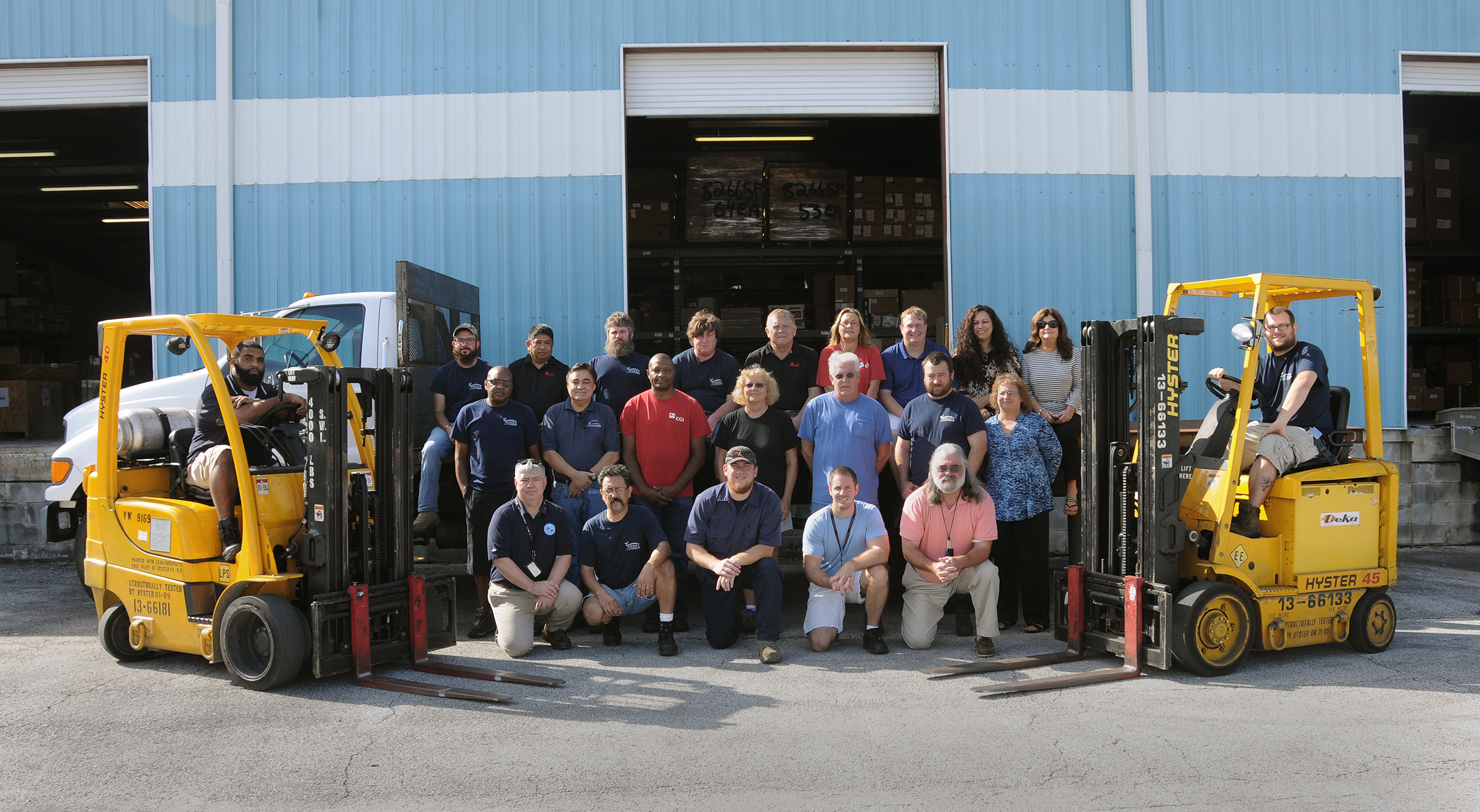
The assembly, inventory, reclamation and security teams outside the Central Kitting Activity work center in Orange Park, Florida. In fiscal year 2015, teams assembled more than 19,000 kits; maintained more than 113,000 kits valued at more than $890 million; shipped an average of 2,000 kits per month; and processed more than 1,200 documents per month.(U.S. Navy photo)
CKA increases financial accountability, transforms business operations with Navy ERP-1.1 Single Supply Solution
NAVAL AIR SYSTEMS COMMAND, ORANGE PARK, Fla. -- Keeping track of more than two million aircraft parts and getting them where they are needed over the course of a year is business-as-usual for the Naval Air Systems Command's (NAVAIR) Central Kitting Activity (CKA) facility in Orange Park, Florida.
Established in 1986, CKA is NAVAIR’s central hub for technical directive (TD) change kits. When engineers develop an improvement or modification for a naval aircraft, every part needed for the upgrade is assembled into a change kit, thus saving time and resources by eliminating the need to stop work to search for or procure a part. CKA is composed of several teams -- assembly, inventory, reclamation and security -- each with their own areas and requirements in the Orange Park facility.
To modernize and standardize operations, especially with increases in storage requirements -- classified storage requirements alone have grown by 272 percent since 2010 -- CKA is moving its databases to the Navy Enterprise Resource Planning (ERP) 1.1 Single Supply Solution, a financial system of record for financial and material management.
“The migration to the ERP database will improve financial transparency and accountability, while reducing the cost of doing business,” said Tom McClay, kit management branch head, Naval Air Warfare Center, Aircraft Division (NAWCAD 6.8.3.2). The Navy’s transition to the ERP system is part of a Congressional mandate for the Department of Defense to achieve full asset accountability and auditability by 2017.
To begin the migration to the Navy ERP system, the team at CKA analyzed the processes for TD modification kits -- including database management, administration and technical support services to maintain the CKA tracking systems -- from kit inventory and assembly to reclamation. The CKA team was assisted by the NAVAIR Audit Readiness Inventory Team (ARIT) and the NAVAIR ERP Business Office (NBO).
“The transition into ERP is ongoing -- inventory and reclamation area information has been moved already -- and eventually all areas will be in the ERP to increase asset visibility, address legacy information technology (IT) compliance issues and enable audit readiness," Clay said. “The CKA team is also leveraging Navy ERP functionality such as Bill of Materials and Material Requirements Planning.”
The CKA is a major component of Modification KIT Management Branch (AIR 6.8.3.2) that provides secure receipt, storage, distribution, assembly and reclamation of the kits. CKA manages more than 100,000 kits for many NAVAIR and Foreign Military Sales (FMS) customers including:
- Program Executive Office, Air Anti-Surface Warfare, Assault and Special Mission Programs (PEO(A)): H-53, V-22, H-1, AH-1, P-3, EP-3, SH-60
- Program Executive Office, Tactical Aircraft Programs (PEO (T)): F-18, E-2, C-2, EA-6B, AV-8, E-6, T-44, T-45, Air Traffic Control and Landing Systems Program, Advanced Tactical A/C Protection Program
- Program Management (AIR 1.0): KC-130, H-46, Aircrew Systems Program, KC-130, Air Combat Electronics Program, Aviation Support Equipment Program
- Propulsion and Power (AIR 4.4)
- FMS: Chile, Finland, Japan, Kuwait, Malaysia, Philippines, Spain and Switzerland
For more information about CKA services, contact Tom McClay at 301-757-8304 or [email protected]. For information about ARIT services, contact Bill Humphrey at 301-757-1227 or [email protected].
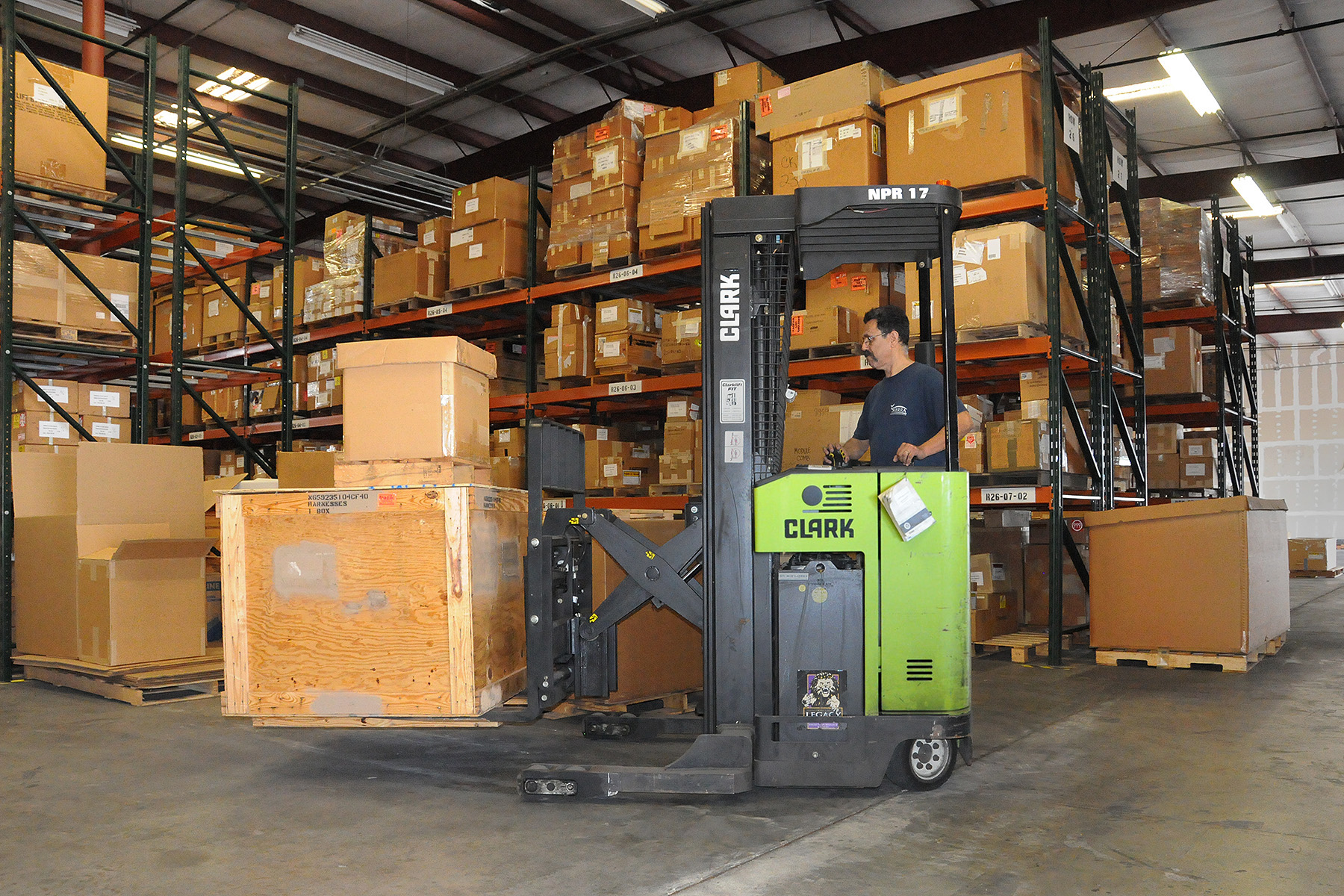
Benjamin Marrufo, warehouse clerk, moves two new technical directive (TD) change kits into place in the CKA facility in Orange Park, Florida, which has more than 160,000 square feet of work and storage space and can handle kits as large as 15-feet wide. (U.S. Navy photo)