
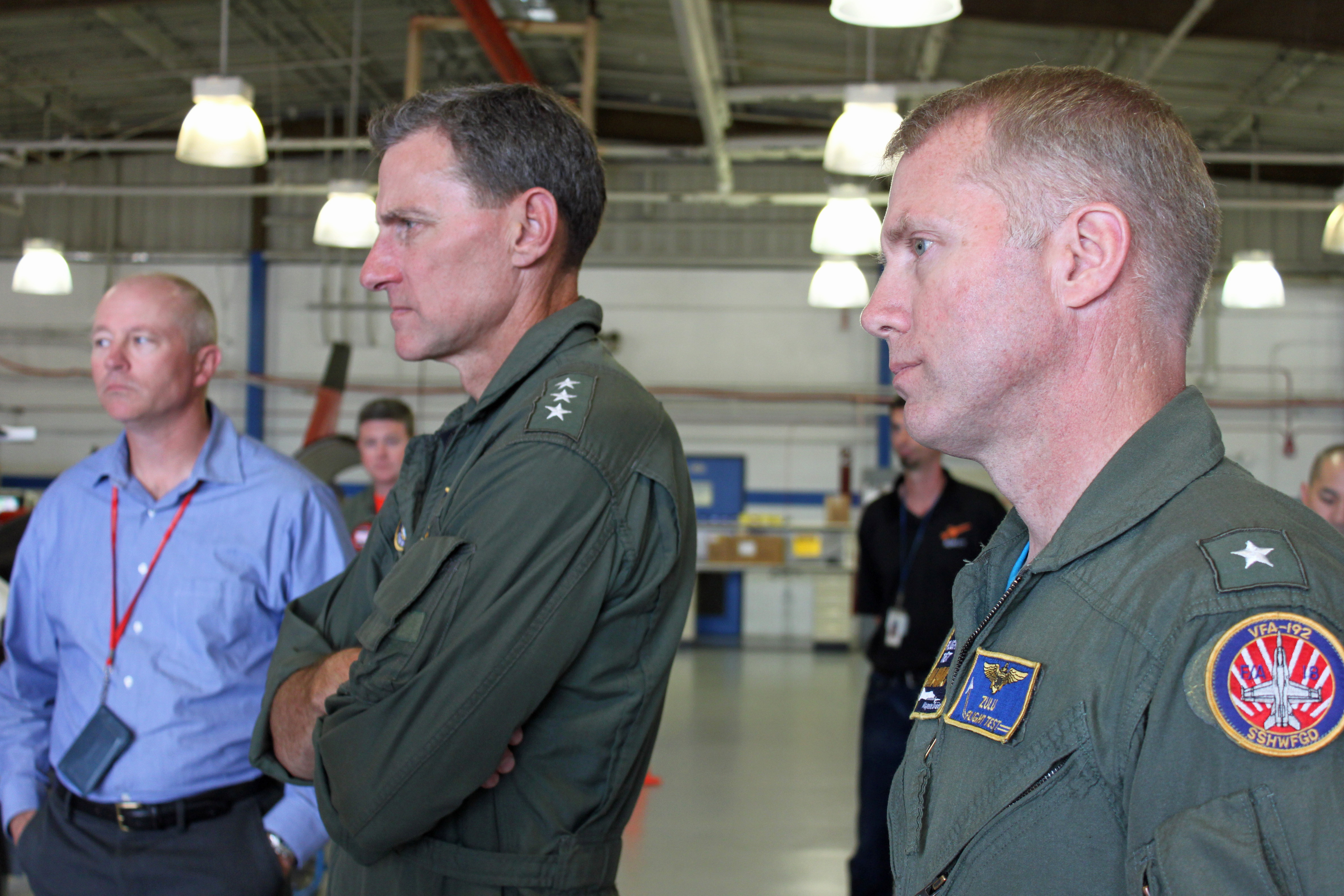
Rear Adm. Brian Corey, prospective Naval Air Warfare Center Weapons Division commander, right, and Vice Adm. Paul Grosklags, commander, Naval Air Systems Command, listen to a brief about NAWCWD’s target and threat simulation capabilities during a tour Oct. 27 in Point Mugu, California. Corey took command of NAWCWD in an Oct. 29 ceremony in China Lake, California. (U.S. Navy photo)
New NAVAIR commander gets 'head-spinning' NAWCWD initiation
NAVAL AIR WARFARE CENTER WEAPONS DIVISION, POINT MUGU, Calif. – The newly installed commander of Naval Air Systems Command, Vice Adm. Paul Grosklags, barely had time to hang his cover in his new office before the weight of responsibility kicked in.
Less than four weeks after his own ceremony, Grosklags was scheduled to preside over another change of command, this time for the Naval Air Warfare Center Weapons Division. It had the added benefit of providing a window for tours and briefs from the team at NAWCWD.
The NAVAIR commander, escorted by the outgoing and incoming NAWCWD commanders Rear Adms. Mike Moran and Brian Corey, spent two days touring NAWCWD facilities at Point Mugu and China Lake. Grosklags heard about the future of electronic warfare; sea and land range capabilities and challenges; unmanned systems and target systems; joint strike fighter projects; and test squadron capabilities, just for starters.
Grosklags kicked off his visit by meeting with NAWCWD’s senior leadership during their monthly Decision Executive Board, getting quick looks at their “big rock” topics and challenges. Leaders gave short summaries of their departments’ goals, capabilities and challenges, prompting questions and praise from the new NAVAIR commander even as time was running short.
“You’ll hear more about all of this during your tours,” Moran said as the meeting wrapped up.
“Good, because right now my head’s spinning,” Grosklags joked.
Grosklags also took time to address what he sees as the way forward for NAVAIR as a whole, highlighting the need to better articulate how manning decisions in support and research, development, test and evaluation affect the Navy operationally.
“We know there’s an impact, we just have to get better speaking the language those decision makers understand,” he said