
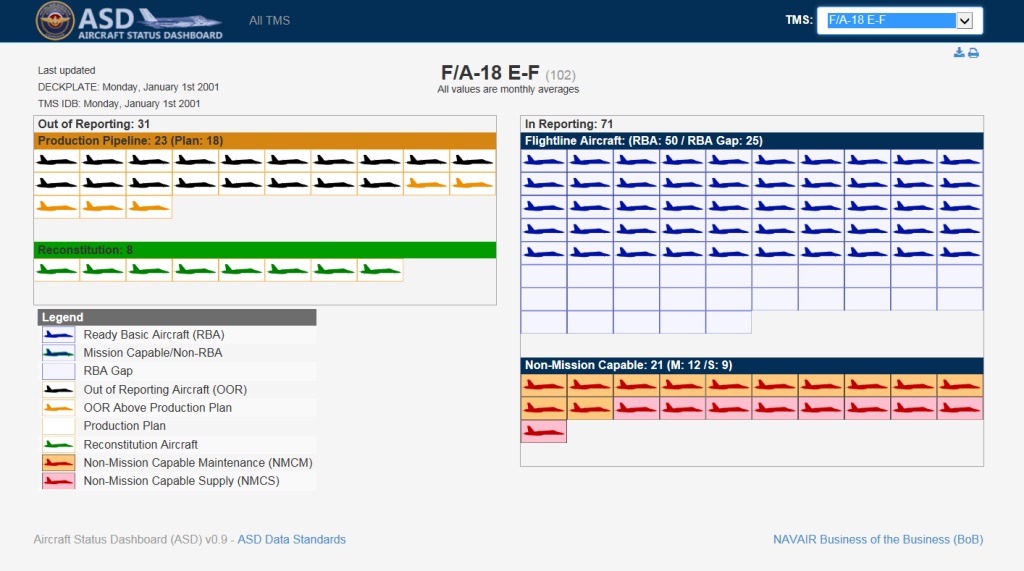
This screenshot is a representation similar to the interactive Aircraft Status Dashboard that displays all deployable aircraft in the Navy’s inventory. (U.S. Navy graphic)
Aircraft Status Dashboard gets high praise from FRC commander
NAVAL AIR WARFARE CENTER WEAPONS DIVISION CHINA LAKE, Calif. - The Business of the Business Enterprise Team is transforming the way aircraft status will be viewed for Navy and Marine Corps air platforms. It started with a need and an idea.
Six months ago, the Fleet Readiness Center was manually gathering monthly data to depict F/A-18 availability and aircraft repair progress. The graphics, and data supporting it, sparked the idea for creating an on-demand view of aircraft status across the naval aviation inventory.
The re-creation and automation of the early PowerPoint charts was assigned to the BoB ET as a proof of concept demonstration. The effort was led by Mike Hill, Lead Business System Integration leader, in partnership with the Aviation Readiness and Resources Analysis Department (AIR-6.8). LBSI is the technical arm of the BoB initiative, launched in 2014 by retired commander Vice Adm. David Dunaway. BoB ET uses data science, automation, aggregation, and analysis, to help the organization increase the speed and effectiveness of decision-making.
“The development team adopted the Agile framework to support the Software Development Lifecycle,” Hill said. “It supports the rolling wave planning, engineering, and development process. This allows early and frequent introduction of new functionality, while maintaining management of configuration and change control. It is compatible with testing and stakeholder validation.”
Using the Agile development process, and frequent interaction with stakeholders to clarify user needs, the LBSI team is creating an interactive resource tracking dashboard of all deployable aircraft in the naval inventory.
Darrell Newman, an Engineer and Scientist Development Program mathematician, designed the graphics. Color codes were used to indicate aircraft status.
“Getting the correct data was the hardest part,” Newman said. “It was kind of like putting socks on a rooster. It may be hard at first, but it can be done.”
Phase 1 is now completed.
“Once the framework for ASD was put together, it went pretty smoothly,” according to Newman. “We’re blazing a trail here.”
After LBSI demonstrated the ASD to command leadership in mid-September, Rear Adm. Paul Sohl, FRC commander and NAVAIR assistant commander for Logistics and Industrial Operations, said, "The dashboard enables NAE leadership to strategically address actions that can be taken across the enterprise to close Ready Basic Aircraft gaps on the flight line. "
LBSI mathematician Christopher Thomas explained the application is available through a CAC-enabled website.
“It’s not something you have to download or install,” Thomas said. “You just need a CAC and the link.”
Thomas emphasized the importance of the software.
"Shifting from a data call paradigm to user serviceable data is a huge step for NAVAIR,” said Thomas, who also works with the Synthetic Guidance team. “The ability to go to your web browser and pull the data you need or view the data in a pre-built dashboard at a moment's notice will be a game changer."
The team is also applying a microservices technique. Microservices describes a software development pattern used to increase the speed and efficiency of developing and managing software solutions. Microservices are language-, platform-, and operating system-agnostic. This approach is being expanded within the NAVAIR construct to support increased data reuse among systems.
The LBSI team worked with IT/IM System Engineer Charlie Solomon to develop the web-based application programming interface (API) to aircraft status data. “I took the virtual Lego-like pieces Mike’s team built, and snapped them together in a server environment that automatically keeps the dashboard fresh using the latest data from multiple sources. I’ve already got ideas about using some of the virtual pieces for other projects.”
LBSI team member Ron Crummett is an electrical engineer whose focus is on data standards and verification.
“I’ve been making sure that the data standard is available on every dashboard page,” said Crummett. “There’s a link at the bottom of each page that goes to the data standard. I also verify the dashboard data matches our data resources.”
Requirements for Phase 2 are now under development with the same accelerated sprint schedule. The dashboard includes a full range of performance indicators including mission capable vs non-mission capable indicators; color-coded aircraft graphics; print options; Data Cards on aircraft series that can be printed independent of the dashboard; Type/Model/Series status per squadron based on aircraft composition; and screenshot capability.
LBSI proved how agile and innovative a group could be to allow the FRCs and NAVAIR to view and understand aircraft availability – while applying the new NAVAIR Metadata Standard and concepts within the NAVAIR Data Strategy.
“It took about six weeks to accomplish,” said Susan Marcellino, LBSI system engineer. “Starting from a methodology perspective (evaluating and demonstrating), to a requirements scoping agreement, and then to initial deployment. We had the data, but we only had a PowerPoint slide containing Excel data for F/A-18. This new dashboard will provide daily aircraft status for all Type/Model/Series aircraft, by BuNo (Bureau Number).”