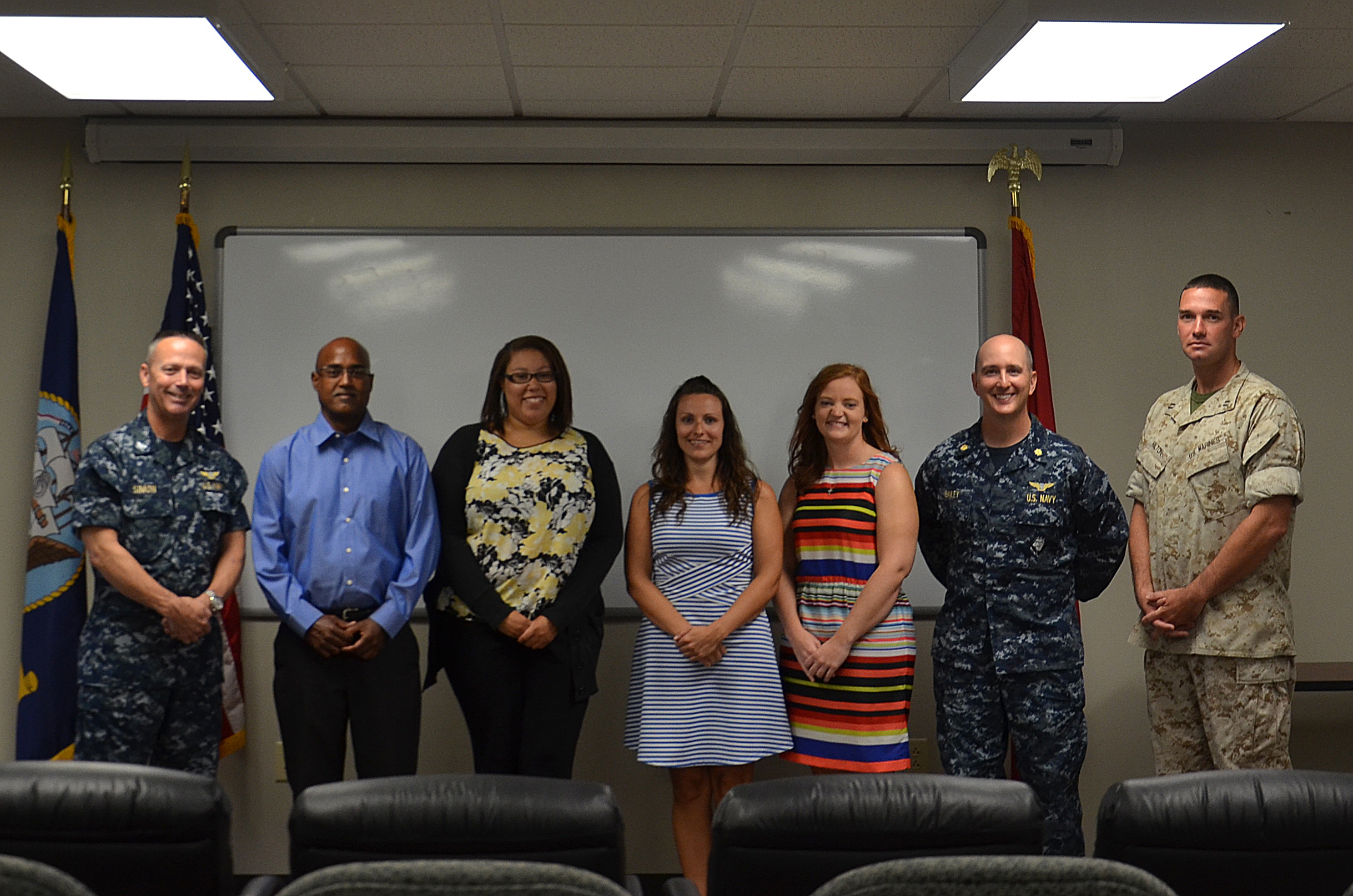
Capt. Eric Simon (left), executive officer for Center for Naval Aviation Technical Training (CNATT) Headquarters Naval Air Station Pensacola, Florida; Lt. Cmdr. James Bailey, aviation maintenance officer (AMO) director at CNATT Detachment Whiting Field, Fla., and Capt. James Halton (far right), USMC, an AMO instructor stand with Russell Lall, Tiffany Smith, Sara Gravatt, Katie Strand -- four interns assigned to the Logistics and Industrial Operations (AIR 6.0) at Naval Air Systems Command (NAVAIR), based at Naval Air Station Patuxent River, Maryland -- following the Naval Aviation Maintenance Program (NAMP) Indoctrination course graduation ceremony Sept. 1. For the first time since 2006, this graduating class includes civilians.
NAVAIR civilians ace Naval Aviation Maintenance Program course
NAVAL AIR STATION WHITING FIELD, Fla. -- For the first time in almost a decade, civilians joined active-duty junior Aviation Maintenance Officers (AMOs) in graduating Sept. 1 from the Naval Aviation Maintenance Program (NAMP) Indoctrination course at the Center for Naval Aviation Technical Training (CNATT) Detachment Whiting Field, Florida.
After a highly competitive application and selection process, four interns assigned to the Logistics and Industrial Operations (AIR 6.0) at Naval Air Systems Command (NAVAIR), based at Naval Air Station Patuxent River, Maryland) -- Katie Strand, Sara Gravatt, Tiffany Smith and Russell Lall – became the first civilians since 2006 to attend the NAMP.
Lt. Cmdr. Kevin Bittle, CNATT Detachment Whiting Field officer in charge, said the way the class was structured allowed interns and AMOs to learn from each other.
“[The interns] bring NAVAIR experience, civilian point of view and subspecialties like engineering, logistics or program management,” Bittle said. “Instructors and other students help them advance their careers by giving them insight into what we do on a daily basis, real life experience and scenarios, as well as instruction into the [reference] which guides most everything we do as maintenance professionals.”
Bittle said the exposure and networking enabled by the integration of interns into the NAMP course is indispensable. Through the unique interactions with the interns, junior AMOs get a better understanding of how NAVAIR functions and how the the civilian employees are eager to better assist them, while the interns gain insight into providing better aid to the AMOs.
The benefits of working with the military students and instructors at CNATT Detachment Whiting Field were emphasized by the interns. Each of their functions contributes a small, yet vital, piece within the extensive NAVAIR organization.
Strand, who works mainly with the budget side at NAVAIR, said her experience in the NAMP allowed her to see what AMOs do, which helped her get a better understanding of how the military operates. Moreover, Strand said having the AMOs in the course meet people who worked at NAVAIR was impactful.
“I think seeing that NAVAIR wants to help them, and that we’re all in this together is a good thing; and it’s not us versus them,” she said.
Gravatt, who works in supportability test and evaluation, said she also saw the benefits to the combined instruction.
“We do behind the scenes type of work, so oftentimes we don't see [the military] side of the house; this is another piece of the puzzle that helps you understand the bigger picture. I appreciate the opportunity to hear their aspects, experiences and sea stories,” she said.
Smith, who deals with the management of hazardous materials, coordinates with the Defense Logistics Agency (DLA), Naval Supply Systems Command (NAVSUP) and other organizations in order to provide the materials that the aviation maintenance officers need. Smith said that participating in the internship program provided an a way for her to see how her department’s input directly translates to the AMOs performing the work.
In addition to gaining a better knowledge of where her job fits into the big picture, Smith said she applied for the NAMP intern program because she felt it was important to meet the people serving in the fleet she supports. The desire to maintain contact with officers and function as an avenue to help the AMOs was a consensus among all of the NAS Pax River interns.
“I always tell them to take my name, take our information. You might need us in the future,” she said.
From learning to navigate the NAMP, to broadening their knowledge of NAVAIR and the COMNAVAIRFORINST 4790 (4790), this program allowed both the interns and young AMOs to create a larger picture of Naval Aviation. Lall, who works in quality assurance, expressed hopes that his involvement in the program will emphasize that both the military and the civilian NAVAIR employees play a very important part in accomplishing the mission; the success of which is primary.
“AMOs really helped open up my vision of how the fleet actually works, so I think it’s just been a wonderful experience, and I'll carry back a lot of knowledge and share it with people at NAVAIR,” he said.
According to the interns, the eight-week course was challenging and fast-paced. Each day, the students extensively studied the intricacies of the 4790. With eight to nine hours of classroom work coupled with at home preparation, the students graduated with a wide ranging breadth of knowledge into the NAMP. Although they felt the course was tough, the four civilians enjoyed the interaction with the instructors and the chance to learn a different perspective.
“They livened up the class and made it relate to real life and their personal experiences, which helped a lot,” emphasized Gravatt.
This experience has also allowed the military students to better understand and appreciate what the civilians bring to executing the NAE mission. According to Lt. Cmdr. James Bailey, and instructor and AMO Director at CNATT Detachment Whiting Field, the most valuable thing the students take away is just because you do not wear a uniform does not make your contribution to the Naval Aviation Enterprise or readiness any less important.
“Whether it’s NAVAIR, DLA or NAVICP, there are a lot of people that you may not work with or even meet who are trying to help you attain some readiness, especially when you are deployed. It really is a team effort, and we just serve in different capacities. Whether we wear uniforms and deploy or work in cubicles doing cost benefit analysis, whatever it is, those jobs are meaningful,” Bailey said.