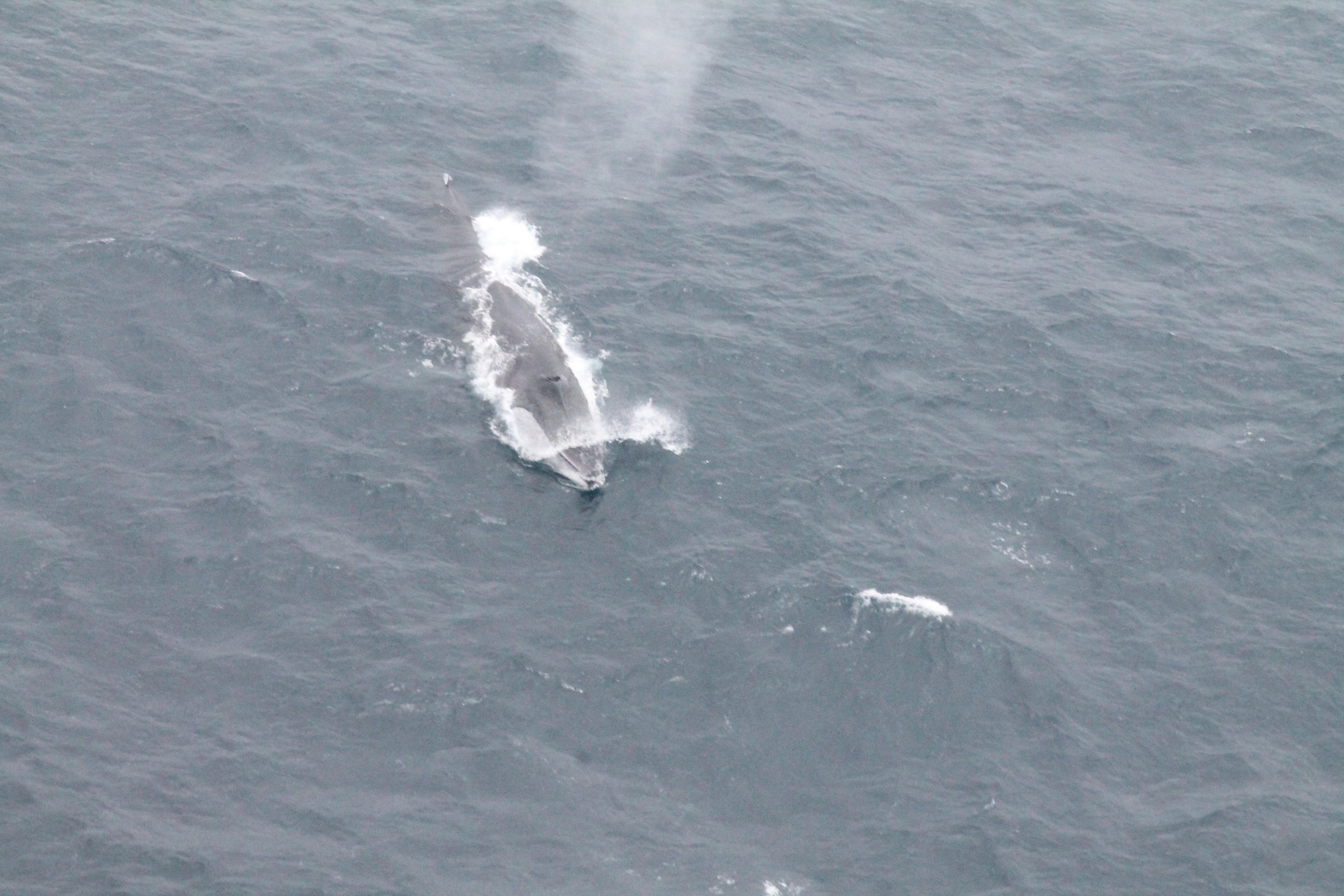
A fin whale surfaces in the Point Mugu Sea Range in June 2015. U.S. Navy aircraft routinely clear active portions of the range for testing, but when tests require the use of live ordnance, an extra layer of safety checks is added to protect the marine mammals that may be traveling through the area. Scientists fly low over the range looking for tell-tale signs of whales and dolphins in target areas. If one is spotted, the test is modified or delayed to ensure the animal’s safety. (U.S. Navy photo)
Weapons testing and environmental responsibility meet at NAWCWD
NAVAL AIR WARFARE CENTER WEAPONS DIVISION, POINT MUGU, Calif. - “Thar she blows” sounds more like something Ahab might shout than anything you’d expect to hear working for one of the U.S. Navy’s warfare centers.
Unless you’re working on Naval Air Warfare Center Weapons Division’s Sea Range at Point Mugu.
The Sea Range, 36,000 square miles of controlled sea and air space, allows NAWCWD to host tests and exercises for a variety of weapons systems and test platforms from all branches of the U.S. military. It also encompasses several of the California Channel Islands and a major shipping lane.
Ensuring the active sections of the Sea Range are clear of ships is a standard safety practice during any exercise, as commercial and recreational vessels often transit through the range. In addition to warning mariners of closures, U.S. Navy aircraft monitor and clear active sea space and airspace sectors prior to any launch activity.
However, in addition to encompassing commercial and recreational travel routes, the Sea Range is also part of migratory routes and important feeding areas for several species of whales and other marine mammals.
That’s where John Ugoretz, NAWCWD’s resident marine biologist, comes in handy.
“Whenever a test or exercise calls for a live warhead to be used,” Ugoretz said, “we conduct a marine-mammal clearance of the target area prior to giving the event a green light.”
In those instances, Ugoretz and other NAWCWD scientists hop in planes and helicopters with binoculars and cameras, flying low and looking for the tell-tale signs of whales or dolphins in the target areas. If they spot one, the test is on hold.
“Sometimes, whales will linger near a target,” Ugoretz said, “and sometimes they’re just swimming through.”
Until they’re clear, however, the test cannot commence.
“We can usually work with the test conductors and make sure the mission succeeds,” Ugoretz said. “It is very rare for a whale to remain in a target area and cause the operation to be halted.”
Some may think that taking care to avoid whales would conflict with Navy priorities, but Ugoretz sees his job in a different light. By ensuring test activities do not harm whales, many of which are endangered or threatened species, the Navy can continue using the valuable Sea Range with relative ease.
“My job is to make sure the Navy can and does meet its mission requirements, even in an environmentally sensitive setting,” Ugoretz said. “It’s about finding the balance between ensuring mission success and doing what’s right for the environment.”