
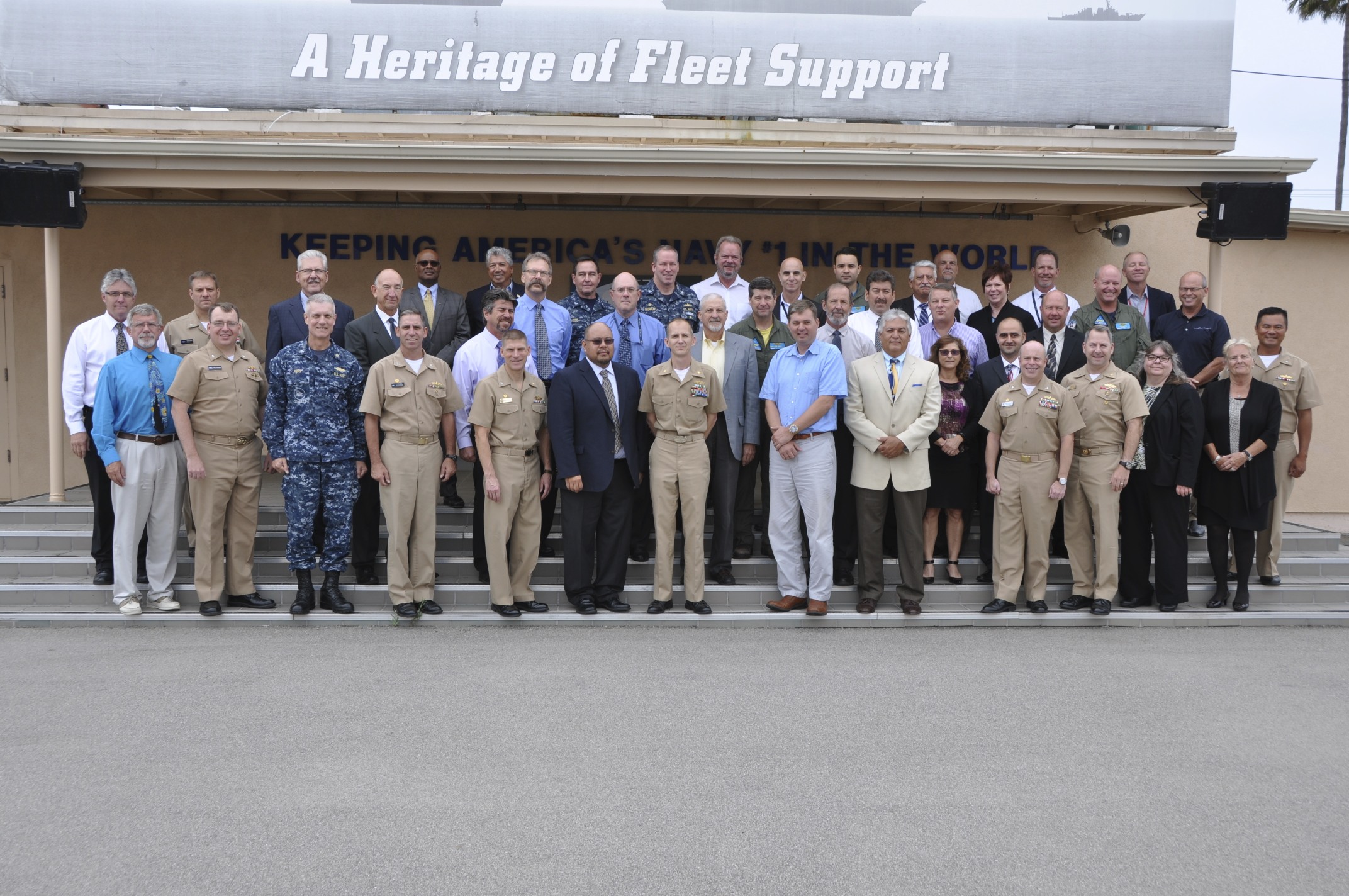
Naval Air Warfare Center Weapons Division Commander Rear Adm. Mike Moran, Vice Commander Capt. Karl Andina, Executive Director Scott O’Neil, and several other command leaders participated in the first Southern California Warfare Center Summit held July 23 at Naval Surface Warfare Center Port Hueneme Division. About 50 representatives from five warfare centers in Southern California attended the event designed to identify potential collaboration opportunities. (U.S. Navy Photo)
SoCal warfare center leaders discuss opportunities for collaboration
Leadership teams from Southern California warfare centers and Navy labs met July 23 at Naval Surface Warfare Center Port Hueneme Division (NSWC PHD) to discuss opportunities for collaboration and mutual support that result in advancing warfighter capabilities.
This was the first collaboration summit for these commands and the meeting allowed each to share overviews about the uniqueness of their respective organization. Represented at that meeting were NSWC PHD, NSWC Corona, Naval Air Warfare Center Weapons Division, Naval Facilities Engineering Command and Space and Naval Warfare System Center Pacific.
“The primary focus was to improve alignment across our commands in support of Secretary Stackley’s guidance, and identify opportunities for collaboration that would benefit the Fleet,” said Rear Adm. Mike Moran, NAWCWD commander. “Clearly, each warfare center has superb technical talent individually but we are convinced that we can be even more impactful for the warfighter as a collective whole.”
The group determined 18 potential areas for collaboration: test and evaluation assets (facilities, equipment, SMEs), workforce initiatives/development, tech transfer, industry outreach, academia outreach, technology and innovation collaboration, autonomous inspection systems, cyber (offensive/defensive), big data analytics and security, electromagnetic maneuver warfare, unmanned systems, machine perception and intelligence, power and energy efficiency, directed energy, renewable energy, environmental stewardship, logistics, and process improvement.
From this extended list, the commands identified five areas that offered the most immediate opportunity for more effective collaboration. Those areas were cyber, tech and innovation, tech workforce and development, test and evaluation assets, and technology transfer.
Those attending then broke into smaller groups to determine short term/quick win opportunities and longer term/investment opportunities. Input from those five teams will be shared with the larger group for consideration and discussion at a future summit meeting.
“The reality is that our technical capabilities are at risk and we need to collectively take action now,” said NAWCWD Executive Director Scott O’Neil. “Luckily, our senior Navy leaders are starting to realize that the Navy labs do have the technical in-house skill set, and are asking for our help in getting the warfare centers back to the forefront of research, development, experimentation and prototyping.”