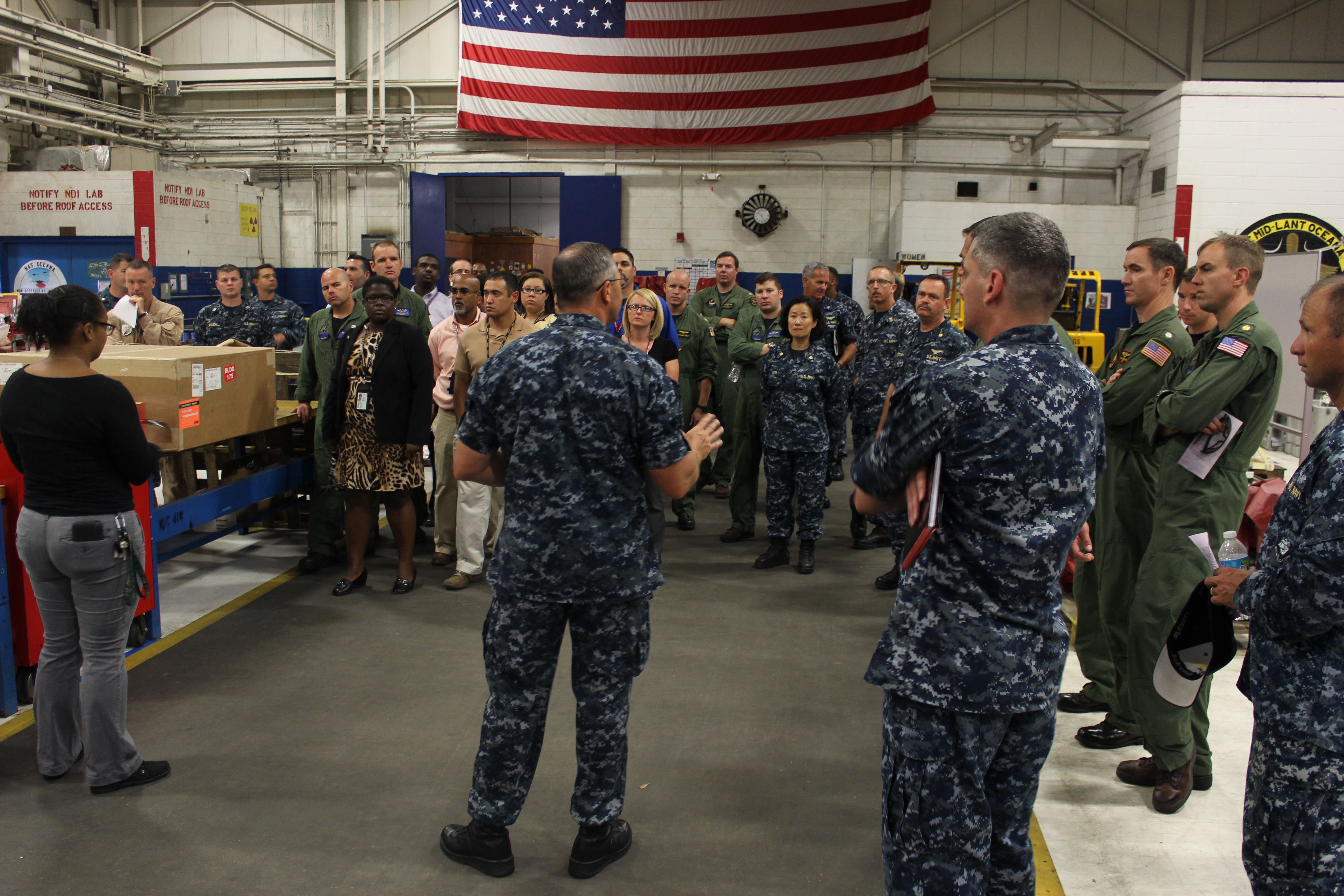
Master Chief Aircraft Maintenanceman Ronald Taylor, from the Power Plants Division at Fleet Readiness Center Mid-Atlantic Oceana, Va., explains the maintenance and repair process of jet engines to Fleet Readiness Center Day attendees, June 2. Leaders from the F/A-18 community at Naval Air Station (NAS) Oceana and NAVAIR’s Naval Acquisition Development Program (NADP) employees went to FRC Day to gain a better understanding of the work taking place at the facility. (U.S. Navy photo)
Fleet Readiness Center Day gives NAVAIR employees new insight
FLEET READINESS CENTER MID-ATLANTIC, OCEANA, Va.— Leaders from the F/A-18 community at Naval Air Station (NAS) Oceana, Virginia, along with Naval Acquisition Development Program (NADP) employees, got a chance to see how important they are to Fleet Readiness Center Mid-Atlantic (FRCMA), during the center’s FRC Day, June 2.
The event, hosted by FRCMA and its commanding officer, Capt. Joseph Rodriguez, gave attendees the opportunity to get a clear understanding of the maintenance actions taking place at the center and to hear how they can better support the timely repair of aircraft for the fleet.
The NADP employees, all of whom support Naval Air System Command’s (NAVAIR) Logistics and Industrial Operations (AIR 6.0), were able to see NAVAIR’s assets — such as components, engines and airframe composites — as they undergo their respective depot maintenance. The event was also an opportunity to discuss challenges and maintenance trends the command needs to be aware of.
“While working in logistics, we hear about maintenance and sustainment from an overarching perspective,” said Joshua Butler, an NADP member and computer scientist at NAS Patuxent River, Maryland. “Being at the FRCMA facility allowed us to envision the topics and activities from a firsthand perspective, making our work experience more valuable and rewarding.”
Participants toured the facilities to see where the work happens and to get insight into the importance of each individual’s role. Many were enlightened on details and functionalities they didn’t know existed prior to the tour.
“We were able to see the repair capabilities available at FRCMA so that we know where a specific capability lies and can utilize that information in the future,” said Tiffany Smith, an NADP member and chemical engineer for NAVAIR. “The most interesting part was going to the ordnance part of the facility and seeing that weapons were getting repaired. I hadn’t realized that that was even possible.”
The F/A-18 leaders in attendance were able to see how FRCMA provides maintenance to their aircraft and gear, and gave them insight into some of the procedures. For instance, aircraft or gear in need of repair that is marked Beyond Capability of Maintenance (BCM), requires it to be sent to FRCMA because it is either too expensive to repair on-site, or there are parts that cannot be ordered. Learning this helped attendees understand why some items take more time to repair than others.
“My intent was to become more familiar with the intermediate support,” said Lt. Cmdr. Jae Smith, Maintenance Material Control Officer (MMCO) at Fighter Squadron Composite (VFC) 12. “Being stationed prior at an FRC, I recognized a lot of the processes. However, using Beyond Capable Maintenance was brand new to me,” he concluded.
In all, participants valued the opportunity to see the people that they support.
“Creating a partnership is necessary,” said Lt. Col. Greg Hoffman, commanding officer of Marine Aviation Training Support Group (MTSG) 33. “The key is becoming familiar with the processes and procedures that are handled by each individual and getting to know the faces behind the scenes,” said Lt. Col. Greg Hoffman, commanding officer of Marine Aviation Training Support Group (MTSG) 33.