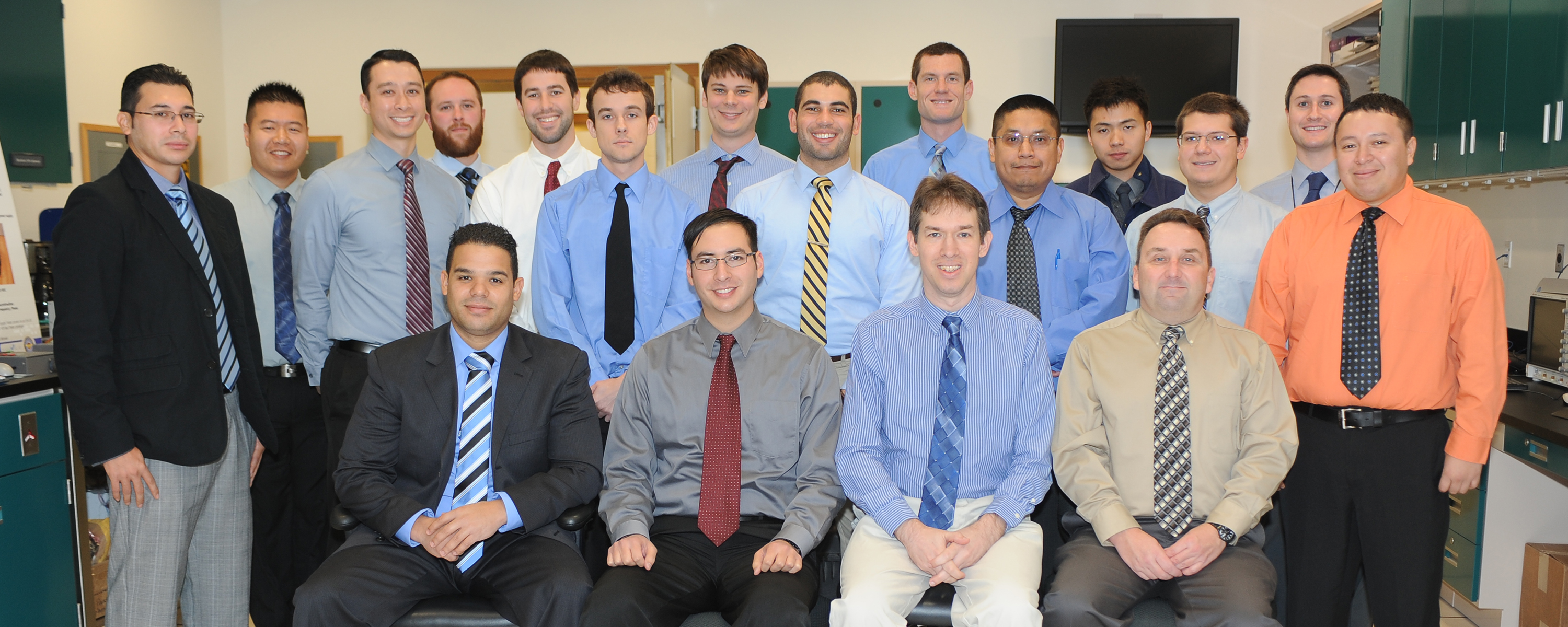
The Integrated Diagnostics and Automated Test Systems (IDATS) Laboratory team poses for a photo op moments before opening the doors to the third annual IDATS Open House on Nov. 14, 2014 at NAVAIR Lakehurst.
IDATS Laboratory celebrates five-year anniversary
JOINT BASE MCGUIRE-DIX-LAKEHURST, N.J. — This past April, the Integrated Diagnostics and Automated Test Systems (IDATS) Laboratory at NAVAIR’s Lakehurst site celebrated its five-year anniversary. Despite the lab’s successes and growth in developing complex technologies in the past five years since its ribbon cutting, its mission remains simple. “Improve avionics diagnostics in the fleet,” said Dr. Russell Shannon, IDATS Lead Systems Engineer, of IDATS’ present mission.
“At first, we were like a startup company, focused on survival,” said Shannon. “Now, we are transitioning to a long-term sustainment strategy.”
The lab first opened its doors on Apr. 20, 2010. However, efforts to build the lab and rudimentary projects commenced several years prior. Shannon said that IDATS resulted from a former NAVAIR division head's vision to create a space where avionics diagnostics issues could be resolved. Shannon explained that many of the programs were experiencing a lot of the same issues that built-in test (commonly known as BIT) alone couldn’t resolve.
In 2003, a $4M Capital Investment Program (CIP) proposal was submitted to NAVAIR’s Investment Working Group for the standing up of an advanced diagnostics capability. The proposal was the largest dollar amount of its time to be funded under the CIP program, explained Shannon. More importantly, it laid the groundwork to begin construction of the IDATS Lab.
The CIP funding “brought in everything except the projects,” said Shannon. “It was up to us to bring in the work.”
While the lab space was under construction, the team hit the ground running and began work on projects including net-centric diagnostic efforts, wireless diagnostic efforts and efforts to create what is today a transitioned technology known as the Smart Connector.
Fast forward to 2015, IDATS researchers have kept busy rolling out the latest advancements in avionics diagnostics products — many of which have received patents and are being evaluated for commercial usage. The team has grown significantly and the lab now supports 10 separate projects supporting a variety of program offices.
The aforementioned Smart Connector Organizational Level (O-Level) Tester and the net-centric MX-12345/USM Diagnostics Avionics Tester (DAT) are two of the lab’s more famous products. http://www.navair.navy.mil/index.cfm?fuseaction=home.NAVAIRNewsStory&id=5496
In addition to these two heavy-hitters, the lab also unveiled some of its newer advancements back in November during its third annual IDATS Lab Open House, which hosted approximately 75 attendees throughout the day. The patent-pending Pinless Connector, as its name implies, removes pins from the design with the goal of negating the need for fleet maintenance as a result of bent, corroded or broken pins.
Another new technology was showcased during the Open House. The Wireless Flight Line Test Equipment prototype seeks to remove the amount of cabling required for testing boxes by providing a wireless connection to Support Equipment (SE). Another advantage of this technology is the potential for reduced maintenance time.
The Open House also exhibited IDATS’ influence beyond the research world. The lab was tasked by the MV-22 Program Office (PMA 275) to create a new O-level tester for the swashplate actuator interface of the MV-22 Flight Control Computer. The project represents “one of the first major investments by a PMA in terms of having IDATS develop O-level Automated Test Equipment (ATE),” explained Shannon. “It’s a good example of why you need advocates in the organization,” he added.
“That’s part of why we do Open Houses — to give our folks insights into what we do,” said Mark Weber, an IDATS leadership team member and electronics engineer for avionics SE.
As for the team’s key to success, Shannon and Weber both credit the “people.”
“The people are key,” said Weber, who added that the challenge is to maintain a pipeline of new talent.
“We are lucky that the branches [within NAVAIR] have given us really excellent people,” said Shannon. “Without the team of high performers, we couldn’t have done anything.”
Shannon also credits much of the lab’s success to support and belief in the IDATS mission from upper management, Program Offices as well as advocates within the Office of the Secretary of Defense.
When asked how the lab’s mission and vision has changed since its opening five years ago, Weber said, “The real effort is transitioning products to the fleet.”
“Everything has moved up the technology readiness levels,” said Shannon. “The next five years are all about transition.”
However, the lab’s focus is not meant in any way to imply that future Open Houses will go stale. Weber said that the IDATS team is also “looking at the next generation of technology” to replace research that is productized and transitioning, and is constantly working “to stay on the edge.”
To learn more about IDATS, visit the IDATS Laboratory home page:http://www.navair.navy.mil/nawcad/lakehurst/capabilities.cfm?ContentID=IDATSLab&NavlID=Capabilities&NavgID=Standard&NavgID2=Capabilities
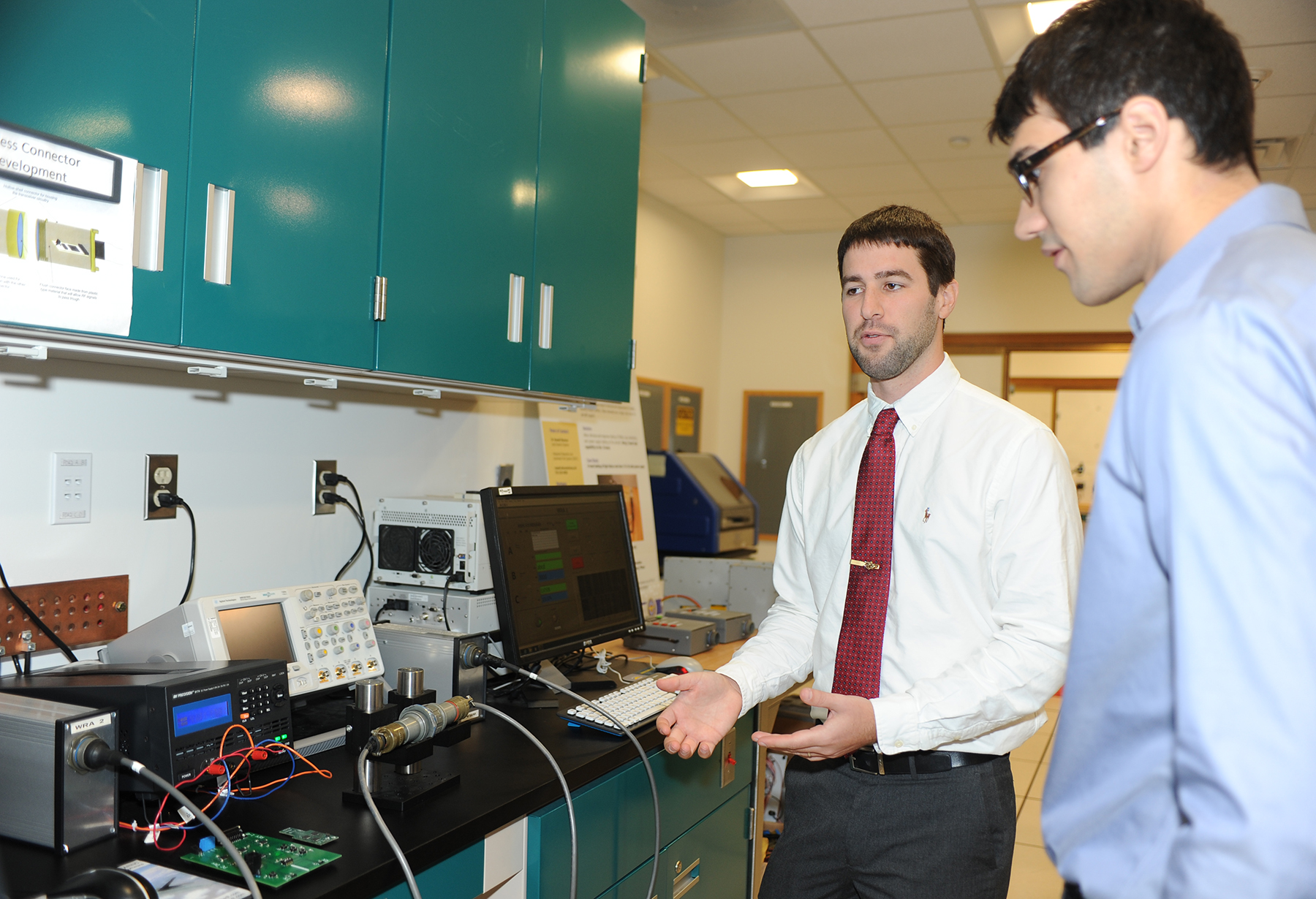
Glenn Shevach, an IDATS principal investigator, presents the Pinless Connector to an attendee at the third annual IDATS Lab Open House on Nov. 14, 2014.