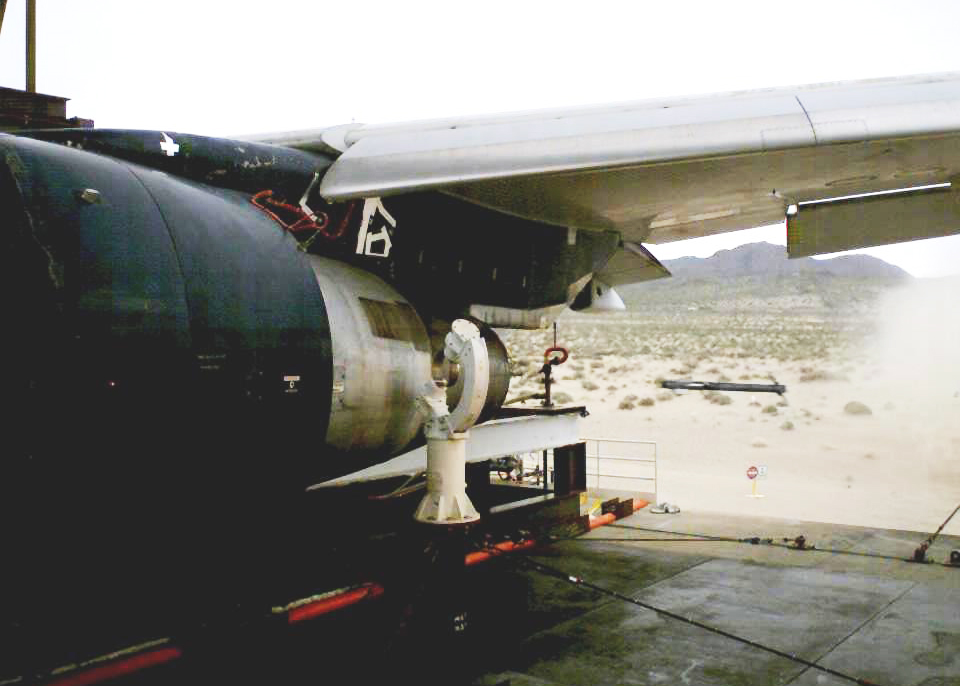
At 100,000 frames per second, this high-speed still captures the Live Fire Test and Evaluation (LFT&E) missile en route to the KC-46 tanker at the Naval Air Warfare Center Weapons Division’s Weapons Survivability Laboratory on April 7. The LFT&E missile is the first of its kind. The KC-46 program office requested the warhead be custom-designed by the Weapons Division to evaluate the highest threat scenario possible. (U.S. Navy photo)
NAWCWD completes most complex weapons survivability tests to date
NAVAL AIR WARFARE CENTER WEAPONS DIVISION CHINA LAKE, Calif. - NAWCWD successfully supported the KC-46 tanker with the most detailed, advanced weapons survivability test series ever conducted at the Weapons Survivability Lab (WSL), China Lake, California on April 7.
The KC-46, a refueling aircraft, is a derivative of the commercially-available, Federal Aviation Administration certified Boeing 767-2C.
“Excellent tests,” said KC-46 lead engineer Scott Wacker, weapons survivability expert. “These have never been done before, so I’m happy to say that we met all our objectives. I believe that we are advancing the state of the art in understanding vulnerability in aircraft.”
The tests, outlined by the KC-46 Live Fire Test and Evaluation Program (LFT&E), will be used to assess KC-46, system-level survivability in high-fidelity, operational environments against ballistic and advanced threats. The results provided a wide range of data instrumental in mitigating worst-case scenarios for the aircraft, which directly improves and preserves warfighting capability.
“There were over 330 channels collecting raw data, 10 high speed cameras recording 10,000 to 100,000 frames per second and 30 real time video feeds,” said Eric Brickson, KC-46 LFT&E engineer. “We had a very extensive list of requirements and NAWCWD met them all.”
Representatives from NAWCWD, Boeing, the U.S. Air Force and the Institute for Defense Analysis were among several of the organizations and stakeholders present to witness the event at the WSL.
“It was a very successful test,” said Col. Chris Coombs, Air Force. “We designed these tests against the aircraft to see how it would perform, so we’d know if the people, whether they are pilots, operators or passengers, could survive on this plane under the most relevant of circumstances.”
According to the KC-46 Program Office, plans call for the procurement of 179 KC-46s to replace one third of the existing aerial refueling fleet.
The WSL consists of six separate test sites, including an engineering and test coordination lab, multiple shops (including machine, sheet metal, jet engine, assembly, coatings and welding) and test article preparation area. The WSL provides engineering, test planning and execution, instrumentation, data acquisition and controls, along with video and communication networking capabilities.
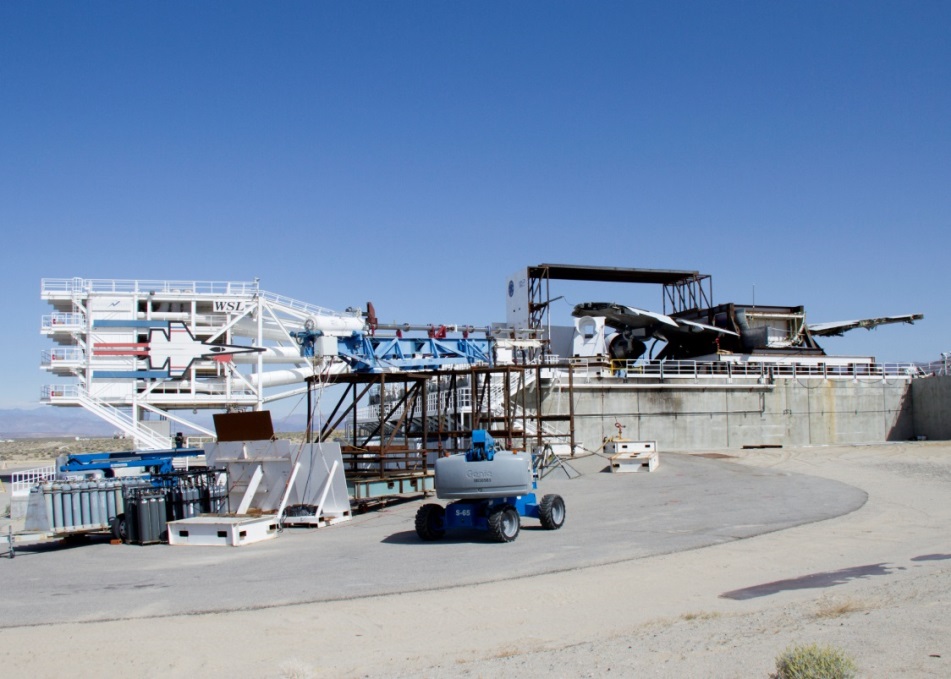
This image displays an overview of the KC-46 test at the Weapons Survivability Lab, China Lake, California. On the left, the large, white High-Velocity Airflow System fired its nine jet engines to simulate realistic flying conditions for the mock KC-46 refueling tanker, seen on the far right. The cannon, pictured in the center, fired a live warhead into a critical position, the aircraft’s left pylon. (U.S. Navy photo)
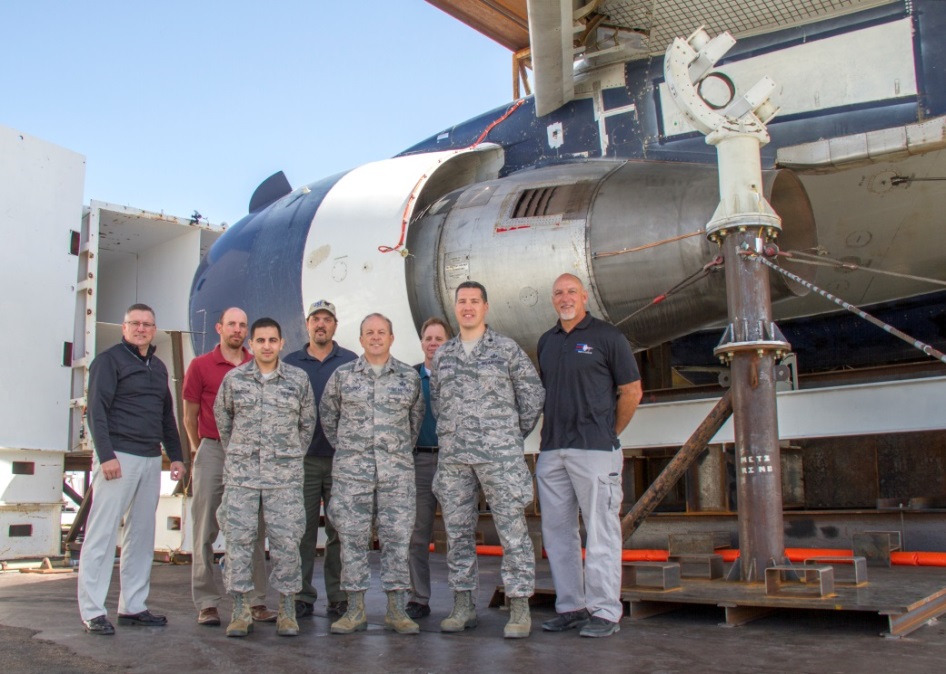
U.S. Air Force’s Col. Chris Coombs of the KC-46 Program Office, center, convenes with other program officials April 7 to inspect the test article in preparation for the weapons survivability test at Naval Air Warfare Center Weapons Division’s Weapons Survivability Laboratory, China Lake, California. Behind them, a live warhead detonated inside the KC-46’s left pylon after passing through the metal ring, which triggered the warhead’s detonator. From left to right are: Jeff Wuich, KC-46 Program Office, Scott Wacker, KC-46 Program Office, 1st Lt. Kerollos Marzouk, KC-46 Program Office, Ron Schiller, head, WSL Engineering Section, Coombs, Bill Franklin, KC-46 Program Office, Lt. Col. Pete Sandness, KC-46 Program Office and Jay Kovar, branch head, WSL. (U.S. Navy photo)