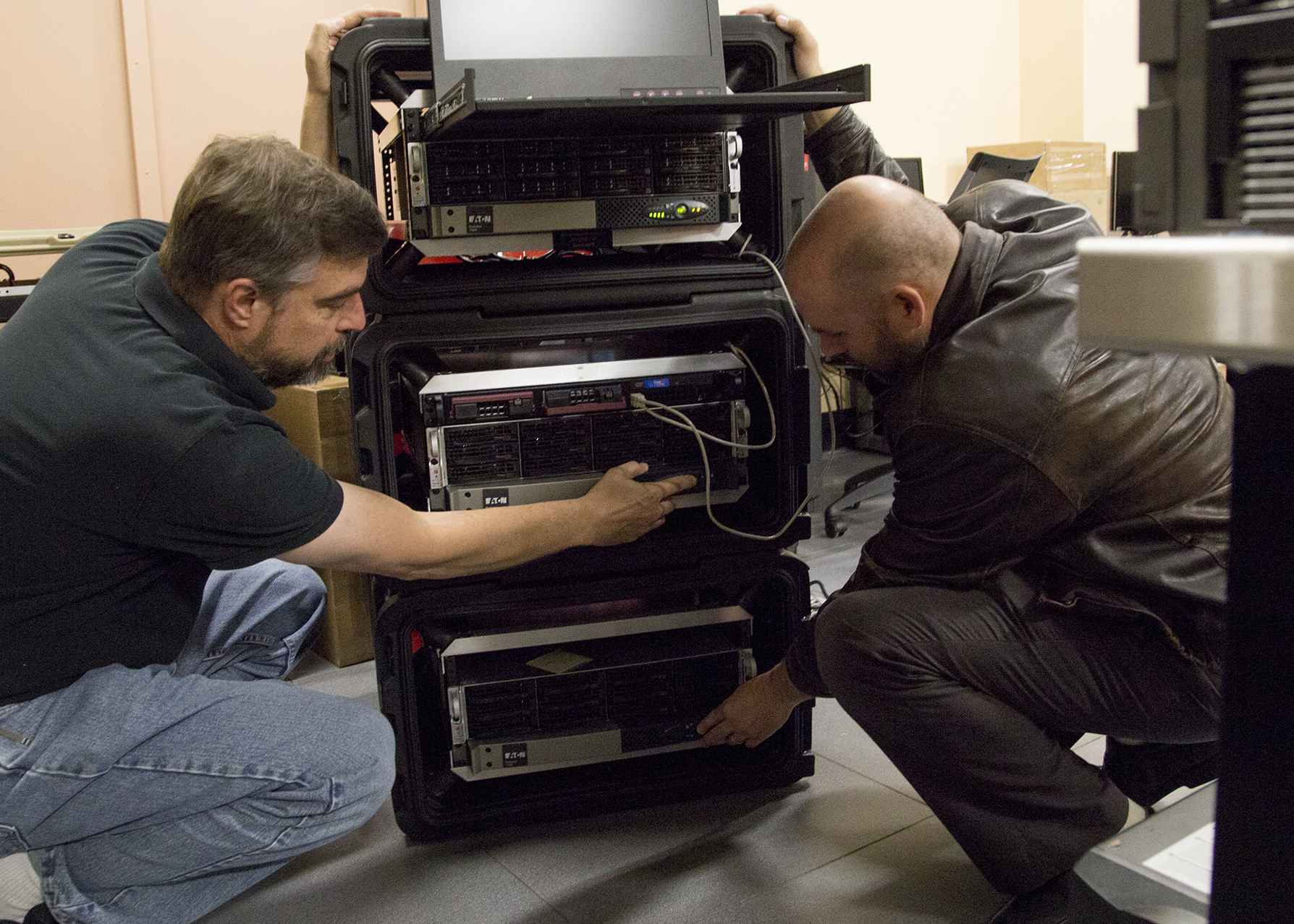
Electronics technician, Erik van Bronkhorst, left, and mathematician Spencer Hall run power diagnostics on a Portable Geospatial Product Library (PGPL) April 15 at China Lake, California. In a turnaround period of two months, the two conceived, designed, procured and constructed the first PGPL prototype as a cost-effective solution for targeteers aboard U.S. Navy aircraft carriers. (U.S. Navy photo)
NAWCWD systems become permanent fixtures aboard U.S. Navy carriers
NAVAL AIR WARFARE CENTER WEAPONS DIVISION CHINA LAKE, Calif. - Naval Sea Systems Command approved a ship change document earlier in the year that will enable Naval Air Warfare Center Weapons Division (NAWCWD) to permanently place their internally developed storage systems aboard all U.S. Navy aircraft carriers.
Developed by NAWCWD’s Spencer Hall and Erik van Bronkhorst, the systems, known as Portable Geospatial Product Library (PGPL), provide geospatial intelligence for a carrier’s aircrew.
“It’s a much improved way of getting the same data that they were getting before,” van Bronkhorst said. “An online data bank versus a room full of DVDs? That’s archaic by today’s standards. Mission planners utilizing PGPL are able to accomplish their jobs more quickly, and more efficiently.”
Each PGPL holds 75 terabytes of reference data specified by the air wing’s targeteer. The data is used by mission planning staff to target threats in the arena of conventional warfare.
Previously, embarkable PGPL systems were loaded and unloaded onto each carrier before and after deployment. Having tested the waters, PGPL’s addition was described in the ship change document as “mission capability is greatly enhanced.”
“NAWCWD was asked to address an issue concerning an antiquated system,” said Capt. Stephen Roberts, former Naval Strike and Air Warfare Center staff intelligence officer. “And after a brief trial period, I’m happy to say that their advancements have become the new standard.”
USS Ronald Reagan will be the second of 10 carriers under the ship change document to be fitted with a PGPL mounting and connection fixture in summer 2015, followed by a permanent installment in fall 2015 aboard USS Harry Truman.
“This system fills a critical gap in the air wing's mission planning and targeting capability,” said Barry O’Neal, NAWCWD program lead. “They save untold hours of valuable time and provide the only viable solution that is currently available. I’m glad to see the document making PGPL ‘official’ as an installed component aboard all carriers.”
A PGPL was also requested and permanently installed at Commander, U.S. Third Fleet, San Diego, California. NAWCWD has been supplying PGPLs to ships and bases since 2010 when the first system rolled aboard USS Carl Vinson.