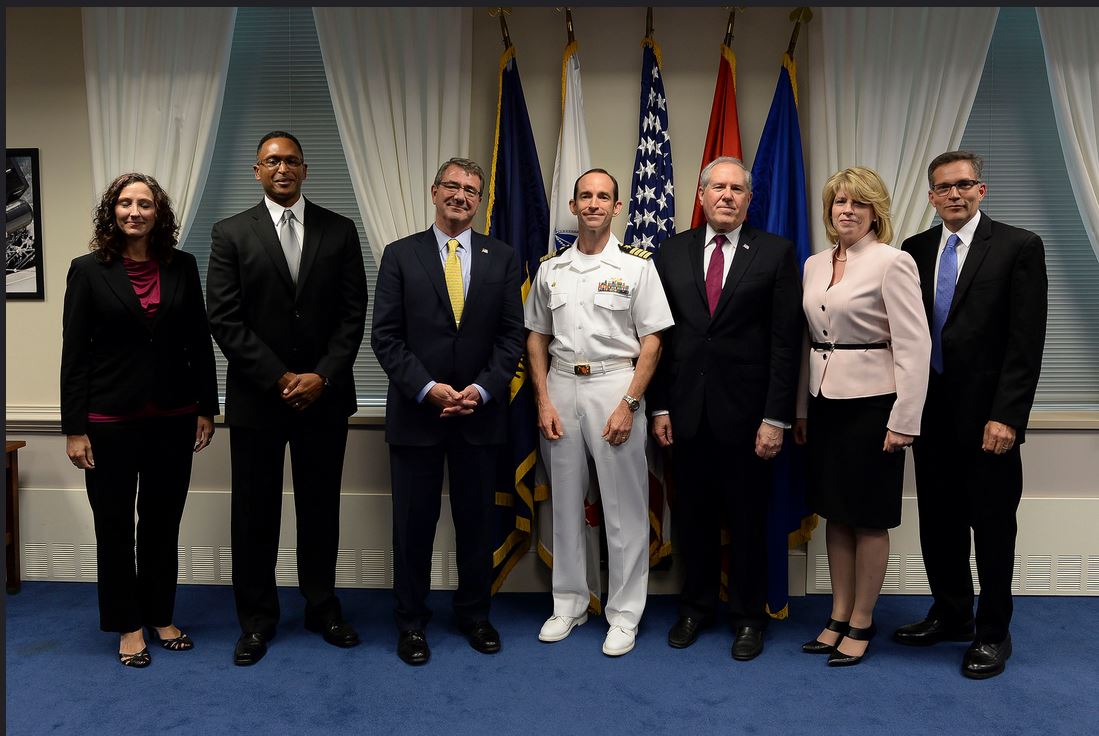
Members of the Maritime Patrol and Reconnaissance Aircraft program office (PMA-290)receive the 2014 David Packard Excellence in Acquisition and Should Cost and Innovation Award from Secretary of Defense Ash Carter (third from left) May 21 at a ceremony in D.C. PMA-290’s efforts led to $5.2 billion in cost savings across the full-scope of P-8A Poseidon development, production and sustainment phases. (U.S. Navy photo)
P-8A team patrols budget, saves billions
NAVAL AIR SYSTEMS COMMAND, PATUXENT RIVER, Md. – Secretary of Defense Ash Carter presented the 2014 David Packard Excellence in Acquisition and Should Cost and Innovation Award to the Maritime Patrol and Reconnaissance Aircraft program office (PMA-290) May 21 at a ceremony held in D.C.
PMA-290’s efforts saved $5.2 billion in 2014 across the P-8A Poseidon system development and demonstration, production and industrial support and sustainment phases.
“Should cost,” is a Better Buying Power (BBP) initiative to incentivize productivity and reduce cost. It challenges DoD leadership to reevaluate a program’s cost estimate to represent efficient economics within the constraints of a declining budget.
“Our team continually challenges the norm, asking ‘can we do better?’” said Capt. Scott Dillon, PMA-290 program manager. “From production efficiency to full lifecycle management, we have been thinking outside of the box to deliver warfighting capability to the fleet in a timely and cost-effective manner.”
P-8A is the first Navy aircraft to be built from the start on a commercial production line, which allows the program to significantly reduce time and overall cost.
Each P-8A Poseidon aircraft begins on a Boeing 737 production line, leveraging efficient commercial practices to significantly reduce time and overall cost. Boeing Commercial Airplanes integrates P-8 unique systems, such as hydraulics, wiring and aircraft structures, early in the production process – eliminating the need for costly rework during final mission systems installation by Boeing Defense Systems.
In addition to this innovative use of commercial production processes, the program office generated significant cost savings by breaking out select weapons systems from the overall aircraft acquisition contract. In this way, PMA-290 avoided significant pass-through fees for contractor furnished equipment.
“We worked with our resource sponsor and industry counterparts to develop practices that show we have a long-term view in mind,” Dillon explained. “We maintain productivity and efficiency while constantly evaluating how to best function in this environment of budget uncertainty.”
PMA-290 took a look at the Operations and Support phase budget and found additional savings in sustainment of aircraft deployed across the globe.
“There is no one-size-fits-all approach for an aircraft of this complexity,” Dillon said. “We tailor each element of the maintenance strategy to leverage the best organization for each job, whether that is the commercial expertise for the 737 airframe and engine depot maintenance or the organic, in-house talent for P-8A missions systems.”
Since the first operational deployment in 2013, the P-8A has flown nearly 34,000 hours in over 6,000 sorties. The “should cost” effort has saved the program billions of dollars and will continue to do so for years to come, he added.
For more information on BBP Should Cost, visit http://bbp.dau.mil/ or http://www.dau.mil/pubscats/ATL%20Docs/Sep-Oct11/Carter_Mueller.pdf.