
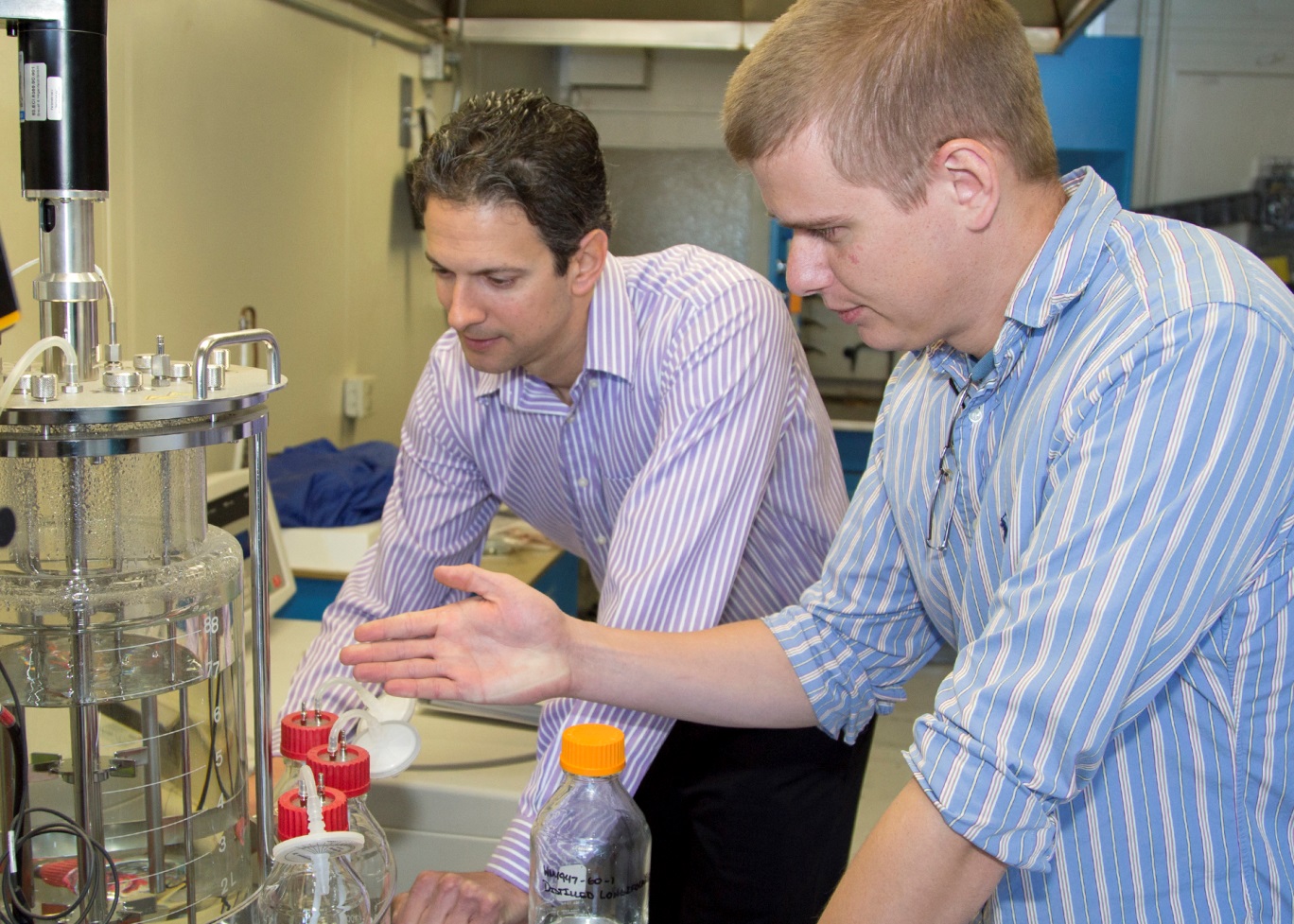
Dr. Ben Harvey, left, and Walter Merriman discuss process parameters for the production of biosynthetic fuels April 17 at Naval Air Warfare Center Weapons Division. A bioreactor like the one pictured on the far left is used to provide a friendly environment for engineered microorganisms (e.g., yeast/bacteria) to generate high-performance biofuel precursors from renewable sugars. (U.S. Navy Photo)
Biofuel breakthrough earns NAWCWD chemists national recognition
Chemist Dr. Benjamin G. Harvey and colleagues Walter W. Merriman and Thomas A Koontz received national acclaim in March for publishing an article citing their creation of a renewable, high-performance biofuel at Naval Air Warfare Center Weapons Division (NAWCWD).
Their paper, unambiguously entitled, “High Density Renewable Diesel Fuels Prepared from Multicyclic Sesquiterpenes and a 1-Hexene Derived Synthetic Paraffinic Kerosene,” was named an ACS (American Chemical Society) Editors’ Choice article on March 12 after its publication in the ACS journal Energy and Fuels.
Chemical and Engineering News, the world’s most read chemical news magazine, also highlighted the article in their print and online magazines that reach more than 161,000 ACS members.
“I was thrilled to have our work recognized both by the ACS and Chemical and Engineering News,” said Harvey. The ACS publishes around 40,000 papers a year and less than 1 percent of those papers get selected for this honor, so I’m both pleased and humbled by the acknowledgement. I think it reflects well on my colleagues and the quality of work being conducted here at China Lake.”
Harvey explained that the new fuel is generated by combining two types of molecules.
High density cyclic molecules called sesquiterpenes can be derived from clove oil or produced from waste biomass using yeast or E-coli as miniature biorefineries. The sesquiterpenes are then transformed using a NAWCWD proprietary process and combined with jet fuel surrogate molecules that can be synthesized from bioethanol.
The combination of these two types of molecules resulted in a fuel that has both high density and the combustion properties required for diesel engines.
Adoption of these fuels would increase the range and loiter time of weapon platforms, including unmanned aerial vehicles (UAVs) that are turning away from conventional gasoline-based engines to diesel.
“Diesel engines can be up to 50 percent efficient, while gasoline engines are typically 25 to 30 percent efficient,” said Harvey. “When you couple that with the higher volumetric energy density of our fuels, the range and flight time of a UAV can be dramatically improved.”
The fuels are currently being produced on the liter scale to support small-scale testing, and NAWCWD is working with commercial partners to further develop this technology.
“The study laid the ground work for a new class of bio-based, designer fuels,” said Merriman. “There have been tremendous strides in gasoline alternatives over the last few decades. But here, the Navy has demonstrated high density fuels with “tunable properties” relevant to weapon systems and other specialized applications.”
Merriman, a recent NAWCWD hire, spent six months working in the Chemistry Division in 2014. Koontz is a former summer student and Naval Research Enterprise Internship Program fellow.
Harvey also collaborates with the San Diego-based company Allylix through a cooperative research and development agreement (CRADA), signed by NAWCWD Commander Mike Moran last year. The CRADA is supported by a grant from the Advanced Research Projects Agency – Energy, a congressionally-funded organization modeled after the Defense Advanced Research Projects Agency within the U.S. Department of Energy.
The Chemistry Branch at the Weapons Division has been conducting research on renewable jet fuels and high density turbine fuels since 2007. This effort has led to a broad portfolio of patents, many of which are currently being licensed.