
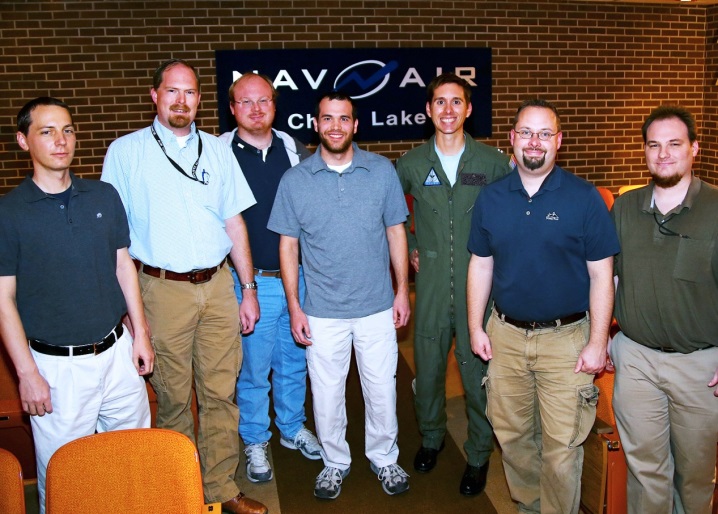
Lt. Jay McVann meets with several students enrolled in the Tactical Engineer Development Program (TEDP) after his TOPGUN lecture “Threat Pilot and Tactics” at Naval Air Warfare Center Weapons Division, China Lake, California on April 17. TEDP announced its first 11 nominees to enter into Cohort 1 on April 15: (not all pictured) Christian Blake, Alyse Dannenberg, Travis Gilbert, Mark Hall, Elizabeth Miliano, Robert Powelson, James Roeder, Chris Scheuber, Vince Schuetz, Steven Smith and Matthew Starr. (U.S. Navy photo)
TOPGUN presentation at NAWCWD raises expectations for TEDP program
Sponsored by the Tactical Engineer Development Program (TEDP), Lt. Jay McVann, TOPGUN instructor, delivered an in-depth presentation called “Threat Pilot and Tactics” at China Lake, California April 17 that set the bar for applicants recently accepted into the new development program.
The lecture served as a precursor for the 11 students in TEDP’s Cohort 1 and was available to select Weapons Division personnel maintaining proper qualifications.
“Absolutely amazing, eye-opening,” said Stephen Smith, TEDP student and computer scientist. “I’m very excited for our upcoming program. I think it will be very beneficial to me, and I’m ready to see what comes next.”
More than 90 Naval Air Warfare Center Weapons Division (NAWCWD) personnel attended the TOPGUN intelligence officer’s open-discussion briefing for an insider’s look into air-to-air and maritime strike training and the tactics used by threat nations of interest.
“Fantastic opportunity – lot of really great questions and crowd participation,” said Lt. McVann. “These events really help to bridge the gap between engineers and our operators. When an engineer can see and understand the threat better, they understand the context under which they’re working.”
Division Head Richard Kirchner relayed the same sentiment when he discussed conceptualizing TEDP for the promising, journey level engineers and scientists at the Weapons Division interested in broadening their level of situational awareness.
“Back when WD was heavy into fleet level experimentation,” said Kirchner. “Several of my colleagues and I developed through osmosis a great deal of engineering-level expertise in naval operations, which eventually lead to some of us enrolling in a five-day seminar on air wing, carrier strike group and joint force tactics, planning and hardware at Fallon.”
“I absolutely wish that we had an institutionalized class like TEDP around back then,” Kirchner added. “Operational context is key to making your ideas relevant. It keeps them from being dismissed early because you were unaware of some important aspect.”
The course’s syllabus encompasses an intensive 25 days of material covering operations in modern air warfare. Selected candidates are slated to attend presentations from active-duty Navy and Air Force instructors, interactive sessions with night vision devices and flight simulators and multimedia courses orated by faculty from the Naval Postgraduate School and NAWCWD experts.
TEDP program lead and former naval flight officer Ian Anderson lobbied with WD leadership and his active contacts within the fleet to secure funding for TEDP and attach lecturers like McVann to its future classes.
“NAWCWD's workforce is an integral part of naval aviation,” said Anderson. “'As much so as the aviators and mechanics that work on the aircraft. It is important that our professional scientists and engineers gain exposure to the realities of the operational environment, so that the strengths of their products can be applied against the weaknesses of our adversaries, who exist in an ever-changing tactical paradigm.”
TEDP Cohort 1’s syllabus is comprised of 25 work days, spanning from May to September 2015. Eligible candidates were nominated by their division heads or TPO/IPT leads via submission of a complete application. Cohort 2 will begin accepting applications in January 2016.