
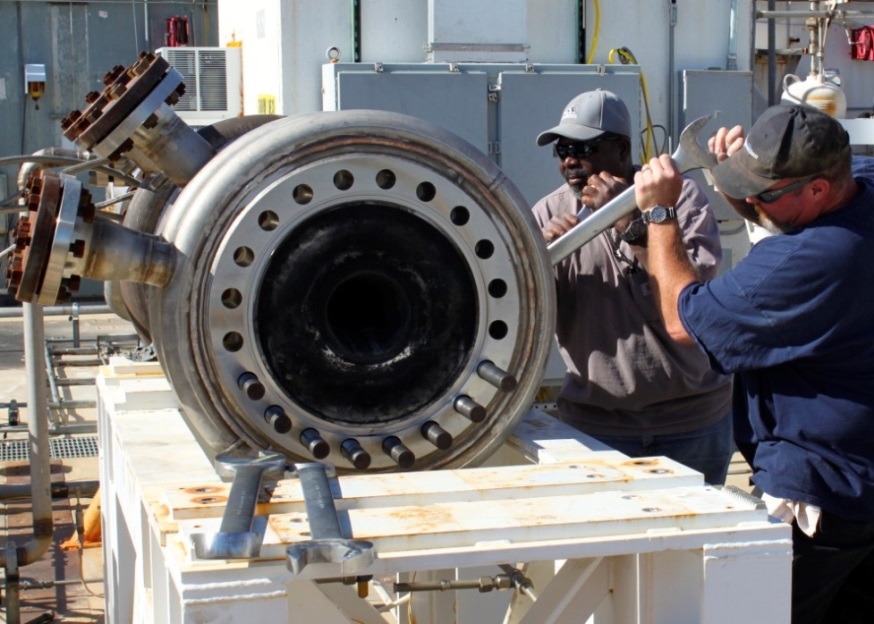
Engineering technicians Eugene Woods, left, and Chad Carrasco tighten bolts on a high-temperature burner at the T-Range in China Lake, California Feb. 25. These burners are capable of replicating Mach 4 conditions at sea level and help test missile subcomponents, solid fuel ramjet engines, liquid rocket engines and full-scale tactical missile rocket to air-breathing engine transition testing. (U.S. Navy photo)
NAWCWD counts down to fully operational T-Range
T-Range lead engineer Ty Walsh announced early March that the Naval Air Warfare Center Weapons Division (NAWCWD) T-Range will be fully operational within the next five months. The T-Range, or thermal dynamics test facility, is in the process of completing upgrades to its air and water systems.
“This year we have been focused on upgrading the facility, hiring staff and going through lots of training to operate the facility in a safe manner,” said Walsh. “We’re just a few months away from digging into the fun stuff.”
Located in China Lake’s propulsion test area, the T-Range is a high-pressure, hot-gas blow down to atmosphere facility that can replicate Mach 4 sea level flight conditions.
T-Range is used to conduct research into air-breathing engines, rocket motor subcomponents and liquid rocket engines and can support full-scale tactical missile rocket to air-breathing engine transition testing where large-sized ejecta might be required.
“The range is very close to supporting a variety of different programs,” added Walsh. “We have a set of internal projects that we are going to use to build up our expertise, maintain the facility and attract new customers beginning in 2016.”
Some of the upcoming internal and external projects for T-Range include:
- Radome testing for the Block II Evolved Sea Sparrow missile in FY16.
- Working towards approval from Office of Naval Research to conduct joint testing with Naval Postgraduate School to investigate rotary detonation engines using tactically representative hydrocarbon fuels.
- Finalizing an agreement between the NAWCWD Weapons and Energetics Department and Harvey Mudd College that will enable senior design workshop students to create a water-cooled Mach 3 supersonic nozzle for a T-Range burner.
- Supporting the expected Coalition Warfare Partnership (CWP) program between the United States and Norway beginning in mid-FY17 to develop and test solid fuel ramjets.
Speculating on future workload, Walsh said that the facility runs most efficiently with three professionals managing T-Range operations and an additional employee from the Engineer and Scientist Development Program (ESDP). The facility would ideally train one ESDP new hire every four to five months.
“We’d like to see at least two ESDPs make their way through here in 2015,” said Walsh. “They actually get cross-trained with our larger Skytop Propulsion Test complex as well because of the commonality between components. Our crew will be well prepared to support upcoming tests in 2017 and 2018 when we start on the CWP program with Norway.”
Upgrades are funded through NAWCWD’s capital investment program and include 1,000 additional cubic feet of high-pressure air storage (totaling 4,000 cubic feet), enhancements to the closed-loop cooling water system and the range’s data acquisition system.
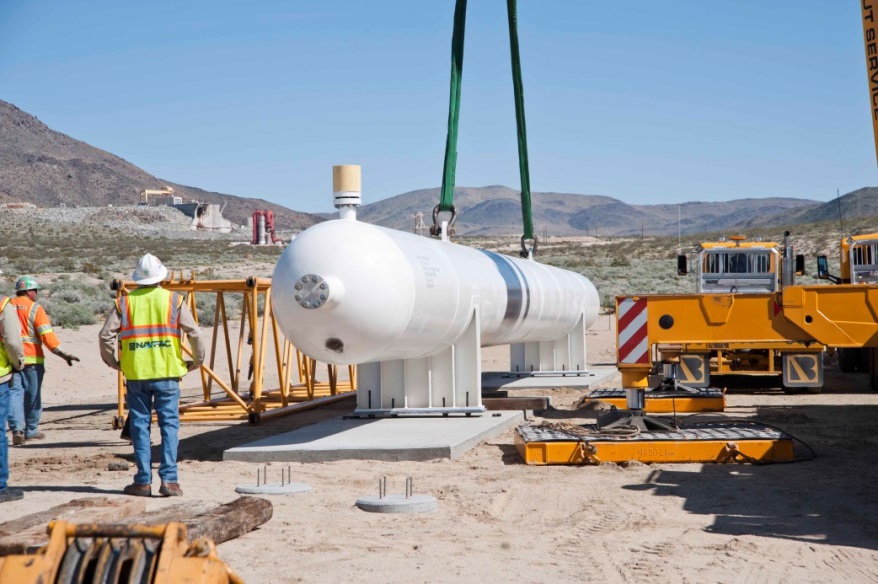
Construction workers watch as a crane lowers a new 1000 cubic foot high-pressure air vessel into place March 15 at the air-breathing propulsion test facility, or T-Range, in China Lake, California. (U.S. Navy photo)