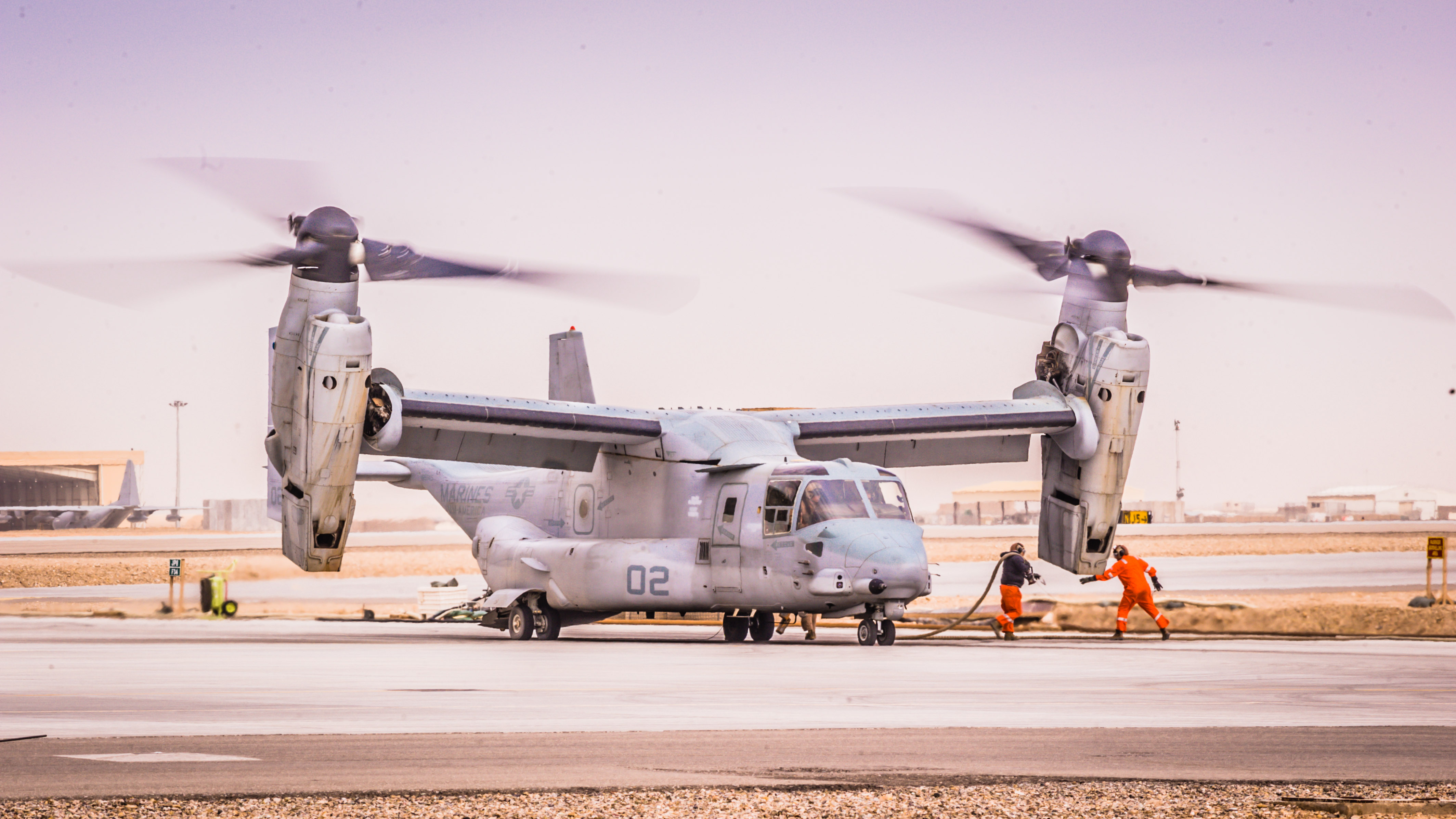
An MV-22 gets ready for takeoff following repair at NAVAIR's Forward Deployed Combat Repair facility in Afghanistan. The FDCR mission ended in June 2014, and was primarily led by NAVAIR reservists with artisans from Fleet Readiness Centers. (U.S. Navy photo)
Closing the curtain on NAVAIR's desert depot
NAVAL AIR SYSTEMS COMMAND, PATUXENT RIVER, Md. – With the reduction in the nation’s military footprint overseas, just a handful of reservists from NAVAIR recently ended a high-impact mission which saved time, money and improved aircraft readiness for the Fleet.
June will mark a year since Sailors from the Navy Reserve Maintenance, Modification and Overhaul (MMO) unit ended a 12-year mission completing complex aircraft repairs in Europe and several Arabian Gulf states.
Dubbed the Forward Deployed Combat Repair (FDCR) mission, the MMO reservists worked alongside Fleet Readiness Center artisans and planners to establish depot-level repair detachments in Italy, Bahrain, Kuwait, Iraq and Afghanistan.
Averaged over the past three years, FDCR completed more than 200 aircraft repairs annually.
The Afghanistan detachment, which responded immediately to the 2012 Camp Bastion attack, was the last FDCR detachment to close, with four reservists and three artisans when the lights turned out.
“It was definitely bittersweet,” said Lt. Cmdr. Doug Webb, the last officer-in-charge for the Afghanistan FDCR mission. “We put a lot of work into making [the depot] able to handle just about anything. It was sad to see it being dismantled, but we know we made a difference.”
FDCR was NAVAIR’s only mobile and forward-deployed aircraft maintenance depot, and was the brainchild of Capt. Christopher Stearns.
“MMO’s greatest strength is bringing the depot to the fight,” said Capt. Chris Stearns, MMO’s former commanding officer. “FDCR was a unique, Reserve-only capability provided by NAVAIR without an active duty counterpart.”
IT STARTED IN ITALY
Stearns was the first NAVAIR reservist to mobilize under a Presidential recall for the FDCR mission, starting in 2002.
As the combat effort began, logistics and maintenance experts analyzed the tradeoffs between time and money spent transporting damaged aircraft from the combat theater to existing depot-level facilities and determined there was a need for FDCR’s mission.
At the time, the Naval Air Mediterranean Repair Facility in Naples, Italy didn’t have the capacity on its own to staff a detachment to theater.
Stearns said starting a new capability like FDCR wasn’t as hard as expected.
“They identified the mission, and [reservists] were able to respond,” said Stearns. “It was amazing to me how many people wanted to go. That made it very easy.”
In the beginning, about a dozen reservists mobilized through the Naples facility, ultimately ending up going through Bahrain, Kuwait, and then to Iraq.
Eventually the reservists were joined by about two dozen civilian artisans from other depots.
“We didn’t have any equipment at first,” said Stearns. “But Naples had flyaway kits and tools, so with their help, we just duplicated what they had. In the beginning it was very arduous. All those guys are heroes.”
Stearns estimates that since 2003, FDCR saved more than $60 million per year in aircraft transportation costs, avoided more than 900 weeks of repair turnaround time, and enabled two more weeks of aircraft availability for each in-service repair. In 2014, Stearns estimates, FDCR avoided more than a year and a half of transit time for damaged aircraft.
“We were a critical asset for the aircraft and nobody else did what we did,” said Cmdr. David Schubkegel, an aviation maintenance duty officer and the last officer-in-charge of the Iraq detachment. “We saved countless amounts of money, time and assets. For our younger guys, because we were stationed with the Marines, it gave them a chance to qualify for their [Fleet Marine Forces] insignia.”
The FMF warfare pin is a career-enhancing qualification that signifies a Sailor’s knowledge of the Marine Corps, including its history and how it operates.
ABOUT THE MMO
Beyond FDCR, the approximately 30 officers and 40 enlisted members of the MMO support NAVAIR in several capacities. MMO Sailors are helping with NAVAIR’s ongoing effort to clean up aviation assets contaminated by the 2011 earthquake and tsunami in Japan’s Fukushima province. The MMO Sailors also provide depot-level maintenance support at the Fleet Readiness Centers and operational-level maintenance at Naval Test Wing Pacific.
MMO is headquartered at Naval Air Station Patuxent River, Maryland, with detachments at Naval Air Weapons Station China Lake, California, and Naval Air Station Jacksonville, Florida. In fiscal year 2014, MMO provided more than 13 years’ worth of time to support NAVAIR missions.
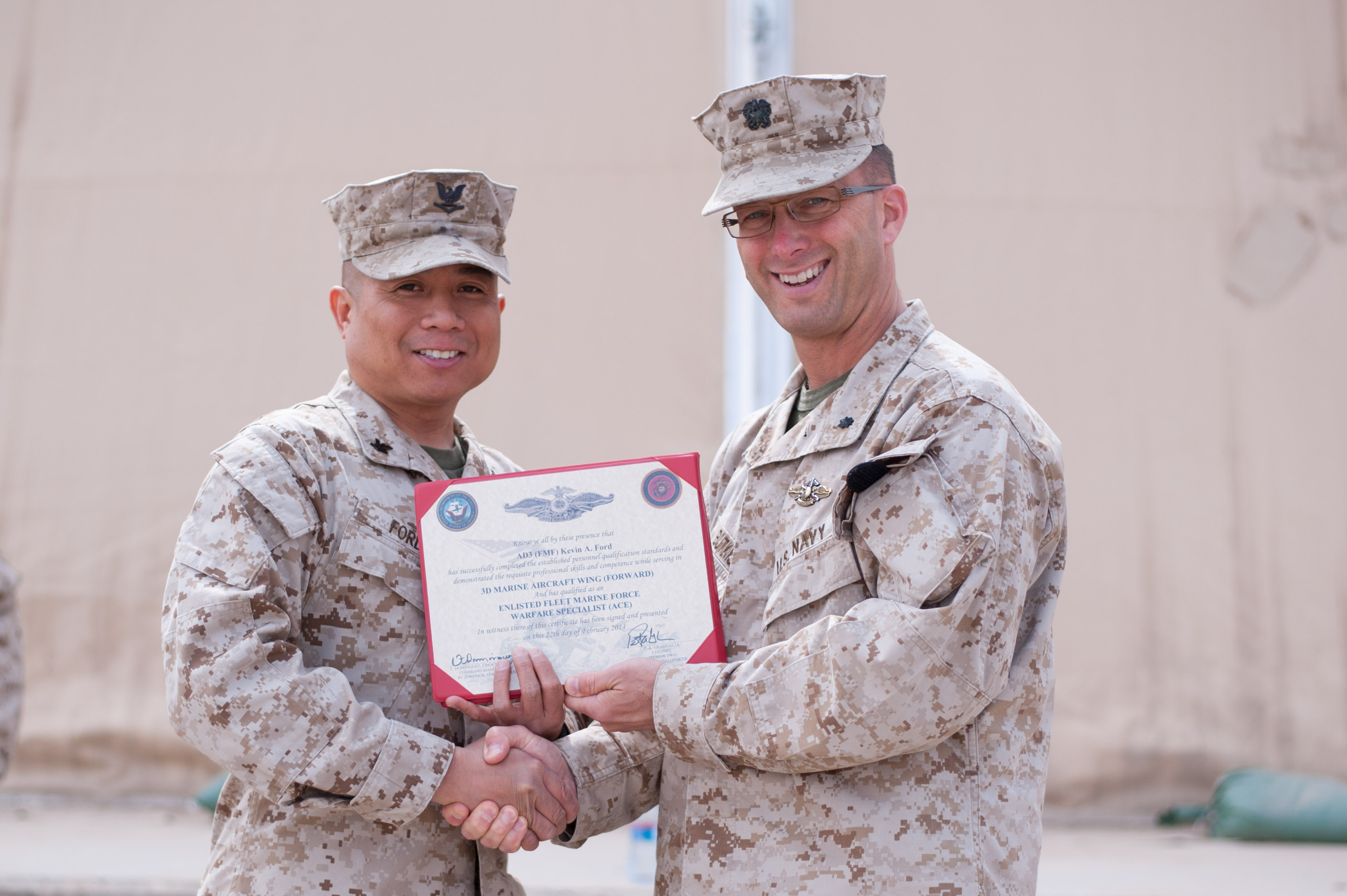
Aviation Machinist's Mate 3rd Class Kevin Ford accepts his Fleet Marine Force warfare pin from Capt. Matt Butkis, during a ceremony at Camp Leatherneck, Afghanistan, in March 2014. The Fleet Marine Force insignia is awarded to Sailors who demonstrate extensive knowledge of Marine Corps history and operations, which improves the ability for Navy and Marine Corps personnel to work together. (U.S. Navy photo)