

Live, virtual and constructive capabilities can simulate and incorporate virtual and constructive entities into live development, testing and training exercises for a fraction of the cost. (U.S. Navy illustration)
Live, virtual, and constructive community talks real plans at NAWCWD
Senior Navy leadership attended a two-day workshop held by Naval Air Warfare Center Weapons Division (NAWCWD) in January aimed at uniting the live, virtual and constructive (LVC) community.
More than 150 experts, program managers and department-level executives developed plans to address the challenges facing the future of LVC. Breakout sessions were held to discuss overlap, share innovative ideas and define future investment requirements and action plans. The sessions focused on several integrated warfighting capability (IWC) mission areas: cyber, network requirements and modeled environments, and tools and standards.
"We have to come together,” urged Rear Adm. Michael Moran, NAWCWD commander. "We need to unite all our efforts and educate the workforce on what we can provide. I think we can come up with a game plan to accomplish that."
Since LVC technology isn’t exclusively owned, a customer looking for an LVC product might fund a similar project that is already underway elsewhere. Even successful projects can become too complex for a single organization to move forward under its own workforce and budget.
"Here's a great example and something that excites me about NAWCWD and China Lake," said Rear Adm. Michael Manazir, director Air Warfare. "We already own a lot of this stuff; it's here. So let's look at LVC for what it is. It isn't just some software program. It's a concept. And that concept only exists when we take all our current activities and bring them together."
Invitees included representatives across a broad spectrum of communities (IWC, modeling and simulation, analysis, systems engineering, test and evaluation and training), competencies, commands and sites.
Department of the Navy representatives and partners from naval aviation program executive offices, Assistant Secretary of the Navy, Research, Development & Acquisition, Office of the Chief of Naval Operations, the Office of Naval Research, Naval Strike and Air Warfare Center, Fleet Forces Command and Navy Warfare Development Command also attended.
"Times have changed," added Leslie Taylor, Naval Air Systems Command (NAVAIR) director of integration and interoperability. "Everyone at all levels can see that this is an imperative. It's no longer a desire. It's a have-to-have. After today, there's going to be an alignment that will produce results."
LVC elements are a cost-effective solution for developing and testing emerging technologies and critical in helping to train warfighters for the complex challenges that they might face in real-life combat situations.
Director of NAVAIR’s battlespace simulation department Amy Markowich delivered closing statements: “The next steps are to develop a Naval Enterprise alignment of LVC capabilities and strategically partner with other system commands and their associated warfare centers. This will enable an operationally-realistic assessment environment to ensure naval warfighters have quality integrated system of systems that work in the mission they require.”
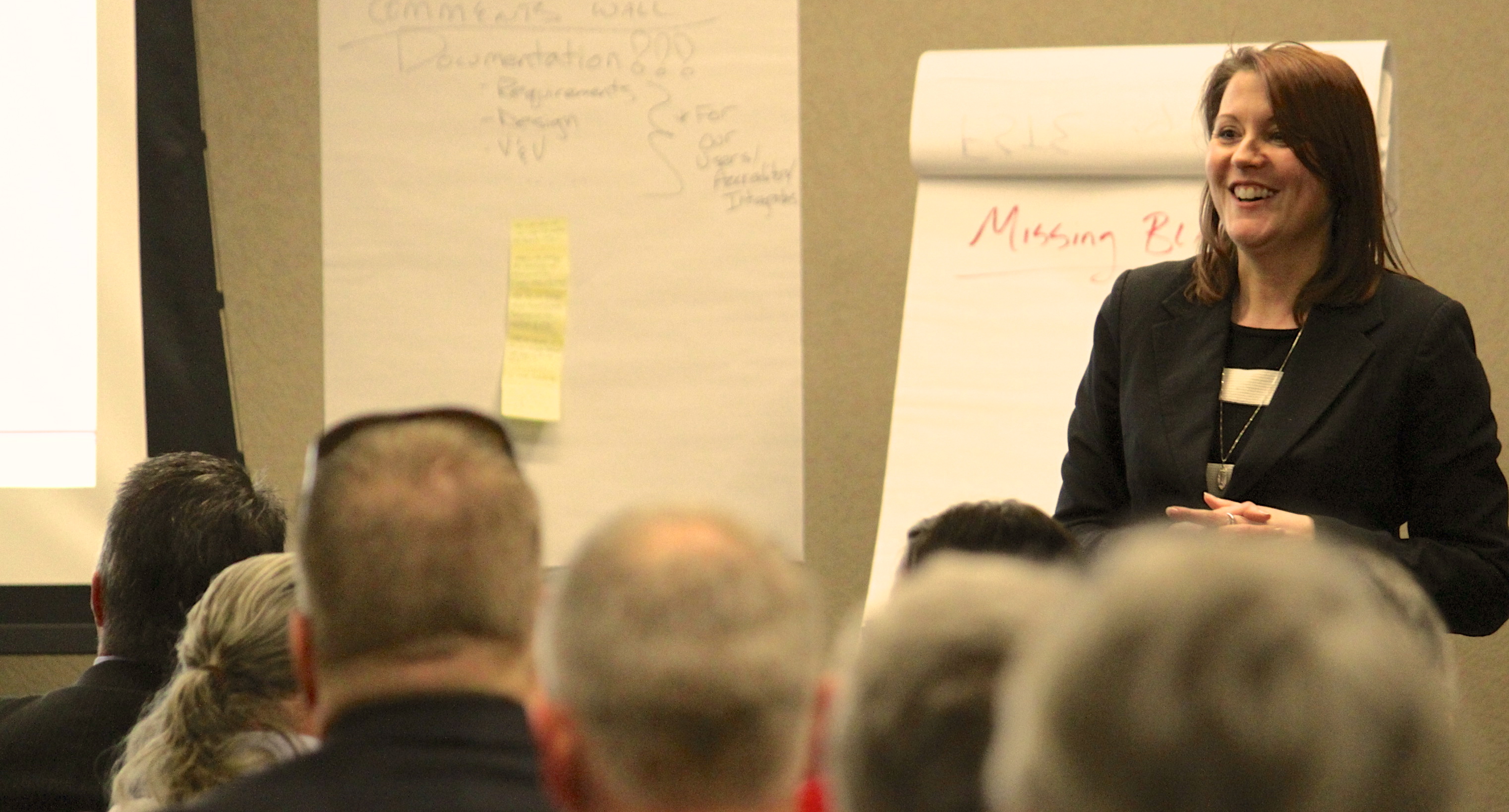
Amy Markowich, director of NAVAIR’s battlespace simulation department, delivers closing remarks to live, virtual and constructive practitioners and leadership after the two-day workshop at Naval Air Warfare Center Weapons Division. (U.S. Navy photo)