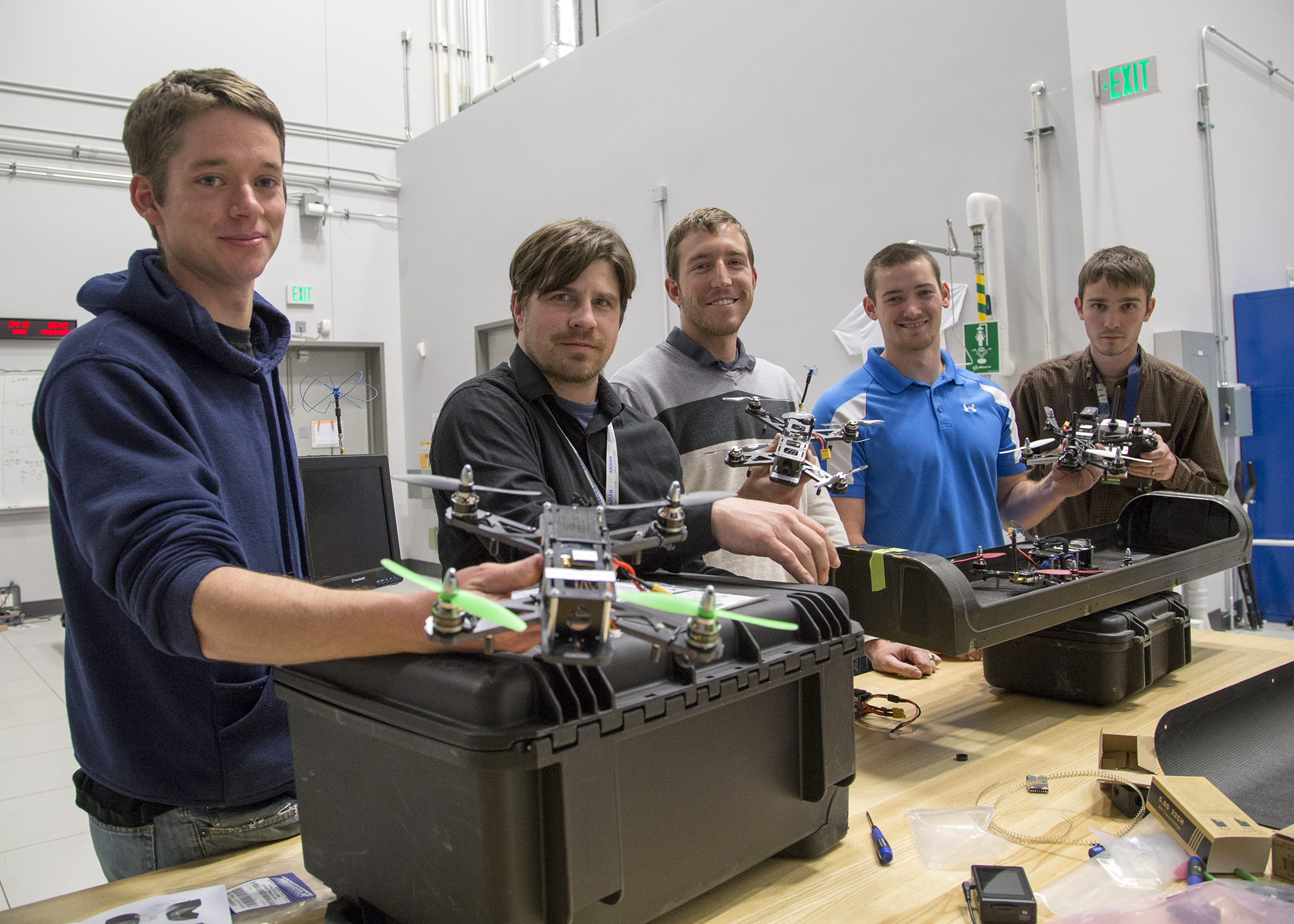
China Lake Innovation Challenge winners propose developing an expendable aerial vehicle, similar to the ones they are holding, that could increase battlefield intelligence. Team members are, from left, Scott Slaughter, Derek Hamel, Chase York, Vincent Schuetz and team mentor Jonathon Duncan. Team leader Nicholas Albrecht and Pavel Rybakov were traveling on temporary duty. (U.S. Navy photo)
NAWCWD Innovation Challenge winners announced
NAVAL AIR WARFARE CENTER WEAPONS DIVISION, CHINA LAKE, Calif. — Executive Director Scott O’Neil announced two NAWCWD winning teams for the 2014-15 Innovation Challenge on Feb. 3. The teams, one from Point Mugu and the other from China Lake, presented the best new ideas from among 18 proposals that address emerging warfighter needs.
The Innovation Challenge is a Naval Air Systems Command initiative that is open to developmental employees across Naval Air Warfare Centers. At NAWCWD, 69 engineer and scientist development program (ESDP) employees accepted the challenge.
Winners receive resources to support their labor, a budget for materials and access to facilities where they can continue their projects.
The winning entry originating at Point Mugu is a project for Battlefield Enhancing Wearable – or BEWEAR for short. The team's Innovation Challenge proposal describes the idea as an application (app) for a smartphone, tablet or other wearable devise that provides vital and immediate information to the warfighter. The smartphone provides a familiar platform that can be easily upgraded and networked. According to the proposal, BEWEAR includes a heads-up-display to free the warfighters’ hands. Over the next six months, the team will work to prove that the system can demonstrate an enhanced utility to the fleet.
The winning China Lake team proposes an unmanned expendable aerial vehicle (EAV) deployed from a larger UAV bay using a new release system. Once released, a user takes control of the EAV to maneuver it to a predetermined location. The smaller EAV’s reach increases by relaying its commands through the larger UAV circling overhead. The system can land, or “loiter” in an area while collecting up-close full motion imagery. The EAV provides intelligence, surveillance and reconnaissance capabilities.
According to the team’s Innovation Challenge proposal, the ability to deploy a smaller air vehicle from a larger one has been attempted many times before. However, by having both players being unmanned systems enables the operators to complete a plethora of concept of operations as well as develop tactics, techniques, and procedures for supporting operations.
All the entries impressed the judges, according to Cameron Bruce, a judge for the Innovation Challenge.
“All the proposals were creative, practical and focused on solving real issues facing our warfighters,” said Bruce, who is deputy director for test and evaluation at Point Mugu. “It was obvious they did their homework and had reached out to some of our of senior mentor folks. The ESDPs and their mentors were excited by the projects – as a result I got excited, too.”
Both winning teams will present their project results in August.
O’Neil recognizes the value that the Innovation Challenge brings to NAWCWD.
"The value of the Innovation Challenge is both a developmental opportunity for our rising scientists and engineers, as well as a means to strengthen the innovation culture at NAWCWD,” said O’Neil. “This innovation culture has been the bedrock of the China Lake and Point Mugu communities for many, many years. I congratulate the first Innovation Challenge winners and plan to follow their projects over the coming months."
“The competition was an awesome and energizing experience for me,” added Bruce. “The future of weapons division is in good hands with these new innovation leaders.”
The Innovation Challenge formally kicked off in October of last year. Participants had about a month to prepare their proposals. Judges then reviewed all entries, including in-depth interviews with the top seven teams, before naming the winners.
The BEWEAR team is Nicholas Holmes (team leader), Kaitane Kircher, Brandon Hessler and Jennifer Cabanayan.
The Deployable Group 1 Expendable UAV (EAV) team is Nicholas Albrecht (team leader), Chase York, Vincent Schuetz, Pavel Rybakov, Scott Slaughter and Derek Hamel.
Everyone participating in the Innovation Challenge is a winner, according to Dylan Riley, NAWCWD director of the Innovation Office for Research and Engineering.
“We encourage all of those who submitted proposals to continue working their ideas,” said Riley. “And, we plan to help them seek out other venues for success.”
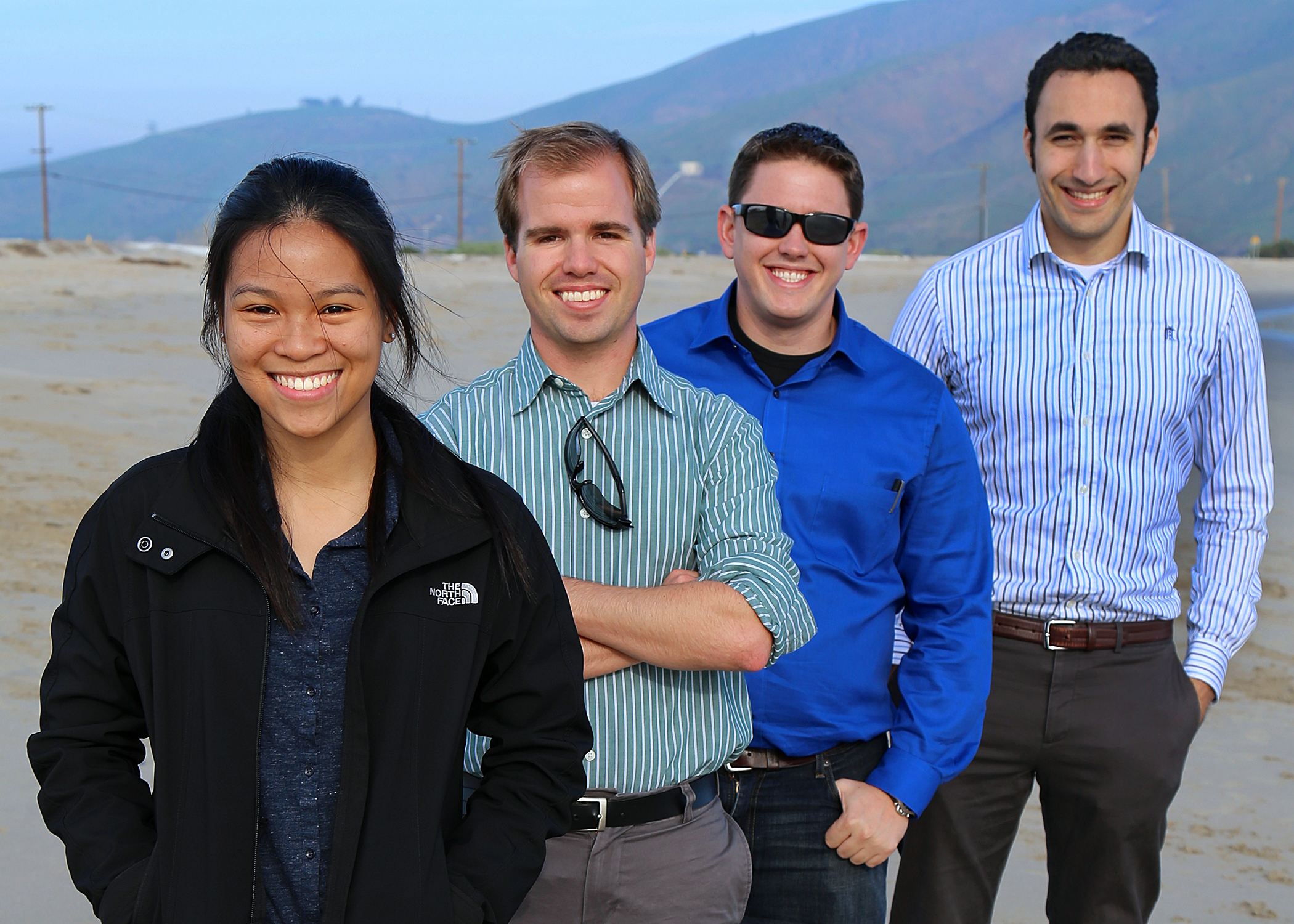
The Innovation Challenge winning team from Point Mugu is, from left, Jennifer Cabanayan, team leader Nicholas Holmes, Brandon Hessler and Kaitane Kircher. The team submitted an idea called Battlefield Enhancing Wearable – BEWEAR for short – that would enhance warfighter tactical awareness. (U.S. Navy photo)