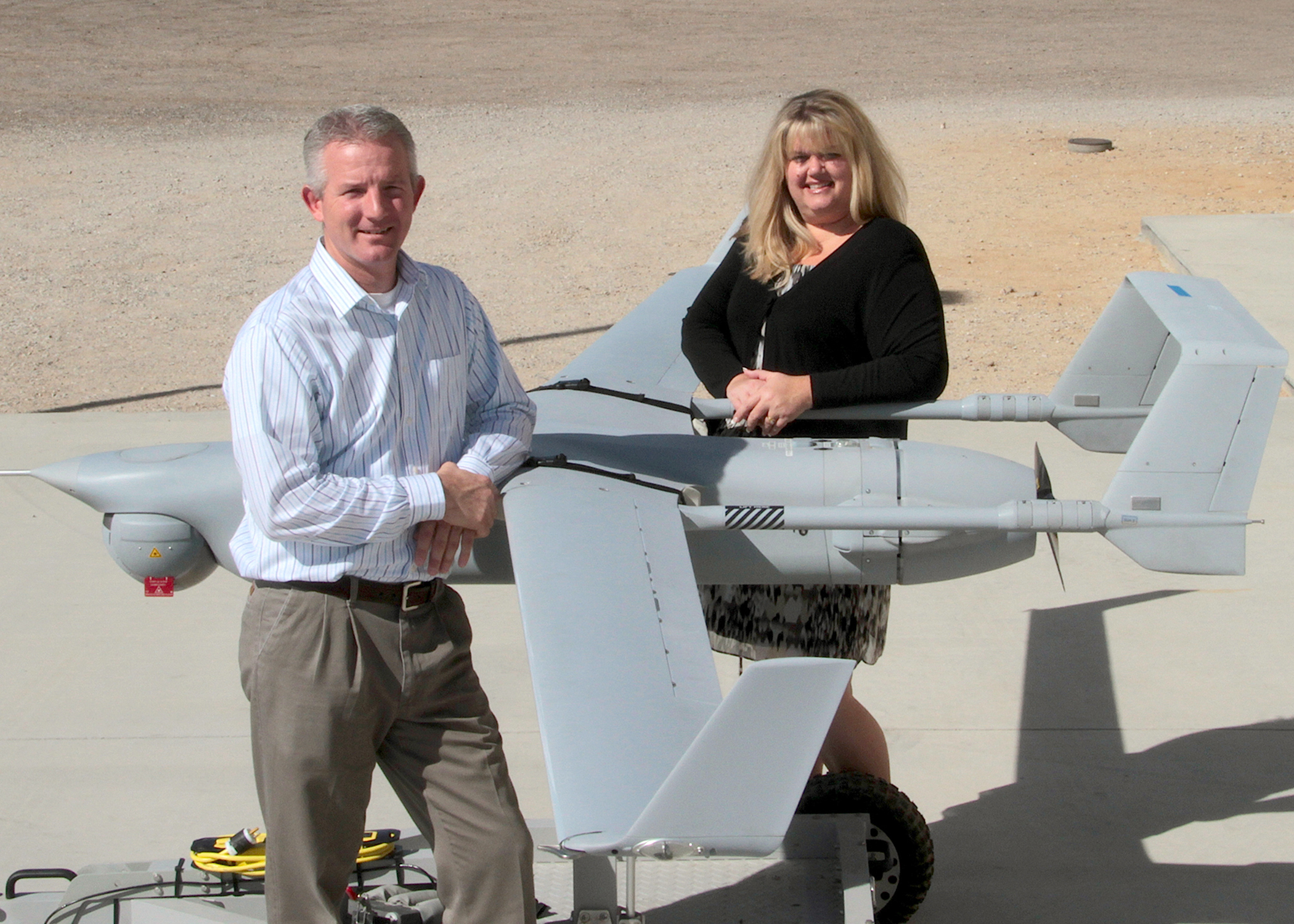
James Bell and Deidre Patin stand next to an unmanned aerial vehicle at Naval Air Warfare Center Weapons Division China Lake, California. A presidential executive order led to the two participating in preliminary discussions with South African officials about new approaches to prevent illegal wildlife trafficking. (U.S. Navy photo)
Executive order leads to NAWCWD consultations in South Africa
NAVAL AIR WEAPONS STATION CHINA LAKE, Calif. - Naval Air Warfare Center Weapons Division (NAWCWD) recently responded to a request from the Office of the Secretary of Defense to support an executive order signed by President Barack Obama that committed the United States to help combat wildlife trafficking throughout the world.
Two NAWCWD unmanned systems (UxS) office representatives traveled to Pretoria, South Africa from Sept. 11-18 for initial meetings. South Africa and the U.S. Embassy organized the meetings to discuss new approaches to prevent wildlife trafficking.
UAVs can be a useful tool to monitor illegal trafficking activity, animal movement patterns and to help secure the country’s borders.
Illegal wildlife trafficking in South Africa has escalated dramatically. According to the World Wildlife Foundation, rhinoceros poaching in the country has increased from 13 incidents in 2007 to 1,004 incidents in 2013. The nonpartisan Congressional Research Office reports rhino horns can sell for $65,000 a kilogram, making them more expensive than gold or diamonds.
Animal parts are trafficked much like illegal drugs and arms, making wildlife crime a big business. Additionally, intelligence communities are interested in learning more about the connection between “under the radar” trafficking profits and terrorism.
Obama announced in Tanzania in 2013 that the U.S. State Department will provide $10 million in regional and bilateral training and technical assistance in Africa to combat wildlife trafficking. This includes about $3 million in bilateral assistance to South Africa.
Deidre Patin, UxS International program representative; James Bell, UxS technical advisor; and Kelly McDonald, international program lead made up the NAWCWD team that responded to the presidential executive order. Patin and Bell attended the meetings in South Africa to explore how NAWCWD could assist in the wildlife trafficking effort.
The original invitation to participate in the meetings came through the Navy International Programs Office, U.S. Embassy in South Africa and the Office of the Under Secretary of Defense (Acquisition, Technology and Logistics), according to McDonald.
“NAWCWD has supported South African engagement for a number of years,” said McDonald. “So when a multi-service contingent was organized to support the presidential executive order, NAWCWD was considered. Our engagement with other countries will help us to develop new uses for our systems as well.”
Today, unmanned systems are more than military tools. They help fight wildfires and search for missing people. UAV automated flight patterns can meticulously survey a geographic grid. Unmanned systems are also valuable to the agriculture industry, as unmanned tractors can navigate themselves to plow straighter rows than any human ever could. NAWCWD is currently working with major U.S. universities to develop the engineering necessary for other unmanned agricultural uses.
NAWCWD facilities are located in China Lake and Point Mugu, California. The weapons division has been involved in full-spectrum (cradle to grave) UxS research, development, training and education for 50 years. NAWCWD was first to use a UAV for search and rescue support, and was involved in the first flight of a Northrop Grumman Corporation RQ-8 (Fire Scout) and X-47A (Pegasus).
“South Africa is developing their own UAV program, so the representatives we spoke to were most interested in the NAWCWD approach to engineering,” said Bell. “Our engineering talents, our experience and our laboratories offer the most value for their wildlife trafficking and border surveillance efforts.
“We are being asked to explain our engineering approach to help them mature their program, so they can address the issues themselves,” he added.
With a technology exchange agreement now on the table between the two countries, Patin hopes to interact more with the South Africans in 2015.
“The first step after the agreement is signed would be to invite their representatives to NAWCWD,” said Patin. “Then we would perhaps explore an engineer exchange program. Discussions are continuing now as we wait for the final agreement.”
The unmanned system collaboration in South Africa offers opportunities for both countries, according to Maj. Jacob Abrami of the U.S. Embassy in South Africa. Abrami serves the United States in the South African embassy as deputy chief, Office of Defense Cooperation.
“By being a mutually beneficial project to our nations, the (unmanned) program will serve as a gateway to greater military-to-military and science and technology cooperation,” said Abrami. “This in turn could … directly improve both nations’ understanding of the system and their development of products, sensors and upgrades to its various components.”