
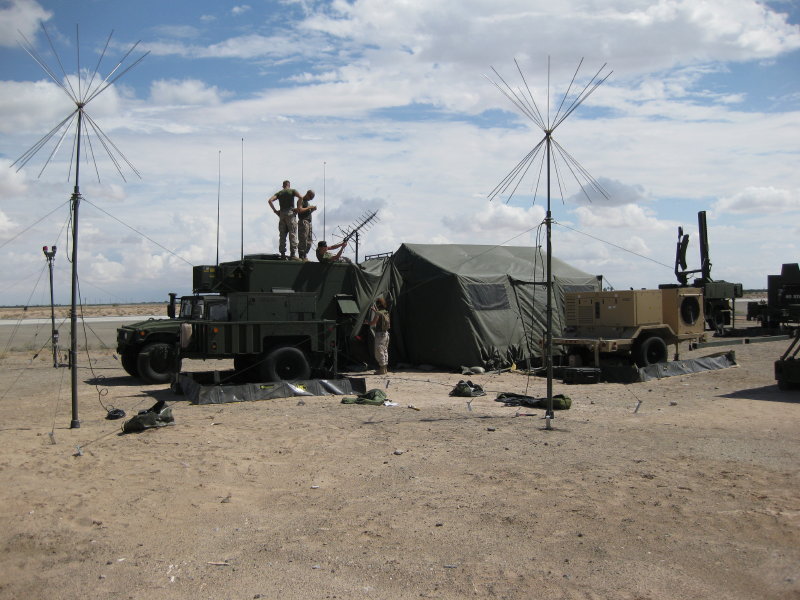
Members of U.S. Marine Air Control Squadron One set up an AN/TPN-31A Air Traffic Navigation Integration and Coordination System (ATNAVICS) at Marine Corps Air Station Yuma, Ariz. The mobile all-weather radar system that provides air traffic control capabilities to Marine air traffic controllers is replacing Marine Air Traffic Control and Landing Systems (MATCALS), which has been used since the 1980s. (U.S. Marine Corps photo)
Marine Corps decommissions old mobile radar system, upgrades new radar
NAVAL AIR SYSTEMS COMMAND, PATUXENT RIVER, Md. — Naval Air Systems Command’s (NAVAIR) Marine Corps Expeditionary Air Traffic Control (ATC) Systems Integrated Product Team completed the demilitarization of its Marine Air Traffic Control and Landing Systems (MATCALS) Sept. 8.
Since its initial fielding to the fleet in the 1980s, MATCALS was used to help Marine ATC detachments guide aircraft in remote locations that had no such capability.
The system began the decommissioning process in 2007, with the roll-out of the Air Traffic Navigation Integration and Coordination System (ATNAVICS).
"The MATCALS legacy equipment is beyond its effective life cycle performance period," said Chip Hibner, expeditionary air traffic control integrated product team lead for Naval Air Traffic Management Systems Program (PMA-213). PMA-213, under the Program Executive Office for Tactical Aircraft Programs (PEO(T)), is responsible for equipping these systems.
"Obsolescence issues and the Marine Corps mandate for a light and mobile force allowed PMA-213 to pursue the ATNAVICS system, which provides the same services but uses today's technology and has a much smaller footprint," said Hibner. "It would take three C-5 Galaxy aircraft — each with a 270,000-pound payload capability — to move one suite of MATCALS legacy equipment, but we can transport the ATNAVICS system using only one KC-130 Hercules aircraft — requiring only a 42,000-pound payload capability."
ATNAVICS consists of a radar vehicle, an operations control vehicle and two tactical power generator trailers and can be set up in less than an hour. Currently, it has an airport surveillance range of 25 nautical miles, but it’s getting an upgrade.
In 2009, ATC along with industry partner Raytheon Integrated Defense Systems, began developing an engineering change proposal (ECP) — the management tool used to propose a configuration change — that will extend its airport surveillance range from 25 nautical miles to 60 nautical miles. The ECP will be implemented as part of the ATNAVICS depot restoration process that modifies or refurbishes the radar every five years, resulting in $13 million in cost savings and enhancing the detachments’ mission effectiveness.
The increased surveillance capability will allow the needed range and altitude for Marine Air Traffic Control Detachments (MATCD) to provide continuous services in support of main air bases, expeditionary air fields, forward operating bases, forward arming and refueling points, and disaster and humanitarian response locations around the world.
The improved system reached initial operational capability in September at a U.S. Marine air control squadron in Yuma, Arizona. The last suite of MATCALS is scheduled to be shipped back to the In-Service Engineering Activity, Space and Naval Warfare Systems Command Systems Center Pacific in San Diego, California, for demilitarization.
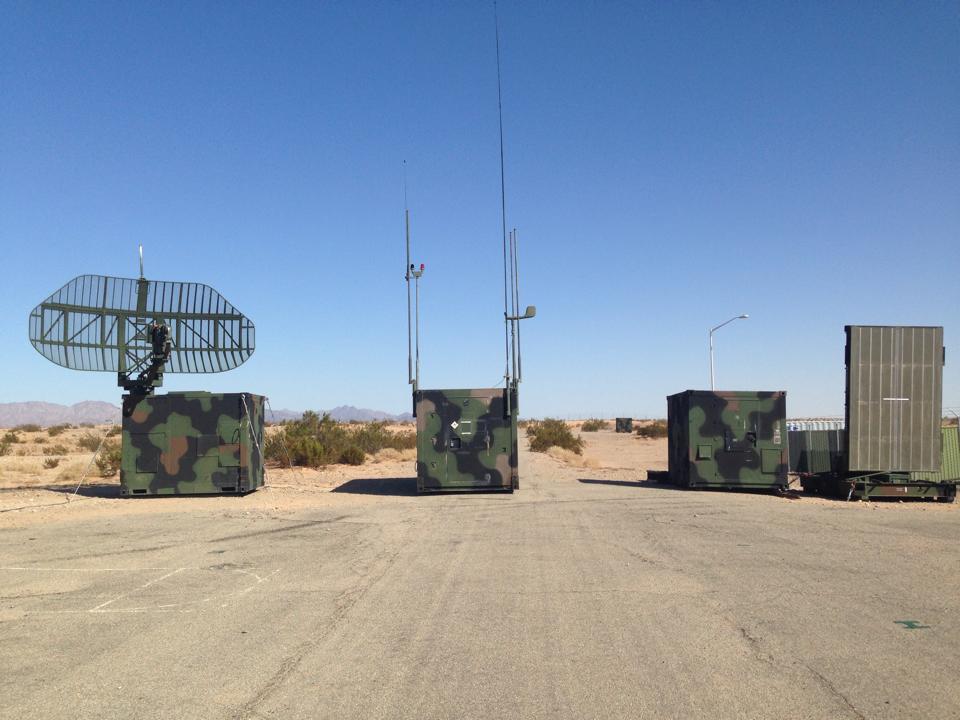
The Marine Air Traffic Control and Landing Systems (MATCALS) is set up one last time in Yuma, Arizona, Sept. 8, 2014. A U.S. Marine Corps mandate requesting a light and mobile force allowed Naval Air Traffic Management Systems Program Manager (PMA-213) to pursue the Air Traffic Navigation Integration and Coordination System (ATNAVICS) system that provides the same services but uses current technology and has a much smaller footprint. (U.S. Marine Corps photo)