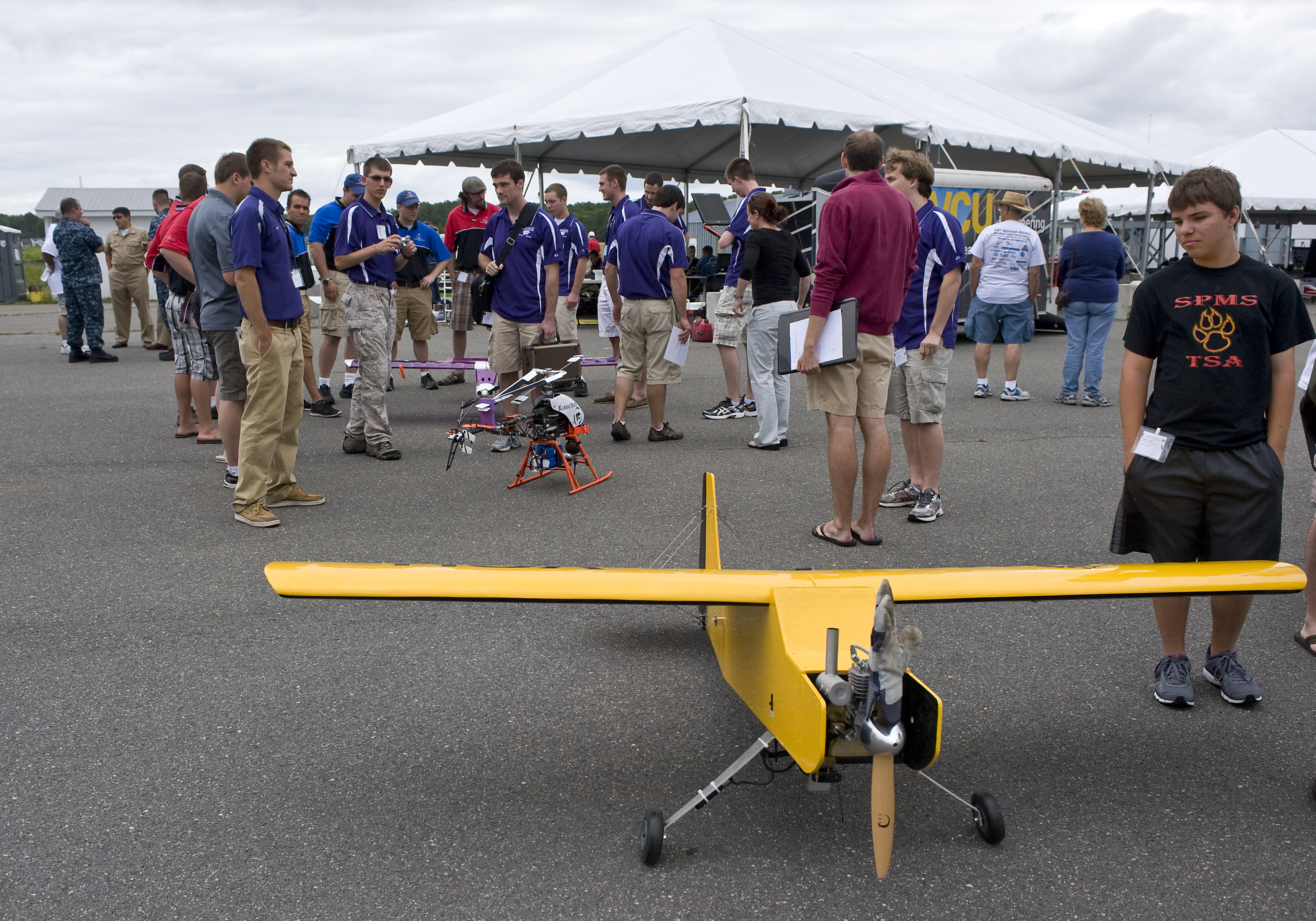
The Association for Unmanned Vehicle Systems International's student competition held annually at Webster Field Annex in St. Inigoes, Maryland draws in dozens of U.S. and international partcipants. This year's event is scheduled for June 18-22. (U.S. Navy photo)
Paying it forward: Student competition inspires NAVAIR career, launches nation’s future workforce
NAVAL AIR SYSTEMS COMMAND, PATUXENT RIVER, Md. — While student engineering competitions have steadily gained popularity for more than a decade, there were few students who seized the opportunity to participate in the first Annual Student Unmanned Air Systems (SUAS) competition sponsored in 2002 by the Association for Unmanned Vehicle Systems International (AUVSI), the world's largest non-profit organization devoted to the unmanned systems community.
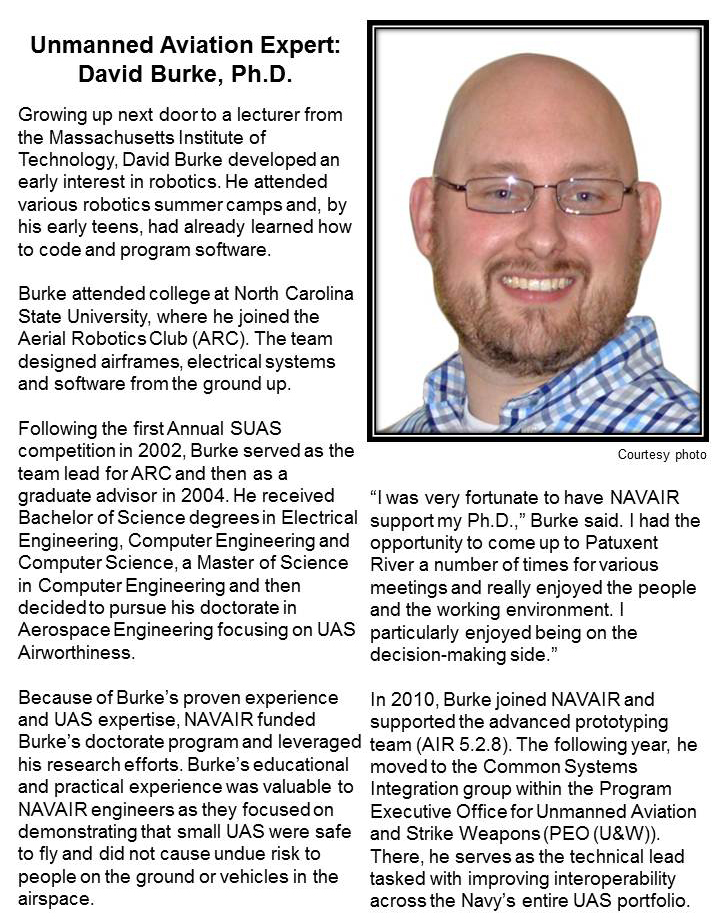
By participating in the competition with his Aerial Robotics Club (ARC) from North Carolina State University (NC State), David Burke positioned himself at the forefront of the growing Unmanned Air Vehicle (UAV) industry and is now the UAS Interoperability Technical Lead for the Unmanned Aviation and Strike Weapons Program Executive Office (PEO(U&W)), a board member for the AUVSI Seafarer Chapter, and involved in formalizing NAVAIR’s involvement in the 12th Annual SUAS competition set for June 18-22 at the Webster Field Annex in St. Inigoes, Maryland.
The 2014 SUAS competition — sponsored by AUVSI, the Office of Naval Research (ONR) and PEO U&W — seeks out students who have a passion for unmanned flight technology with the objective of developing the nation’s future UAS and UAV workforce. The competition also equips students with the opportunity to showcase their hands-on design and engineering skills to prospective academic sponsors and employers while enhancing the Navy’s visibility and that of its industry and academic partners, Burke said. In particular, students will have the opportunity to bring their résumés and talk to prospective employers about potential job opportunities in a field that features more than 11,000 UAVs in the Department of Defense's (DOD) inventory.
“This event has always brought in the best and the brightest young talent,” said Joe Brannan, a former NAVAIR employee who founded the competition and is now serving as AUVSI’s Florida Peninsula Chapter president and a volunteer for the event. “Many students, like David, have gone on to support the growing UAV field at DoD organizations, including NAVAIR and ONR.”
As an undergrad, Burke had hoped that his team’s UAV would make an impact on the national scene. At that time, there were little more than 100 UAVs in the DOD’s inventory and he knew that the technology was still immature for unmanned systems. As his team’s custom-designed, pilotless aircraft — built out of paper and featuring a built-in camera —came to life in the skies above the competition, he knew that great opportunities lay ahead.
“It’s hard to believe that only 12 years ago there were just two teams and two colleges in the competition — NC State and Cornell,” Burke said. “That just gives you an idea of how fast this industry is growing. The technology has matured to the point that it’s not out of scope for a college team to develop and fly an autonomous aerial vehicle at a very low cost.”
Burke, now considered an expert in the field of UAS, attributes a great deal of his success to his participation in the SUAS competition.
“I am 100 percent certain that I would not be where I am today if I hadn’t been on Webster Field flying that small UAV 12 years ago,” Burke said. “That event opened the door for the countless opportunities that established my career and I hope this year’s event does the same for the many young, bright engineers who will help shape our future workforce.”
For several years, Burke served as a mentor for AUVSI for student competitors. This year, one of his former proteges who attended Great Mills High School in Great Mills, Maryland will compete with the NC State team.
More than 40 teams have registered for AUVSI’s 12th Annual SUAS competition in June, including a number of international participants. The competition is open to all military, civilian and contractor personnel with base access.