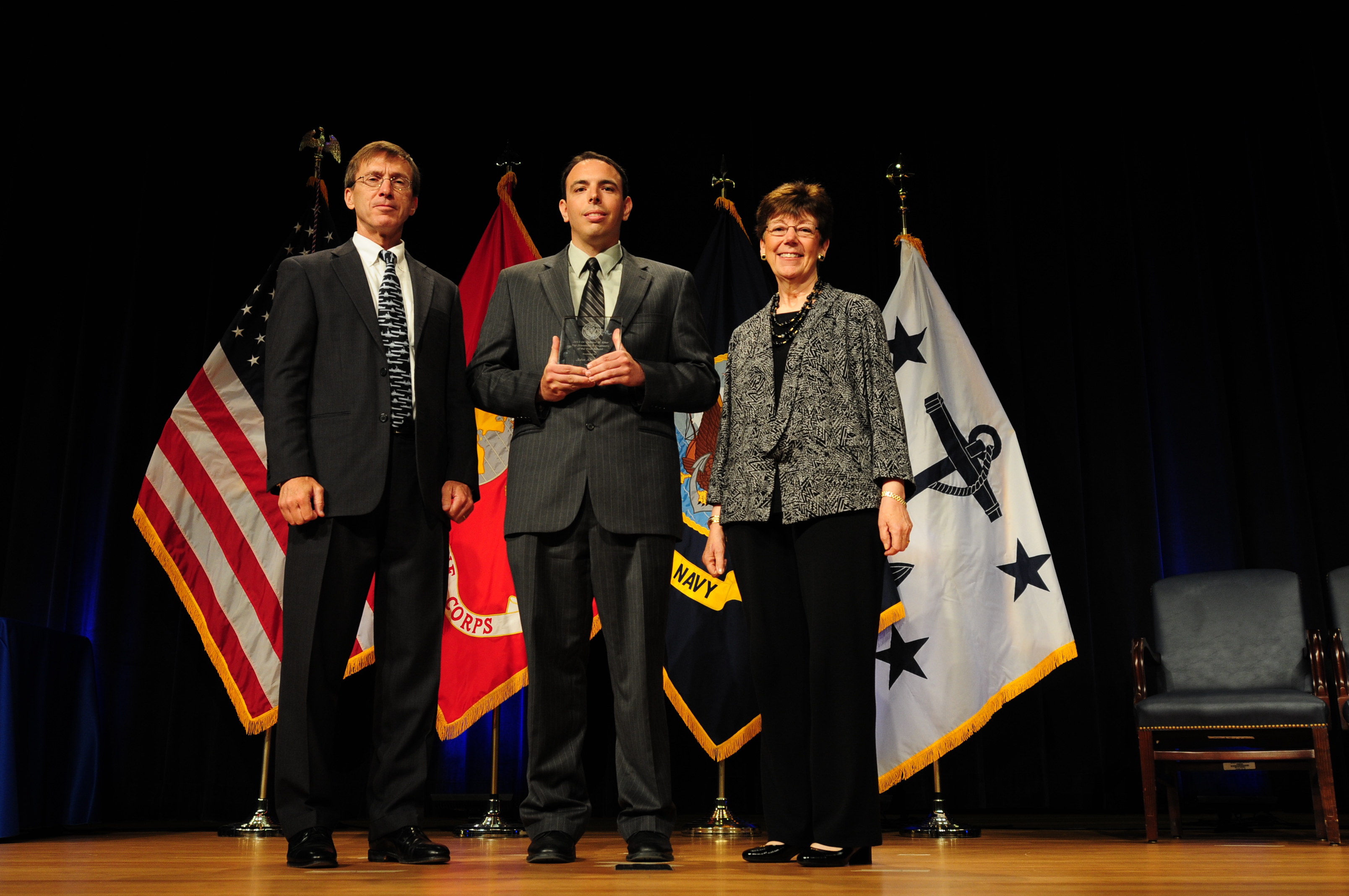
John Alotbelli received the Dr. Delores M. Etter Top Scientists and Engineers of the Year Award for his work with service life management from Assistant Secretary of Navy Research, Development and Acquisition (ASN RDA) Sean Stackley and former ASN RDA, Dr. Delores M. Etter, for whom the award is named, on June 6 during a ceremony at the Pentagon.
NAVAIR Lakehurst engineer wins award for service life management work
JOINT BASE MCGUIRE-DIX-LAKEHURST, N.J. — John Altobelli of Naval Air Systems Command (NAVAIR) Lakehurst was one of three NAVAIR employees to be awarded the Dr. Delores M. Etter Top Scientists and Engineers of the Year Award during a ceremony at the Pentagon on June 6.
Altobelli, who currently serves as the Aircraft Launch and Recovery Equipment (ALRE) Service Life Management Program (SLMP) catapult design team lead, was selected as a winner of the prestigious award for his work in developing a first-of-its-kind method to predict the service life of ALRE components with complex loading histories — an area where no previous solution existed.
“Safety, reliability, availability and cost are really key to what service life management is about. For us, to predict a good service life we consider all of this with safety being paramount,” said Altobelli.
The steam catapult is a piece of ALRE with non-traditional loading applied to it. Over time, loading and unloading can result in fatigue damage. The C13 catapult in particular undergoes four loading stages during launch. “Each stage has completely different loads and each causes a stress in a different direction,” said Altobelli.
The complex loading provides challenges in determining service life. “There was nothing that allowed us to calculate how a crack would grow in this type of environment,” said Altobelli.
His method provides a solution. The method is mostly an algorithm, he said. Altobelli explained that while the tools used to calculate service life were not new to the field, the way he proposed they be utilized was new. “It organized different processes and theories for fatigue into a way that hadn’t been done before,” Altobelli said.
The majority of Altobelli’s work on his method began in 2012. However, it was during August 2011, while the rest of the East Coast was preparing for Hurricane Irene, that Altobelli developed the initial software code. “The day before Hurricane Irene I noticed the problem and that weekend I coded up the first solution,” said Altobelli. His unique software code accounts for the various loading conditions of the catapults.
He enlisted the help of Tirupathi R. Chandrupatla, a Rowan University professor and an ALRE special projects advisor for NAVAIR Lakehurst during multiple summers, in the optimization of Altobelli’s method. They compiled their work into a paper, “Fatigue Life Calculation with Loads Varying in Magnitude and Direction,” that was presented in 2013 at the Society of Automotive Engineers’ (SAE) World Congress.
Altobelli’s optimized method was integrated into a fatigue calculation tool that was previously developed for crack initiation calculations by Altobelli and Chandrupatla. With Altobelli’s method incorporated, the tool gained the added ability to predict service life for components with complex loading scenarios.
Additionally, the tool can be used to predict the effects of a changing air wing on ALRE such as the catapults. It will allow Altobelli and his team to determine if components meet requirements and if increased maintenance is needed.
Altobelli, Christopher Clark and Arjuna Flenner are NAVAIR’s three winners. Additionally, the Office of Naval Research, Naval Sea Systems Command, Space and Naval Warfare Systems Command, Naval Facilities Engineering Command and Marine Corps Systems Command produced award winners.