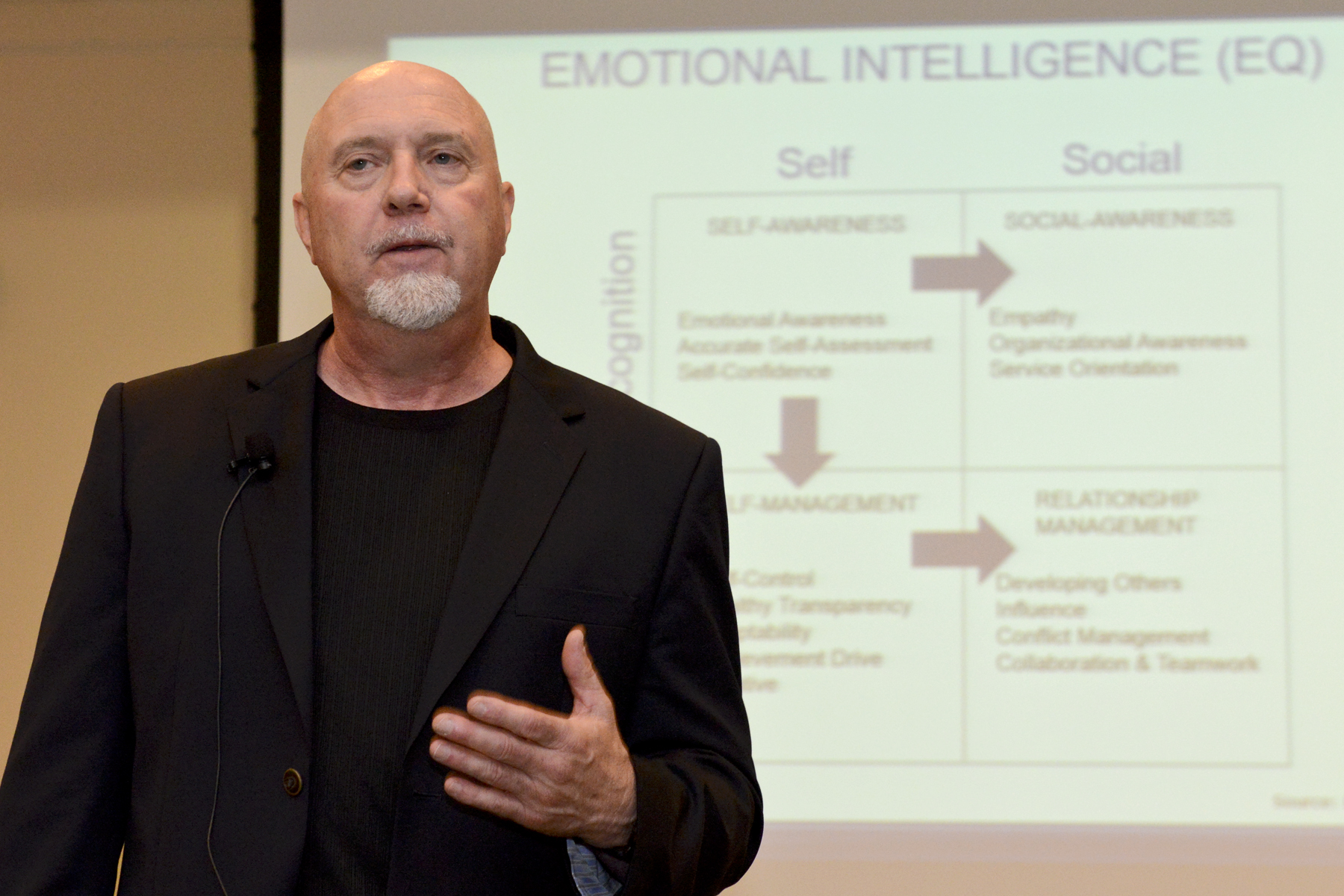
Tom Reed, president of Reliant Learning LLC, explains the four stages of emotional intelligence: self-awareness, social awareness, self-management and relationship management. Reed spoke as part of NAVAIR’s “Mentoring at the Speed of Life” event May 22 on the topics of emotional intelligence and employee engagement and their connection to mentoring. (U.S. Navy photo)
Mentoring helps raise emotional intelligence and employee engagement
NAVAL AIR SYSTEMS COMMAND, PATUXENT RIVER, Md. — The secret to changing your life? Develop your emotional intelligence.
That’s what Tom Reed, president of Reliant Learning LLC, told 360 employees at a NAVAIR mentoring event May 22. Emotional intelligence — the ability and degree to which you know yourself, manage yourself, understand others and integrate this information to better manage situations and relationships — is the No. 1 predictor of leadership success at any level of the organization, he said.
“Emotional intelligence plays a big role in our professional and personal success, can be learned at any age and needs to be continually developed to be mastered,” he said. “But, it cannot be developed without the help of others. Mentors play a role in developing our emotional intelligence.”
Your level of emotional intelligence determines how successful you will be at work, because you must be able to work with others effectively, Reed explained, citing a connection between emotional intelligence and the ability to adapt to change and new ideas.
To improve emotional intelligence, Reed recommended stepping out of your comfort zone, asking for honest feedback from trustworthy people and participating in mentoring.
“Mentoring is a collaborative learning relationship,” he said. “Find a positive mentor who enjoys learning, then establish boundaries and safe topics. Target specific areas for improvement. You can build your knowledge and understanding of emotional intelligence together.”
Another benefit to mentoring, he said, is its ability to connect people to each other and to the organization, a key part of employee engagement. Engaged employees tend to be motivated, productive and more satisfied with their jobs, according to research.
“Mentoring connects people, creates a culture of development and knowledge sharing, helps break down organizational silos, promotes collaboration and serves as a catalyst for change,” he said.
Rear Adm. Paul Sohl, commander of the Fleet Readiness Centers and NAVAIR assistant commander for logistics and industrial operations, knows the importance of mentoring firsthand. One of his mentors in China Lake, California, gave him advice he still follows today: “When in doubt, go wide. Do something different.”
“It’s so easy to be in your comfort zone,” he said, “but there is nothing more powerful than stepping out, looking at things differently, and taking a risk.”
Honoring NAVAIR’s mentors
Sohl also recognized the winners of NAVAIR’s first Mentor of the Year Award: Michael Grice, Valisa Harris, Greg Heller, Brian Hicks, Barbara Lupei, Dora Quinlan, Timothy Quinn and Rosalie Sommer.
“This award is a way for NAVAIR to recognize individual contributions from people who get involved in very meaningful ways,” Sohl said. “These mentors embody the adage of ‘leading from the front’ and being an active participant in the careers of tomorrow’s leaders.”
NAVAIR’s mentoring program, established in 2007, offers training, group and speed mentoring sessions, and an online iMentor tool to match potential mentors and mentees based on their skills, interests, location, experience or keywords.
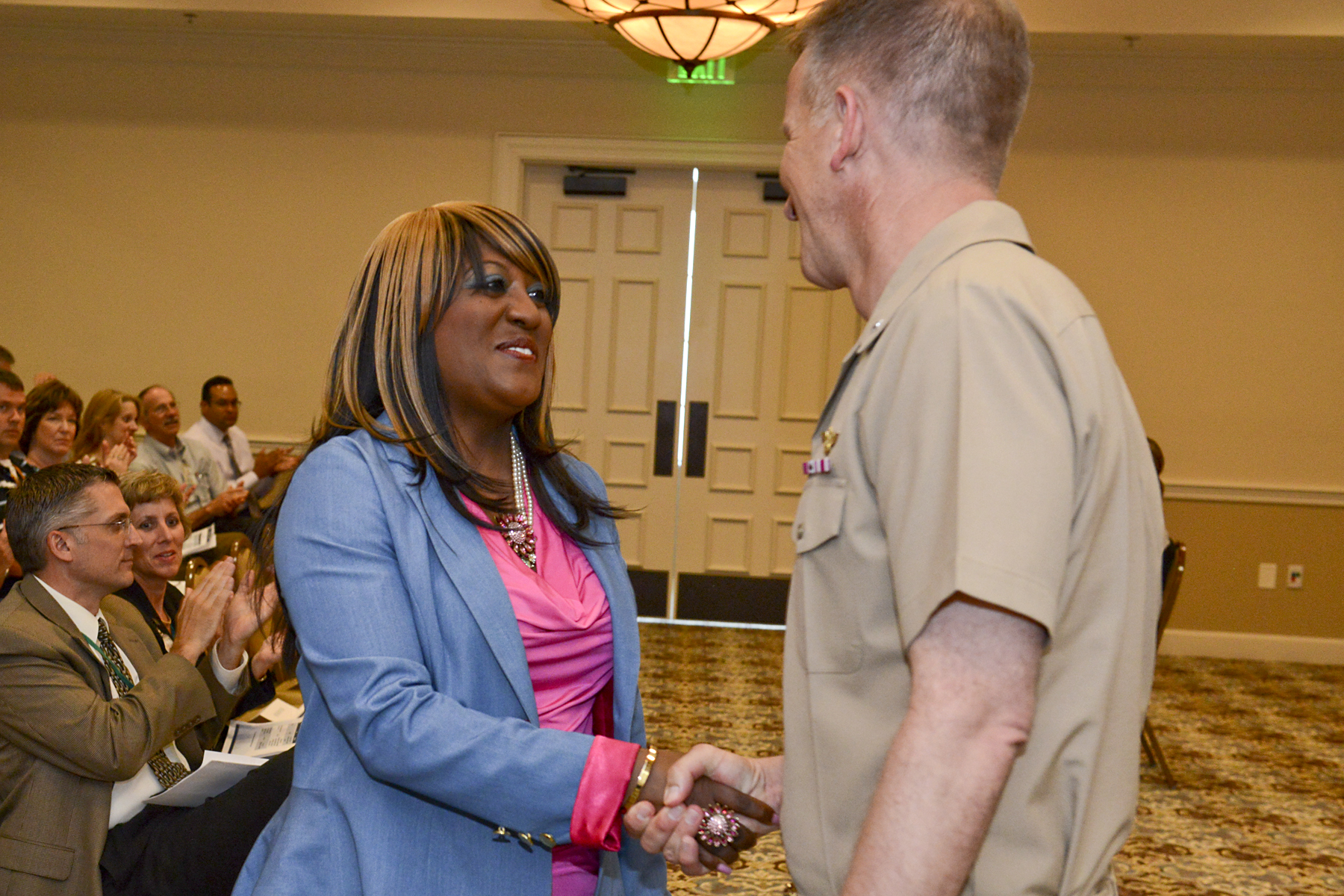
Valisa S. Harris, left, accepts the Patuxent River, Maryland, NAVAIR Mentor of the Year Award from Rear Adm. Paul Sohl at a national mentoring event May 22. The award, the first for the command, recognizes employees who best exemplify the ideal qualities and character of a mentor. (U.S. Navy photo)