
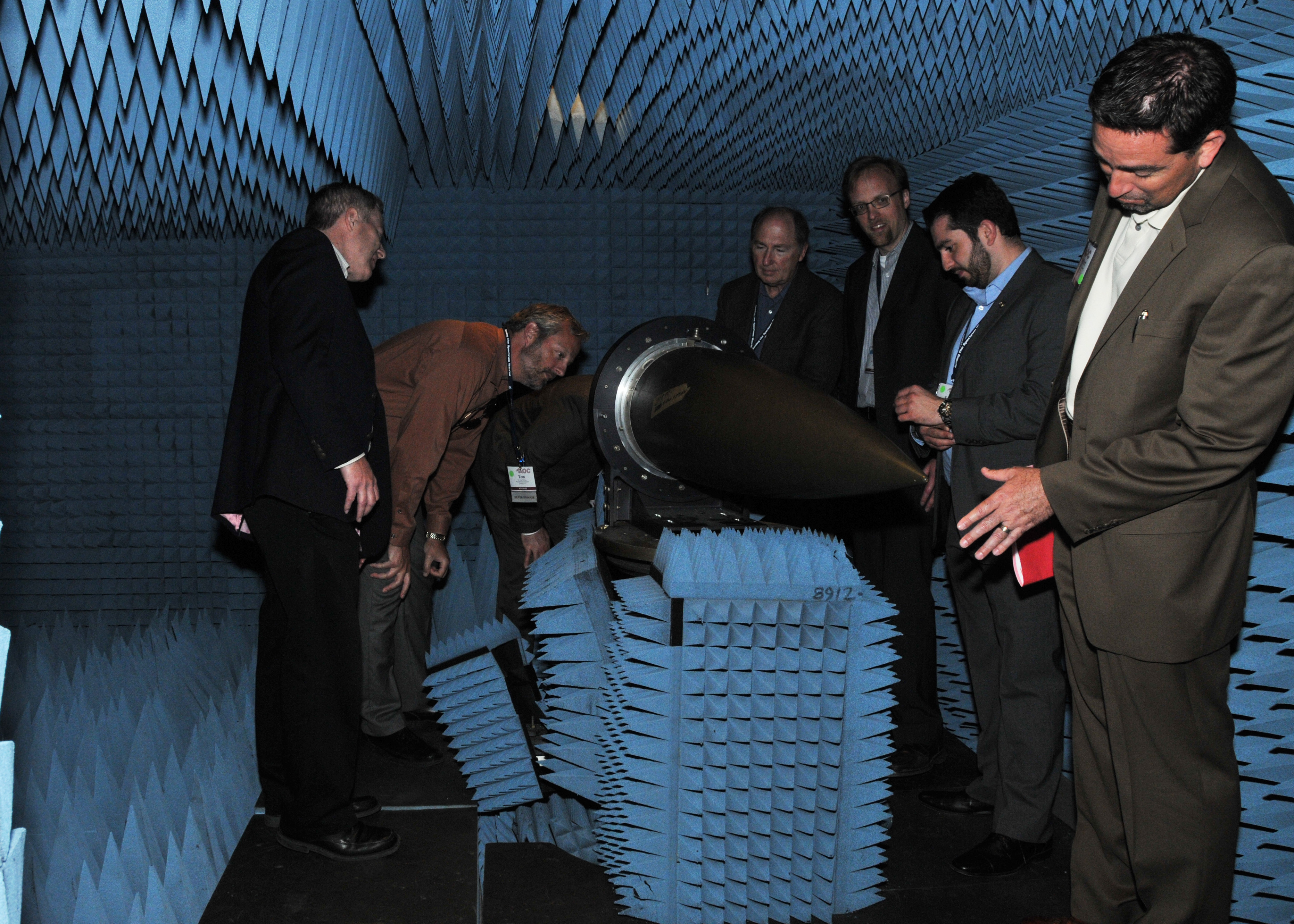
Attendees of Naval Air Warfare Center Weapons Division’s 43rd Electronic Warfare Symposium at Point Mugu tour the command’s Electronic Combat Simulation and Evaluation Lab on April 9. (U.S. Navy photo)
NAWCWD hosts 43rd electronic warfare symposium
Naval Air Warfare Center Weapons Division held the 43rd Electronic Warfare Symposium at Point Mugu on April 8-10.
The conference was hosted by NAWCWD under a co-sponsorship agreement with the Association of Old Crows, an EW professional organization. This year’s theme was “Enabling Collaborative EW through Innovation and Invention.”
Participants toured NAWCWD Point Mugu’s EW and simulation labs, Navy targets facilities, NAWCWD Range Operations, and had the opportunity to see static displays of aircraft, targets and EW equipment.
“Collaborative EW addresses our ability to jointly maneuver and fight in the electromagnetic spectrum collaboratively,” said Mark Schallheim, president of AOC’s Point Mugu chapter. “‘Collaborative EW’ is a daunting challenge and the presentations, Q&A and follow-on discussions addressed technical issues and organizational barriers, as well as potential solutions.”
Dr. Ron Smiley, director of Naval Air Systems Command’s EW/Combat Systems Department and Avionics Department, welcomed more than 430 attendees and explained how this event affects the fleet and warfighter.
“This symposium is critical to NAWCWD because it allows a venue to bring together industry and government,” Smiley said. “Staying up to date in EW technology is essential to supporting the warfighter. I am very thankful that Mr. Kendall [Under Secretary of Defense for Acquisition, Technology and Logistics] put out guidance this year to allow us to host and participate in this symposium. Electronic warfare is changing, becoming more challenging and has continued to become a lot more esoteric, particularly with the convergence of electronic warfare and cyber warfare. The topics discussed over the next three days will give Sailors and Marines the tools they need to carry out their future missions safely.”
This year’s keynote speakers were Rear Adm. Donald Gaddis, program executive officer of NAVAIR’s Tactical Aircraft Programs; Rear Adm. John Haley, J3 director at Strategic Command; Rear Adm. Mark Darrah, commander of NAWC Aircraft Division; Jay Kistler, director of EW and Countermeasure Technologies at Defense Research and Engineering; and Dr. Joseph Nichols, technical advisor for Flight Test and Evaluation at Air Force Test Center.
“Unlike 20 years ago, our advisories are developing similar technologies that we are, and are doing it right now,” Darrah said. “The only way we will stay ahead of the threat of our enemies is to take paper ideas and give it to our people for trial and error until we succeed. I don’t do anything in engineering without grabbing the young engineers to put in their two-cents. The younger generation thinks differently than we do. What we ‘old guys’ might think is complicated, is seen as simple by what we call ESDP’s [participants in the Engineer and Scientist Development Program.]”
AOC President Wayne Shaw closed the symposium and encouraged attendees to continue collaboration. “We have had a great three days. After you leave here, please continue the collaboration and continue to advance our technologies.”
The symposium facilitated the exchange of enabling concepts and provided a venue to disseminate current research in the fields of EW.
"We must continue symposia like this to stay ahead of our enemies and advance our technology,” Darrah said. “What I am asking from everyone here is a collaboration of technology and we need it now.”
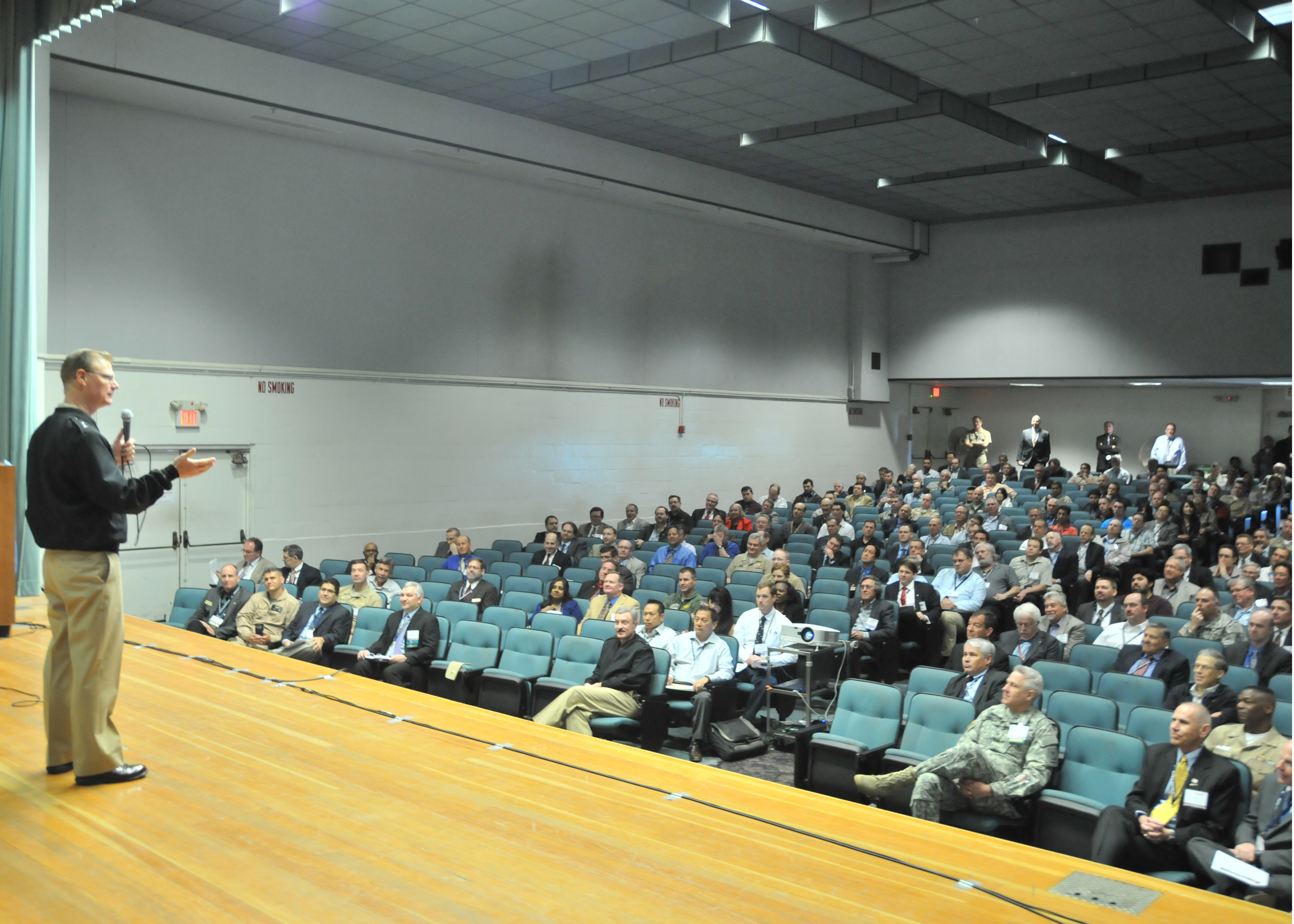
Rear Adm. Donald Gaddis, program executive officer for Tactical Aircraft Programs at Naval Air Systems Command, speaks to participants of the Electronic Warfare Symposium at Naval Air Warfare Center Weapons Division Point Mugu on April 8. More than 400 participants attended the three-day event. (U.S. Navy photo)
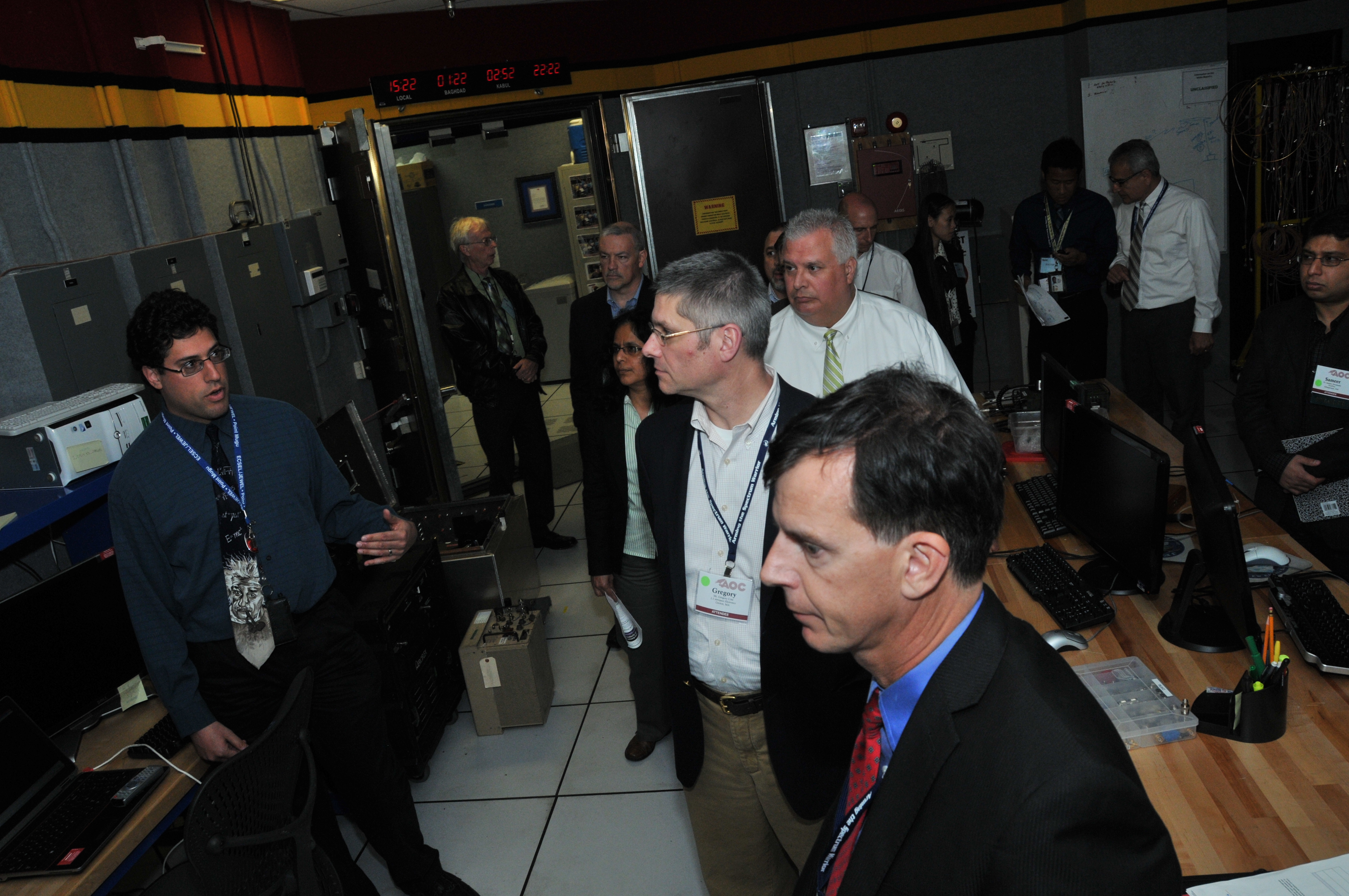
Geoffrey McStroul, left, a Naval Air Warfare Center Weapons Division engineer, explains the capabilities of the Joint Electronic Warfare Effects Lab to attendees of the Electronic Warfare Symposium at NAWCWD Point Mugu on April 9. (U.S. Navy photo)