
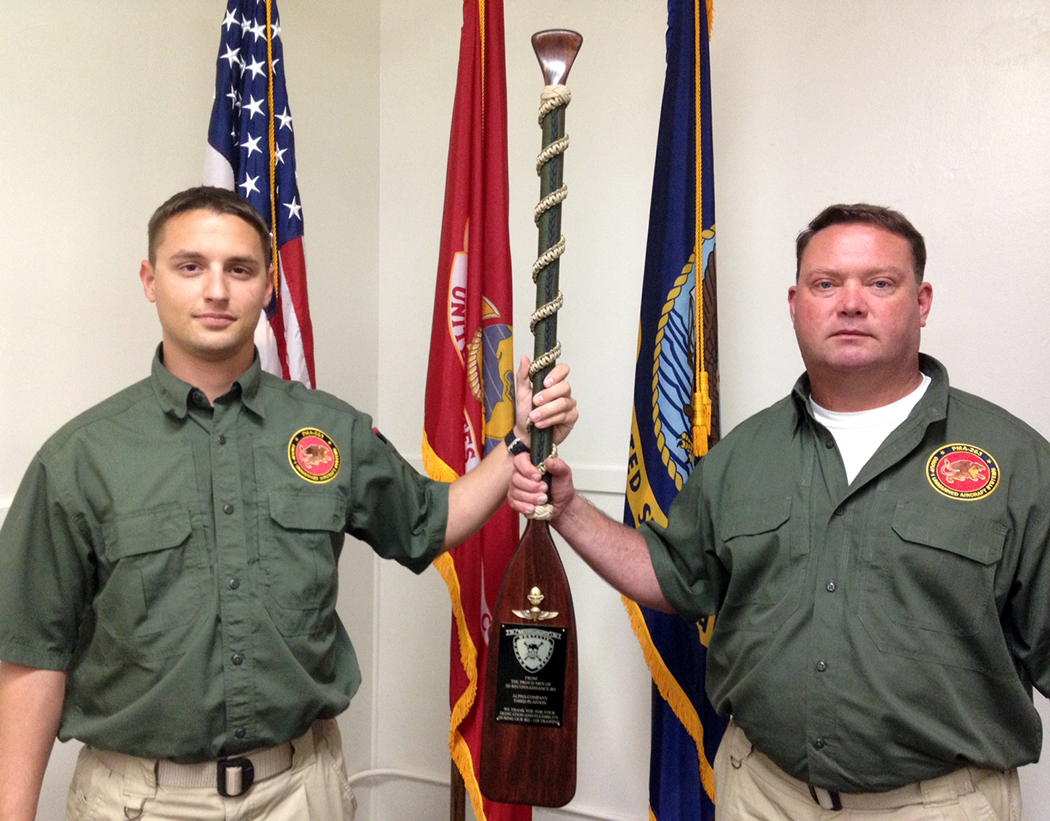
Christian Tobler and Bill Peek, Navy and Marine Corps Small Tactical Unmanned Aircraft Systems (PMA-263) Training and Logistics Support Activity (TALSA)-West instructors hold the prestigious Marine reconnaissance paddle they were presented by students Oct. 11 at the completion of the course. (Courtesy photo)
Instructors receive Marine recon paddle
NAVAL AIR SYSTEMS COMMAND, PATUXENT RIVER, Md. – Usually, at the end of a training class, it is the students who receive awards, but this time it was the instructors.
Navy and Marine Corps Small Tactical Unmanned Aircraft Systems (PMA-263) Training and Logistics Support Activity (TALSA)-West instructors Bill Peek and Christian Tobler received an esteemed Marine Corps reconnaissance paddle from their students at the completion of their RQ-11B Raven course in October at Marine Corps Air Ground Combat Center in Twentynine Palms, Calif.
The paddle dates back to WWII Marine “Raiders” who were predecessors to the reconnaissance Marines and performed amphibious operations. A primary part of their mission was using rafts, so every individual was issued a paddle and they kept it with them throughout their careers.
“We are honored to be part of this unit, and honestly once I saw the young presenters tearing up and clearing their throats to talk, it was a huge reminder to me of the symbolism and significance of what was going on,” Peek said. “We should all be ‘rowing’ in the same direction.”
The presentation of the paddle is usually reserved for a reconnaissance Marine that is leaving active duty, or has been killed in action. The event, known as a paddle party, involves wrapping the handle in parachute cord, representing parachute and free-fall operations.
He and Tobler were presented the paddle for their ability to overcome significant challenges that could have canceled the training course.
TALSA Team Lead, Irma Alexander said they endured delays due to severe thunderstorms and rain, 40 mph wind gusts, interruptions from range control due to flying frequency and air traffic, government furloughs limiting the staff’s availability, and still the instructors completed the course on time.
“I am extremely proud of our TALSA instructors who went above and beyond to ensure this Marine unit received their Small Unmanned Aircraft Systems certification,” said Col. James Rector, program manager for STUAS who oversees the TALSAs. “This is an example of warfighter readiness at its best using our Group 1 systems.”
The TALSA provides Marines with Group 1 SUAS training using the RQ-11B Raven, RQ-12A Wasp IV and RQ-20 Puma. The systems are lightweight aircraft that are hand launched and can be controlled from the ground or with preset coordinates. The courses last five to 10 days and upon graduation students are certified as SUAS operators, fully prepared to provide their unit with boots-on-the-ground intelligence, surveillance and reconnaissance (ISR) capability.
“Since the dawn of warfare, commanders on the ground have looked for ways to shoot, move, communicate, and have good 360-degree situational awareness of what is exactly going on in their battlespace,” Peek said. “From dismounted scout teams to men in hot air balloons tethered to the ground, all methods are tried and true. Now we are in a position to get units to understand what Group 1 UAS brings to the fight.”
With small unmanned aircraft systems becoming a vital aspect in the ever-changing battlefield, PMA-263’s Group 1 systems and TALSA sites provide consistent training and support to the fleet. TALSA-West opened its doors this June as the second training facility of its kind in the country. Already they have trained more than 160 students. TALSA-East, located at Camp Lejeune, N.C., opened July 2012 and has trained more than 225 Sailors and Marines.