
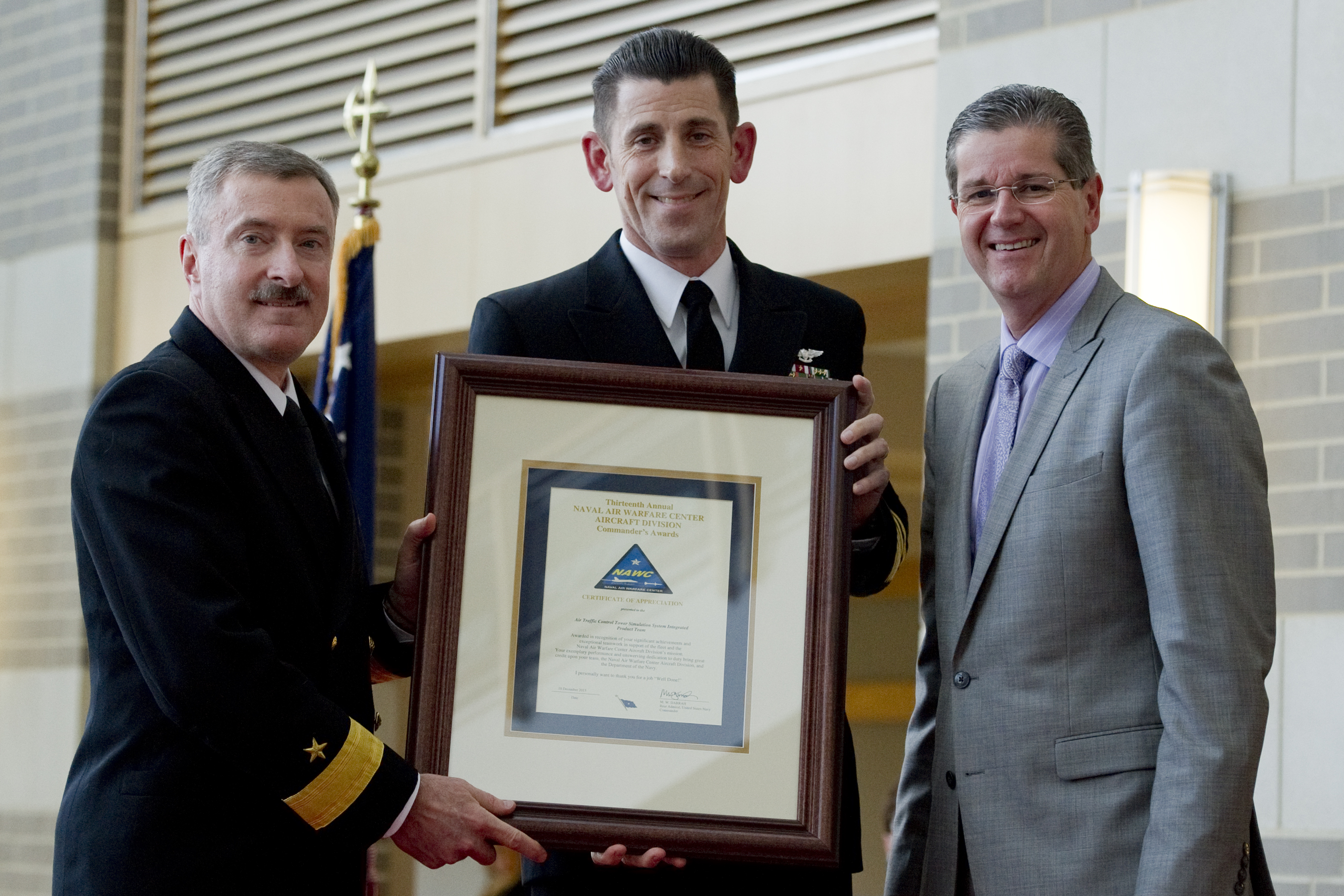
Flanked by Rear Adm. Mark Darrah, commander of Naval Air Warfare Center Aircraft Division (NAWCAD), and Gary Kessler, executive director NAWCAD, Master Chief Gordon Carlon accepts a NAWCAD Commander’s Award on behalf of the Air Traffic Control Simulation System Integrated Product Team (IPT) during the annual recognition ceremony Dec. 18 at Naval Air Station Patuxent River, Md. The award saluted the Naval Aviation Training Systems’ (PMA-205) IPT for upgrading technology, using a commercial solution and increasing Air Traffic Controller’s daily training accessibility while simultaneously reducing operating time and life-cycle cost. (U.S. Navy photo)
Training solution brings recognition to Navy’s air traffic control simulation team
NAVAL AIR SYSTEMS COMMAND, PATUXENT RIVER, Md. — The Navy’s first-ever Air Traffic Control Tower Simulator System (ATC-TSS) team was honored with a Naval Air Warfare Center Aircraft Division Commander’s Award during a ceremony Dec. 18 at Naval Air Station Patuxent River, Md.
The award saluted the Naval Aviation Training Systems’ (PMA-205) integrated product team (IPT) for upgrading technology, using a commercial solution and increasing Air Traffic Controller’s (ATC) daily training accessibility while simultaneously reducing operating time and life-cycle cost.
“We are humbled to receive such a prestigious award,” said Lt. Cmdr. Jeff Dugard, ATC-TSS IPT lead. “Our air traffic controllers are the military’s bird’s-eye view. Proper training ensures they are detail-oriented, work well in stressful situations, adhere to strict standards and are decisive. It’s a privilege to support them.”
The ATC-TSS acquisition effort provides a new tool for Navy air facilities and replaces outdated technology at various Marine Corps sites. A total of 38 simulators are scheduled for delivery to 34 installations and will replace the aging Tower Operating Training System at the ATC “A” school in Pensacola, Fla. The first device was delivered to Naval Air Station Key West, Fla., early spring.
According to the award summary, the team leveraged information and lessons learned from the Federal Aviation Administration and Air Force to ensure system requirements were drafted in a manner that would reduce and/or eliminate shortcomings.
“The ATC-TSS IPT serves as a role model for us all,” said Capt. Craig Dorrans, PMA-205 program manager. “The team overcame many obstacles to successfully solve a critical training issue for the fleet. They personify effective communication and team cooperation.”