
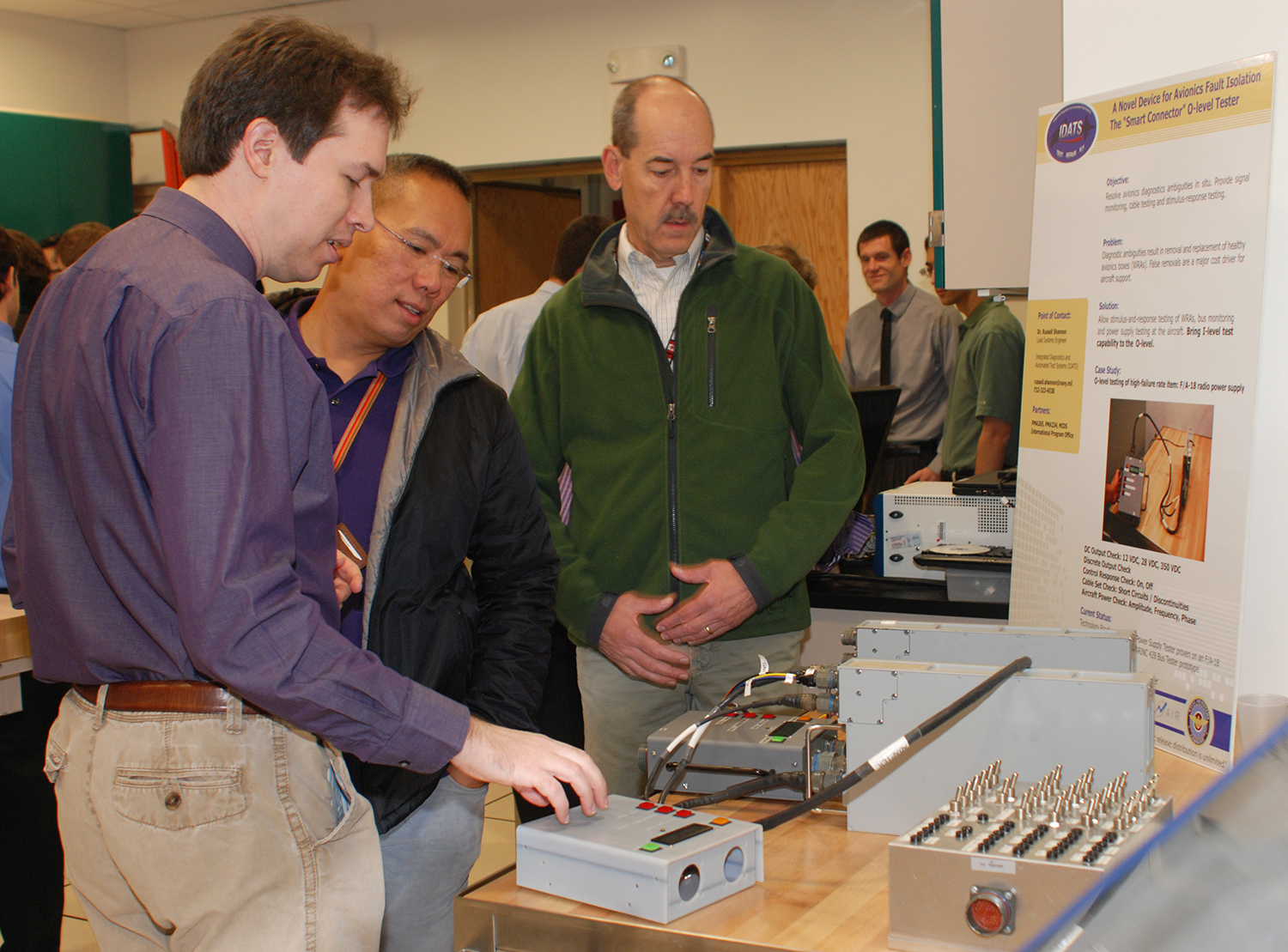
Dr. Russell Shannon (L), the IDATS lead systems engineer, discusses the capabilities of the Smart Connector O-Level Tester with attendees of the IDATS Lab second annual Open House held Nov. 15 at JB MDL in Lakehurst, N.J. (U.S. Navy photo)
Lakehurst IDATS Laboratory hosts second annual Open House
Joint Base McGuire-Dix-Lakehurst, N.J. - On Nov. 15, the Integrated Diagnostics and Automated Test Systems (IDATS) Laboratory hosted its second annual Open House at its facility at the Naval Air Warfare Center Aircraft Division (NAWCAD) Lakehurst. The second annual Open House served as a platform for attendees to tour the lab facility, meet the lab’s principal investigators, view technology demonstrations and learn about the lab’s latest advancements and research efforts in support of naval avionics diagnostics.
Attendees of the Open House had the opportunity to see the IDATS Lab’s research and development efforts up close and personal. Two of the most notable demonstrations of the day were of the Smart Connector Organizational Level (O-Level) Tester and the net-centric MX-12345/USM Diagnostics Avionics Tester (DAT) for F/A-18 electro-optic pods. With nearly three-quarters of all Navy and Marine Corps maintenance actions relating to avionics, there is an on-going need to develop and utilize advanced diagnostic capabilities in order to improve fault detection and isolation, reduce “false alarms” and reduce unnecessary remove/replace/repair actions that can result in wasted man-hours, unnecessary costs and aircraft downtime.
The patented Smart Connector Tester inserts between running avionics boxes and provides a combination of bus monitoring and stimulus-and-response testing to effectively and accurately diagnose those boxes. In doing so, the Smart Connector is able to provide more efficient testing and diagnostics, therefore, providing a reduction in unnecessary removals.
The DAT provides a lighter, smaller, less expensive replacement for the current AN/USM-681 F/A-18 electro-optics tester. Solving many of the obsolescence issues of its predecessor, the DAT consists of a commercial-off-the-shelf (COTS) militarized PC and an interface device, which are connected over a shielded network cable. The DAT is able to communicate between the O-Level and Intermediate Level (I-Level), allowing the I-Level to build historical information on common issues, which can then be relayed back to the O-Level, thus, allowing for more efficient testing at each level of maintenance.
Currently, the Navy is in the final stages of licensing the Smart Connector patent for use by a foreign government’s fleet of F/A-18 aircraft. The DAT was fielded in 2013, first for use by foreign militaries, and is expected to be fielded by U.S. forces soon. It will be the first piece of fully net-centric Support Equipment (SE) in the Navy/Marine Corps inventory.
Additionally, the IDATS Lab showcased several of its research projects and provided attendees the opportunity to speak with principal investigators about the technological capabilities and the applicability of the projects to other programs. Adriano Parga, an electrical engineer who works within the ALRE Engineering Division at NAWCAD Lakehurst, said, “I enjoyed seeing all the technology that was shown. I didn’t know all of this was here.” He added, “I could see how all of it [the technology] could help within our team… the most practical that would help us would be the Smart Connector.”
Dr. Russell Shannon, the IDATS lead systems engineer, sees the Open House as a great event to showcase the future of avionics diagnostic technology. “The goal is to bring people in [to the lab] and spread the word about who we are and our mission,” said Shannon. “For management, it [the key message] is that IDATS is contributing to the Naval Aviation Enterprise (NAE) and to the Lakehurst mission. The lab is positively impacting change in naval avionics diagnostics.”
Mark Weber, an IDATS leadership team member and electronics engineer for avionics SE, is especially passionate about showcasing the lab’s capabilities to the Joint Base community. He sees the Open House as an opportunity for newer engineers to become familiar with the research and development efforts of the IDATS Lab. “Our second goal is to show leadership and Support Equipment Program Officers (SEPOs) what we are doing … and how they can apply our technology in their programs,” said Weber.
Looking ahead, both Weber and Shannon are enthusiastic about future Open Houses. “We saw a lot of returning people and new faces,” said Weber who added that the lab saw an increase in attendance from last year’s Open House. He said one of the big goals that the lab would like to have achieved by the next Open House is the transition of the showcased products to the fleet. Shannon is also enthusiastic about seeing many of the products coming to fruition. “FY13 was probably our best year, yet. We had more projects, more work… We are going into FY14 in a very strong position,” said Shannon who hopes to see a U.S. Navy-fielded DAT and other cutting-edge technologies at next year’s Open House.
First opened in April 2010, the IDATS Laboratory seeks to provide modern avionics diagnostic and testing solutions for Navy/Marine Corps systems.
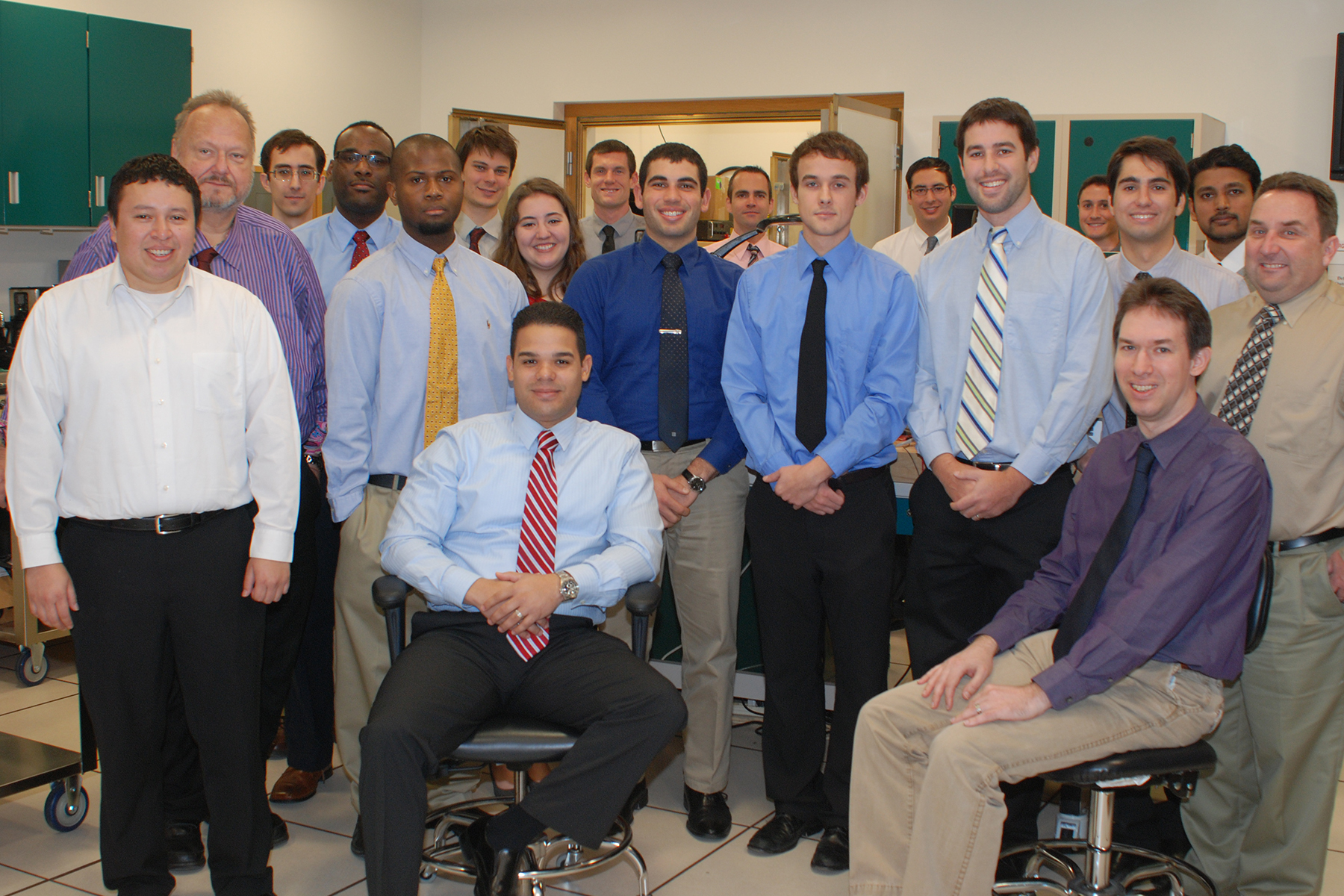
The IDATS lab team gathers for a group photo before the IDATS Laboratory second annual Open House held Nov. 15 at JB MDL in Lakehurst, N.J. (U.S. Navy photo)