
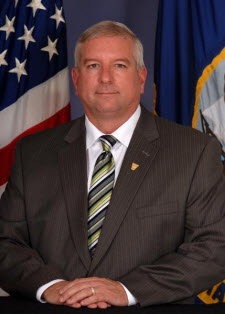
Dennis J. West, Deputy Commander, Fleet Readiness Centers
Safety improves at Navy’s Fleet Readiness Centers
Naval Air Systems Command, Patuxent River, MD -- The Navy’s Fleet Readiness Centers are becoming safer places to work. This is the message taken to the Pentagon Nov. 6, as top officials from Commander, Fleet Readiness Centers (COMFRC) touted efforts to increase safety and reduce injuries for employees to the Navy Executive Safety Board, chaired by the Vice Chief of Naval Operations.
“Providing quality aircraft, engines and components at an affordable cost to the Fleet is our mandate and providing a safe work environment for our employees is our obligation,” said Dennis West, deputy commander of COMFRC, which oversees eight major FRCs. “I believe we demonstrated that.”
In the last four fiscal years, the Total Case Incident Rate (TCIR) and Days Away, Restricted and/or Transfer Case Incidence Rate (DART) throughout COMFRC have been greatly reduced. TCIR is the rate of nonfatal recordable injuries and/or illnesses for every 100 employees. DART measures the rate of illnesses or injuries requiring restricted work activity, job transfer, and/or days away from work for every 100 employees.
Both rates have dropped below Bureau of Labor Statistics averages for similar industrial workplaces.
The total number of Occupational Safety and Health Administration (OSHA) recordable nonfatal injury and illness cases at FRC East, located at Marine Corps Air Station Cherry Point, NC, for example, was reduced from 207 in fiscal year 2010 to 97 in FY2013. During the same time period, TCIR was cut in half and DART cases reduced nearly two-thirds.
“These reductions are impressive, but we have more work to do,” said Ken Pettersen, COMFRC director of Safety and Regulatory Compliance. “Our goal is to reduce injuries to as low a rate as possible. We’re doing it by mitigating risks, educating our employees and responding as quickly as possible to potential issues.”
A significant emphasis on command-wide safety has contributed to a remarkable and dramatic decline in injuries. Throughout COMFRC, a combined $15.5 million has been invested in the past five years on safety-related equipment and resources to help keep employees safer while working on aircraft.
Actions include procurement of fall protection and ergonomic handling equipment, additional personal protection equipment, replacing and repairing outdated equipment and facilities, enhanced training, and more.
“We’ve had success in the past and we look forward to partnering with OSHA and other outside agencies to continue making the FRCs as safe a work environment as possible,” West said. “OSHA has a depth of knowledge and expertise that we can tap into and become better at what we do.”
Another key area of emphasis for COMFRC is protecting employees and the public from exposure to heavy metals such as Hexavalent Chromium, also known as chromium (VI). Exposure can occur during the painting of aircraft exteriors, interiors or parts, and during the sanding and grinding of chromate-based coatings prevalent in naval aircraft. In combating potential heavy metal exposure FRCs have increased attention to cleaning, banned food and drink in or near production areas, increased training, purchased hundreds of thousands of dollars worth of High Efficiency Particulate Air (HEPA) vacuums, increased equipment maintenance schedules, and aggressively shared best business practices across all FRC sites.
“Working with OSHA, we’ve developed an action plan to significantly reduce employee exposure to heavy metals,” said Pettersen. “We haven’t had any reported illnesses due to heavy metal exposure and we can’t take the risk.”
More than $7.75 million has been earmarked in FY13 for heavy-metal abatement construction and upgrade improvements throughout the Command, with another $23.8 million in investments for 2014-2015.