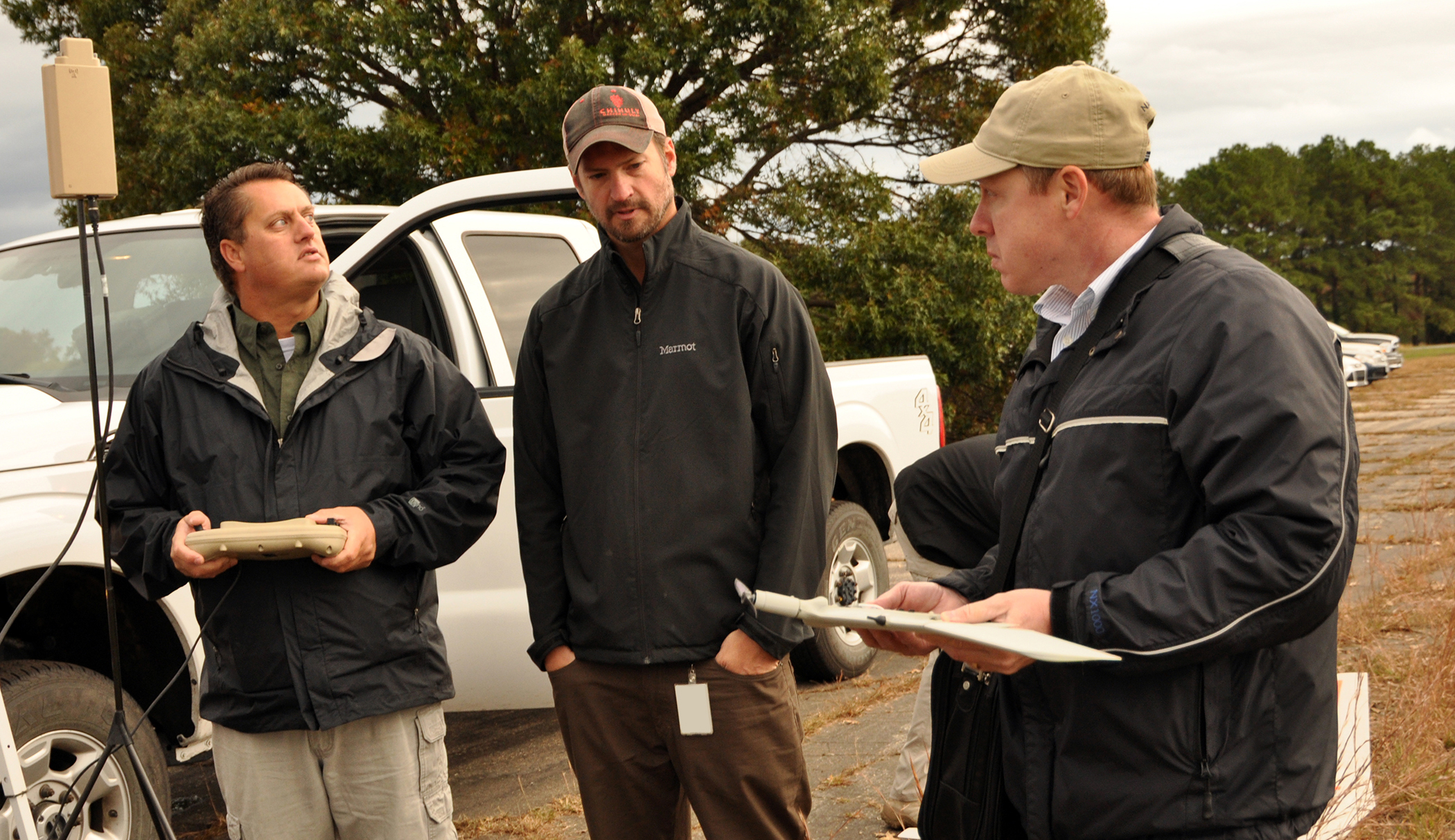
David Johnson, left, Navy and Marine Corps Small Tactical Unmanned Aircraft Systems (PMA-263) Training and Logistics Support Activity instructor keeps an eye on the aircraft while demonstrating to Dr. Andrew Niccolai and Tim Ledbetter, with the Coast Guard Research and Development Center, how to operate one of the Group 1 air vehicles Oct. 23 at the Webster Field Annex. (U.S. Navy photo)
Technology transfer to benefit Navy, Coast Guard
NAVAL AIR SYSTEMS COMMAND, PATUXENT RIVER, Md. – A DoD technology transfer program will help breathe new life into legacy Small Unmanned Aircraft Systems (SUAS) and provide cost avoidance to the Navy and Coast Guard.
During a demonstration Oct. 23 at Webster Field Annex, the Navy and Marine Corps Small Tactical Unmanned Aircraft Systems (PMA-263) Group 1 team demonstrated its systems to Coast Guard science and technology representatives, giving the team a first-hand look at the systems it will be receiving. Group 1 SUAS are unmanned aircraft weighing less than 20 pounds.
“This was an excellent opportunity to experience what capabilities Group 1 SUAS bring to Navy and Marine Corps forces while discussing how to map those capabilities to the Coast Guard mission sets with UAS experts,” said Dr. Andrew Niccolai, Director of Unmanned Aircraft Systems (UAS) Technology Projects, Coast Guard Research and Development Center in Groton, Conn.
Niccolai and his team will be receiving 20 Wasp III systems through the Domestic Preparedness Support Initiative (DPSI) and Department of Navy Technology Transfer program, which works with military services to identify surplus equipment available for transfer to the Department of Homeland Security community, including state and local first responders.
Niccolai said this transfer will enable them to demonstrate the potential benefits of SUAS to a broader Coast Guard fleet outside of their largest, Legend-class National Security Cutter ships, which has worked with larger UAS technologies.
“This technology transfer is a fantastic opportunity for the Coast Guard Research and Development Center to develop ‘in-house’ UAS capabilities,” he said.
Coast Guard Lt. Cmdr. Jeff Vajda, UAS platform manager with Aviation Forces in Groton, Conn., said unlike the larger, more complex systems that are familiar to the Coast Guard, Group 1 SUAS can provide small surface and shore-side units with an easily deployable capability for tactical surveillance and situational awareness.
PMA-263 will reap benefits as well, saving an estimated $30,000 expense by not demilitarizing the 20 systems.
“This is really a win-win situation,” said Marine Corps Maj. Gary Shill, PMA-263 Group 1 deputy integrated product team lead. “The Marine Corps is disposing of systems we no longer have a requirement for and the Coast Guard is avoiding the cost of having to purchase new systems.”
Shill said PMA-263 has transitioned to the Wasp IV system and no longer has a requirement for the Wasp III, which originally cost $150,000 per system.
The Wasp III system is a battery-powered, hand-launched reconnaissance and surveillance tool. The air vehicle portion weighs approximately one pound and transmits live airborne video images and location information via electro-optical and infrared (EO/IR) cameras to a ground control station. This capability enables operators to navigate, search for targets, recognize terrain and record all information for analysis. It flies autonomously to preprogrammed waypoints using GPS navigation or can be flown manually. It has seen use in Afghanistan by the Marine Corps since 2007.
In comparison, the Wasp IV is slightly larger weighing less than three pounds and provides the fleet still images and full motion video using a digital data link and dual EO/IR gimbaled camera with an all-environment capability.
Shill said he also hopes this technology transfer will help establish a maritime environment relationship with the Coast Guard since the Marine Corps does not currently operate shipboard Group 1 systems.