Naval Air Warfare Center Aircraft Division (NAWCAD) Executive Director
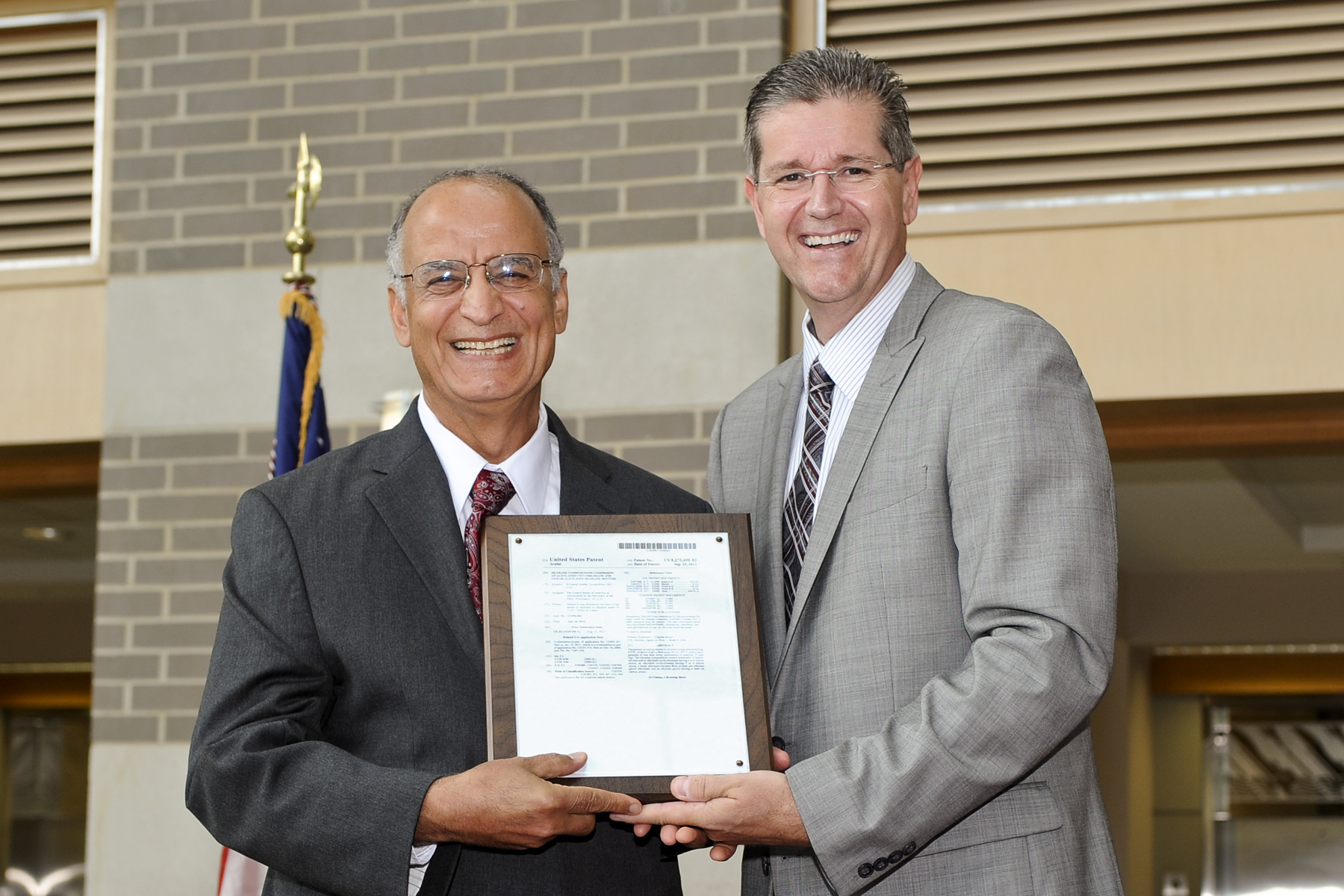
 Gary Kessler, right, presents Dr. El Sayed Arafat with his seventh patent award since joining Navair in 2000. (U.S. Navy photo)
A patent on the future
NAVAL AIR SYSTEMS COMMAND, PATUXENT RIVER, Md. — A button-sized bomb detector, a terrain awareness warning system and a retention harness: NAVAIR recognized the inventors of these and more at an awards ceremony here August 29.
“I want to share leadership’s sincere appreciation for the contributions each of you have made and continue to make to naval aviation,” said Gary Kessler, Naval Air Warfare Center Aircraft Division’s (NAWCAD) executive director. “These events inspire us and give us great hope that the future of naval aviation is bright, and will continue to be the best in the world because of each and every one of you here today.”
Ten scientists received patents for inventions created at NAWCAD facilities this year. The inventions included active aluminum rich coatings; a system and method for depth determination of an impulse acoustic source; siloxane (silicone) compositions; aluminum alloy coated pigments and corrosion-resistant coatings; gradient magnetometer atom interferometer (a measuring device that uses electromagnetic waves); and integrated net-centric (structured) diagnostics dataflow for avionics systems.
“At NAWCAD we continue to expand on inventions and take more advantage of our funding for innovative ideas,” Kessler said. “We are creating partnerships with universities and innovative small businesses to enhance the opportunities for inventions. Today we honor 53 inventors that walk among us here at Navair. Some of those patents issued are for better processes, better tools and new devices that will keep us safer and help us do our job better.”
NAWCAD provides engineers and scientists with state-of-the-art research, development, test and evaluation facilities. Experts in fields ranging from physics and chemistry to electronics and aerodynamics are able to conduct testing, study new methodologies and invent new products and methods to help the warfighter.
“For the future of naval aviation, we have to reduce the cost of our weapons systems and we have to deliver them quicker,” Kessler said. “We will do that by owning the architectures and interfaces and relying on our folks here more to link the technical baselines and designs of our future systems. We are very fortunate to have some of the best and brightest here with us at NAWCAD and our teammates out at WD (Weapons Division) that do that each and every day for naval aviation.”